Business Process Automation in Oil and Gas:

How to Streamline Source-to-Pay and Improve Capital Efficiency

Business Process Automation in Oil & Gas Stock Image

Introduction: Why Automation Now?

Upstream oil and gas faces relentless cost pressure—OpEx has surged 15–20% in recent years, while CapEx remains tight. Inflation, labor shortages, and supply chain volatility make “doing more with less” the new normal. Automation isn’t optional—it’s a survival strategy. According to McKinsey, automation can cut process costs by up to 45% and deliver payback in 12–18 months. In other words, business process automation in oil and gas is no longer optional; it forms the foundation of digital transformation ensuring better operational resilience. 

This guide shows how operations, accounting, and supply chain teams can automate critical workflows—accounts payable, spend management, and contracts—to drive efficiency and resilience.  

From well site to the back office, business process automation connects the work done in the field with digital processes that boost capital efficiency, improve financial accuracy and drive smarter decisions.

What Is Business Process Automation?

Business process automation (BPA) uses software to execute recurring business tasks with minimal human input. In upstream oil and gas, this includes source-to-pay activities such as sourcing, contract management, ordering, field ticket processing and finally invoice processing.

What Are the Key Benefits of BPA for Oil and Gas Companies?

High-Impact Use Cases in Upstream Oil and Gas

Accounts Payable Automation

BPA delivers the most value when applied to workflows that are repetitive, high-volume and prone to delays or errors and upstream oil and gas operations are full of them! From invoice approvals to contract renewals, these processes often span field teams, office staff and external vendors, making them ideal candidates for automation. The following use cases highlight where automation can drive measurable impact across accounts payable, procurement, contracts and back-office workflows.

What Are the Top 5 Invoice Management Challenges in Oil and Gas?

  1. Remote teams often delay invoice approvals due to manual routing and lack of visibility.
  2. Missing or mismatched documentation leads to payment errors and reconciliation issues.
  3. Duplicate or late payments increase financial risk and vendor dissatisfaction.
  4. Without automation, pending liabilities are hard to track, creating budgeting blind spots that could spell trouble down the road.
  5. The cost to process a single invoice manually can sometimes exceed $10, straining AP budgets.

How BPA Solves It:

  • Digital invoices and OCR: Digital invoices and optical character recognition (OCR) can capture invoice data instantly, reducing manual entry. Digital versions of invoices make them much easier to track and detect compliance or coding issues.
  • Managing by exception: Automation handles routine approvals and coding, while exceptions, such as out-of-tolerance amounts or non-compliant tickets, are flagged and routed to the right reviewers. This approach minimizes manual intervention and keeps operations focused on critical issues.
  • Fast, accurate approval routing: Rules-based approval routing ensures invoices reach the right approvers quickly and with accurate coding data.
  • Error-free matching automation: Automated matching of POs, invoices and receipts eliminates discrepancies and reduces time spent on manual invoice reconciliation.
  • On-the-go approvals: Mobile-friendly approval tools allow busy field teams to monitor and approve tickets or invoices where they work, without the need to check in at the main office. Specific amount tolerances, auto-coding and automated exception-handling can be configured to ensure operations teams only review and approve compliant tickets or invoices while AP handles exceptions.
  • Transparent audit trails: Real-time audit trails provide full transparency for finance and compliance teams. Errors such as discrepancies in contracted rates, incorrect coding, or other issues are automatically identified using the company’s customized parameters. Any exceptions are immediately routed to the appropriate staff members for review and correction, streamlining the process and minimizing delays.
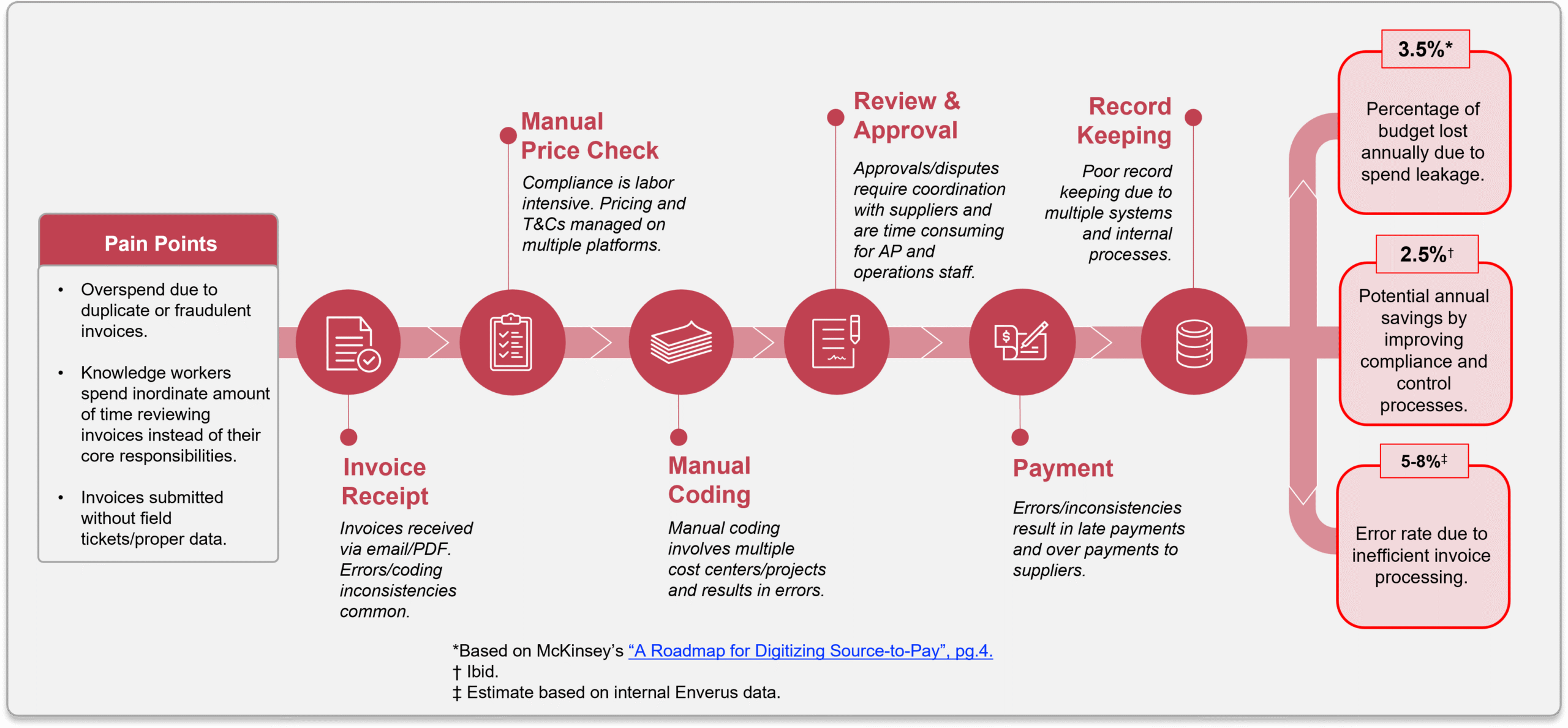
The hidden cost of manual processes: Overspend, compliance risks and inefficiencies plague traditional invoice workflows. This diagram shows where errors occur—from invoice receipt to record keeping—and the financial impact of spend leakage and processing delays.

Spend and Procurement Automation

Spend management automation gives upstream operators greater control over sourcing, approvals and purchasing across departments and field locations. By digitizing procurement workflows, companies can reduce maverick spend, accelerate order fulfillment and improve visibility into budget usage. This helps ensure that purchases align with approved vendors, negotiated pricing and operational priorities.

What Are the Top 5 Spend Management Challenges?

  1. Maverick or spontaneous spend outside approved channels leads to budget overruns.
  2. Missed savings opportunities occur when teams lack visibility into negotiated vendor terms.
  3. Slow approvals and order fulfillment delay field operations and impact production timelines.
  4. Fragmented vendor communication results in inconsistent service and missed expectations.
  5. Without centralized reporting, leaders struggle to understand total spend across the organization.

How Automated Spend Management Solves It:
  • Standardized purchasing with digital price books: Digital price books, approved vendor lists and digital sourcing workflows help standardize purchasing and reduce rogue spend across all steps of the source-to-pay.
  • Stay on track with real-time budget controls: Real-time budget controls help teams stay within limits and flag overspending early. For instance, depending on tolerances, automated systems can automatically flag non-compliant invoices for review.
  • Seamless vendor collaboration via built-in communication tools: Both internal teams and vendors utilize the same software, providing built-in communication tools that allow better coordination without the need for endless emails and phone calls.
  • Unified spend visibility through centralized dashboards: Centralized dashboards provide a unified view of spend across all departments ensuring a less siloed workflow between AP, supply chain and operations.
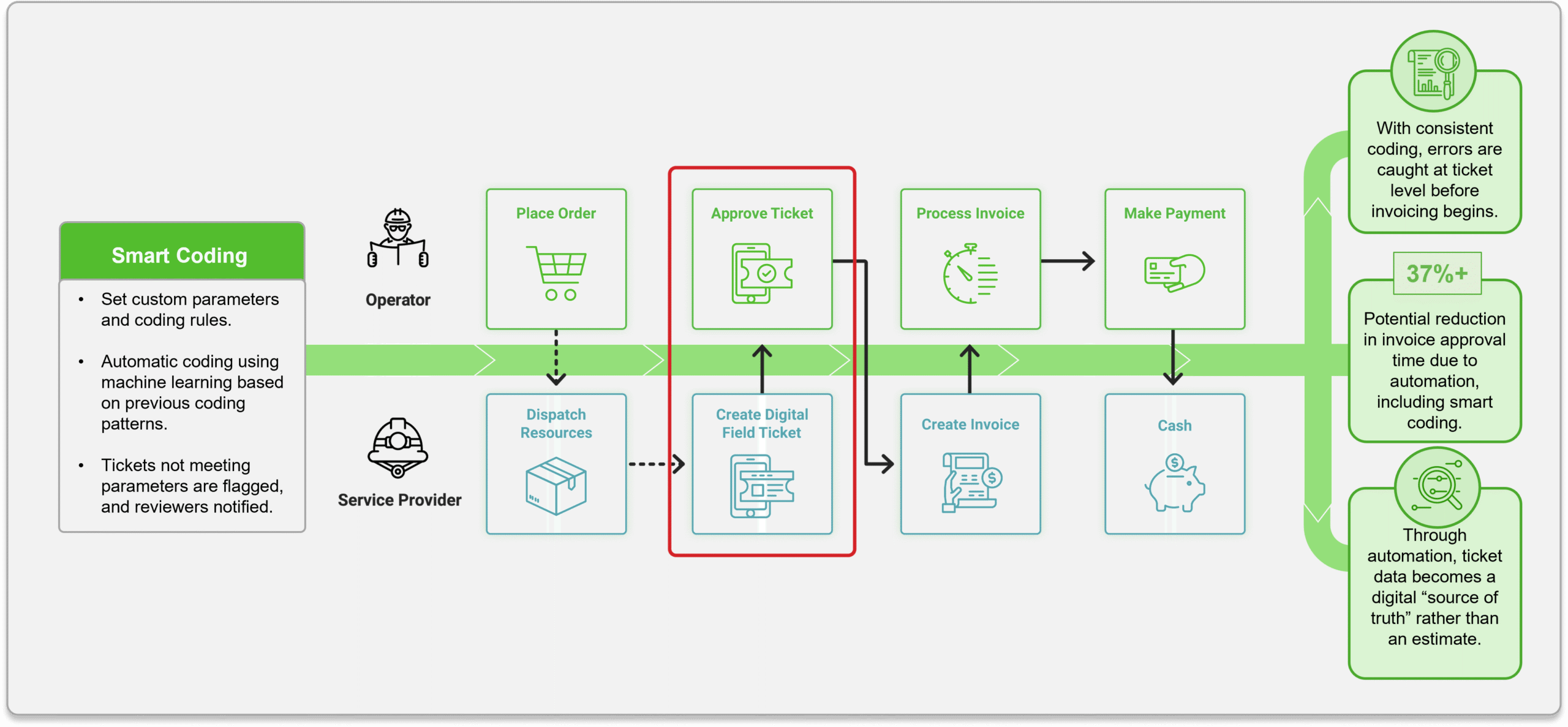
Automated coding and approvals ensure compliance, catch errors early and turn ticket data into a reliable source of truth that improves the accuracy and auditability of your entire source-to-pay cycle.

Contract Management Automation

Contract management automation helps upstream teams manage the full lifecycle of supplier and service agreements with greater speed and control. By digitizing contract drafting, approvals, renewals and compliance tracking, companies can reduce manual effort, avoid missed deadlines and ensure consistent terms across departments. This approach minimizes risk, improves visibility and supports stronger vendor relationships by keeping contracts accurate, accessible and audit-ready.

What Are the Top 5 Challenges With Contract Management?

  1. Missed renewals can lead to service interruptions or unplanned cost increases.
  2. Manual routing and version control create confusion and slow down approvals.
  3. Teams have poor visibility into contract terms and obligations, increasing compliance risk.
  4. Without audit trails, it’s difficult to track who approved what and when.
  5. Legal teams can become bottlenecks when contract workflows aren’t automated.

How Automation Solves It:

  • Template-based contract generation speeds up drafting and ensures consistency: Pre-approved templates also eliminate the need to start from scratch, reducing legal bottlenecks and ensuring that every contract adheres to company standards and regulatory requirements.
  • Automated routing and reminders keep contracts moving through the approval chain: Contracts are automatically sent to the right stakeholders based on predefined workflows, with built-in reminders that prevent delays and reduce the risk of missed deadlines.
  • Clause libraries powered by AI simplify legal review and reduce manual edits: AI-assisted clause libraries suggest standardized language based on contract type and risk profile, helping legal teams quickly identify and insert the right terms while flagging anomalies.
  • Vendor management tools link contracts to supplier performance and compliance: Automation and AI allow for contracts to be integrated with supplier profiles, enabling teams to track KPIs, renewal dates and compliance metrics directly within the contract management system.
  • Digital audit trails provide full traceability for every contract action: Every edit, approval and comment is logged automatically, creating a secure and searchable record that supports internal audits and external regulatory reviews.

Workflow Automation Across the Back Office

Workflow automation connects tools, teams and data across departments to ensure tasks are routed, tracked and completed efficiently. It helps standardize execution, reduce delays and improve visibility across operational processes.

Examples of Workflow Automation in Upstream Oil and Gas:
  • Joint interest billing (JIB) processing becomes faster and more accurate with automated workflows.
  • High-volume/low-dollar invoice cycles, like those from oilfield services call-outs, are mostly digitized and automated, requiring less manual oversight from key technical staff.
  • Automating materials management ensures accurate inventory tracking, faster requisitions and real-time visibility from field to warehouse—reducing delays, preventing stockouts and cutting overspend.
  • Expense approvals are streamlined, reducing delays and improving processing time.
  • Daily production reports are auto generated, shared and integrated into ticketing software improving operational visibility, as well as enabling complex cost splits and price book matching.
  • Safety and compliance checklists are digitized, ensuring timely completion and audit readiness. Field teams can complete required protocols from mobile devices, with automated tracking and time-stamped records that simplify audits and ensure nothing gets missed.
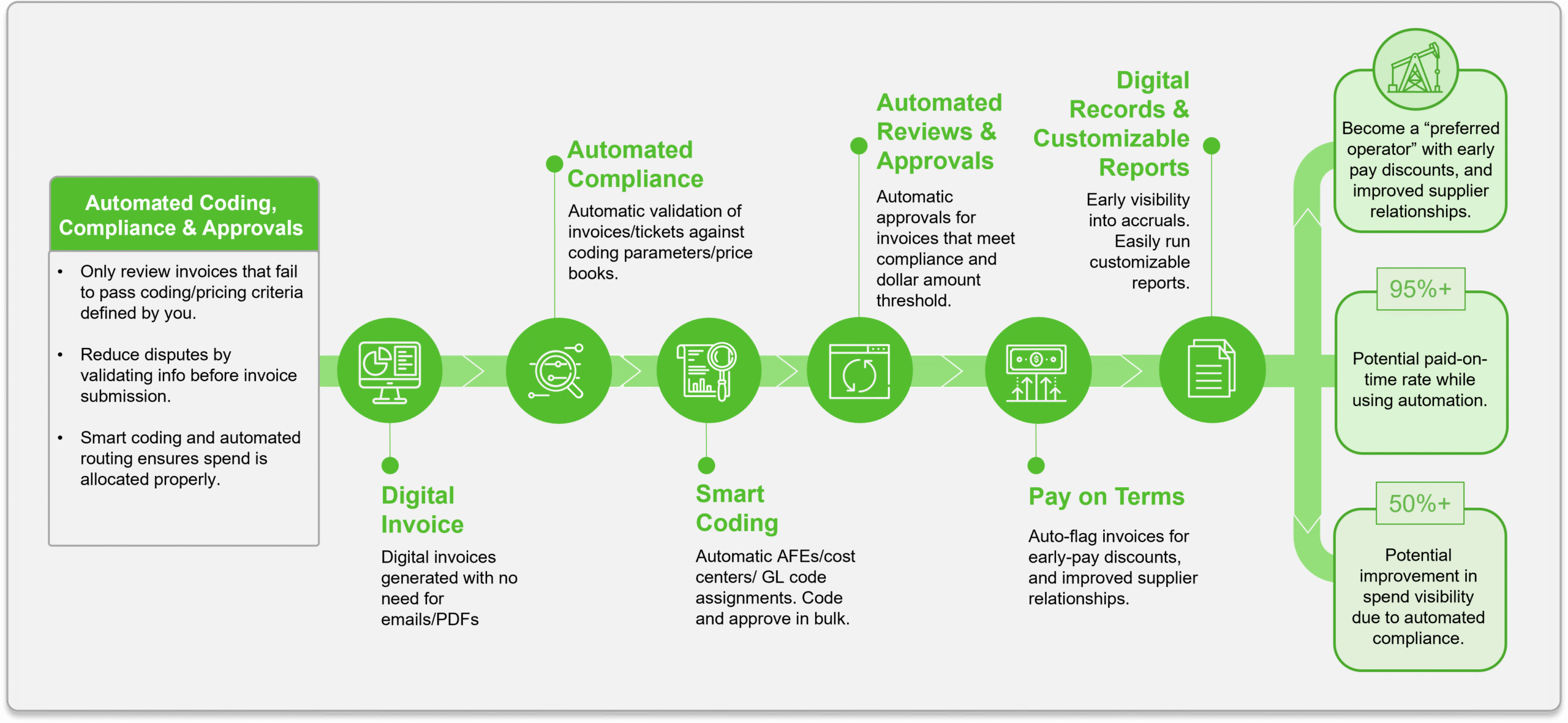
Automation in action: Smart coding, automated compliance checks and digital approvals transform invoice workflows. With early-pay discounts and improved supplier relationships, automation drives measurable gains in efficiency, compliance and spend visibility.

How Does AI Supercharge Business Automation?

AI-powered automation adds intelligence to workflows by identifying patterns, predicting outcomes and learning from historical data. Unlike traditional rule-based systems, AI adapts to changing inputs and improves over time. This makes deploying AI especially valuable in dynamic environments like upstream oil and gas. It enables systems to not only execute tasks faster but also anticipate issues and flag anomalies and surface insights that would otherwise be buried in operational noise. By layering AI into automation, companies shift from reactive process management to proactive decision-making.

What Are the Top AI Use Cases for BPA?

  • AI can flag duplicate or anomalous invoices before they reach payment processing.
  • Predictive analytics help forecast vendor performance based on historical trends.
  • Natural language processing extracts key clauses from contracts for faster review.
  • AI auto-categorizes spend data, making reporting and analysis more efficient.
  • Chatbots assist procurement teams by answering routine questions from vendors and guiding workflows.
AI-powered automation brings intelligence to oil and gas workflows—flagging anomalies, predicting outcomes and surfacing insights that drive faster, smarter decisions across the source-to-pay cycle.

What Is the ROI of BPA in Oil and Gas?

BPA delivers measurable returns for upstream oil and gas operators by reducing manual effort, accelerating workflows and improving data accuracy across departments. From accounts payable to procurement and contract management, automation helps cut processing costs, eliminate delays and increase visibility into spend patterns that ultimately drive smarter decisions. Companies adopting automation report lower invoice costs, fewer errors, faster cycle times and improved supplier relationships. These gains contribute to stronger margins and more resilient operations. For energy businesses dealing with price volatility and the drive for maximum capital efficiency, business automation drives tangible reductions in opex and capex, not to mention increased efficiency across multiple teams.

Key Benefits From BPA:

  • Lower total processing costs: Automation eliminates manual data entry and repetitive tasks, reducing invoice and procurement processing costs significantly while also freeing teams for higher-value work.
  • Accelerated cycle times: Streamlined workflows and automated routing shorten approval and payment cycles, improving cash flow and reducing delays across AP, supply chain and operations teams.
  • Improved compliance and audit readiness: Built-in rules and digital audit trails ensure every transaction meets policy and regulatory standards, minimizing risk and simplifying audits.
  • Enhanced spend visibility: Real-time dashboards consolidate data from field and office, giving leaders clear insight into budgets, commitments and vendor performance to prevent leakage.
  • Stronger supplier relationships: Consistent, on-time payments and transparent processes build trust with vendors, improving collaboration and securing better terms.

How to Get Started With BPA

Getting started with BPA doesn’t require a full-scale overhaul, but it does require a smart, focused launch. The most successful upstream operators begin with a single department, map their existing workflows, and define clear success metrics before scaling. Automation doesn’t only involve adding technology to how you already do things; it’s also about aligning tools with real operational pain points and ensuring teams are equipped to adopt them. With the right foundation, even complex oil and gas environments can secure fast wins and long-term transformation.

Steps to Launch Automation Successfully:

  1. Start with one department: Begin with a focused area like accounts payable or contract management to build momentum, demonstrate quick wins and reduce complexity during rollout.
  2. Map out existing workflows: Document current processes to uncover inefficiencies, bottlenecks and manual touchpoints that are ripe for automation.
  3. Define success metrics: Establish measurable goals or KPIs such as reduced cycle time, lower cost per transaction, or fewer manual approvals to track impact and ROI.
  4. Pilot automation with internal champions: Select team members who understand the workflows and can advocate for the solution, provide feedback and drive adoption across peers.
  5. Choose upstream-ready tools: Use automation platforms designed for oil and gas use cases to ensure compatibility with field operations, ticketing systems and supplier workflows.
  6. Prioritize user adoption: Invest in training and intuitive UX to ensure teams embrace the new tools, minimizing resistance and maximizing long-term success.

Conclusion

Business process automation represents a strategic change, not just a technological improvement. For upstream oil and gas operators, automating core workflows like AP, procurement and contract management unlocks faster decisions, tighter controls and measurable cost savings. But the real value lies in building a foundation for scale, resilience and innovation. No matter where you are on your automation journey, the best time to start is now—because the right tools are already here, ready to deliver results.

Did You Know? Enverus Offers a Full Suite of Business Automation Solutions!

From accounts payable automation to procurement workflows and contract management, Enverus helps upstream operators streamline processes, reduce costs and gain real-time visibility across the entire source-to-pay cycle. Our solutions are designed to:

  • Eliminate manual bottlenecks and accelerate processing times with digital invoicing and field tickets.
  • Improve compliance and audit readiness with built-in controls that allow you to automatically verify an invoice against field tickets and contracted rates.
  • Give you a 360° view of your spend across multiple teams in your organization.

Book a Discovery Call Today

Ready to unlock faster, smarter operations? Request a discovery call to explore how Enverus can help you reduce costs, improve compliance and transform your source-to-pay workflows.

Related Content

Enverus Blog - Oil and gas procurement automation: End project delays and overspending
Business Automation Operators
BySusie Yuill
November 2, 2023

Purchase order automation has the power to relieve oil and gas operators and OFS companies of many headaches in the procure-to-pay process. Energy companies continue to manage the procurement process using tedious, manual workflows that result in the same issues...

3 Key Efficiency Metrics for Enhanced Operations With Enverus PRISM® Activity Analytics
Energy Analytics Midstream
ByEnverus
December 6, 2022

Understanding the timing of each stage of preproduction, known as efficiency metrics, is imperative for having confidence in forecasting cycle times of operators and service companies. This helps ensure equipment is fully utilized and groups know what’s needed for each...

Carbon Capture, Utilization & Storage: Finding Opportunities in an Emerging Market
Energy Analytics Midstream
ByEnverus
November 1, 2022

The current state of carbon capture, utilization and storage (CCUS) is dominated by the supermajors and large midstream companies who can afford to absorb risks in this emerging market. CCUS project developers are forging ahead without the typical commitments between...

business-persons-working
Business Automation Energy Analytics
ByEnverus
September 28, 2022

Saying the energy industry — an industry accustomed to challenge and change — has been rocked over these past few years is probably an understatement. Pandemics, wars, wildly variable oil futures, rapidly changing energy policies and inflation have quickly increased...

Planet earth with sun rising from space
Energy Analytics Midstream
ByEnverus
August 17, 2022

Part 1: Pinpointing CO2 emitters Global alignment on net zero policies, Wall Street sentiment, and large tax credits from the U.S. and Canadian governments for carbon capture investment, are leading to exciting new opportunities for historically midstream service providers. Dominated...

Related Solutions

Save time with automated price validation workflows and optimize spend with price compliance reporting and spend analytics.

Read More

OpenOrder, a purchase order software made for oil and gas, increases spend visibility and controls without burdening operations, with flexibility to issue, approve and track procurement of services and materials with a purchase order.

Read More

Gain complete inventory oversight. Track the quantity and value of inventory by location and accurately log material transfers in your accounting system.

Read More

Enverus RFx is an AI-powered sourcing solution that simplifies bid management, expands supplier networks and provides transparent insights into pricing and activity. Streamline procurement and focus on your bottom line with Enverus RFx’s advanced technology. 

Read more about Enverus RFx.

Accelerate invoice approvals and payment with cloud-based digital field ticket management.

Read More

Digitize and automate invoice processing and approvals with oil and gas enterprise accounts payable software.

Read More

Save time and reduce costs with a single streamlined solution to handle joint venture and AP invoice approvals in one system.

Read More

With Enverus Instant Analyst™, you receive answers you can trust, delivered in seconds. Sourcing from 25+ years of vetted data and research on the most trusted SaaS platform designed exclusively for energy.

Read more

Outsource mineral phone and print and mail, so your land and accounting teams can focus on critical work.

Read More

EnergyLink software provides secure and convenient online access to oil and gas owner statements and account information — available 24/7.

Read More

Enverus consulting services are provided by a team of technology experts, designed to optimize customer usage and maximize ROI of their OpenInvoice solutions.

Read More

Let’s get started!

We’ll follow up right away to show you a quick product tour.

Let’s get started!

We’ll follow up right away to show you a quick product tour.

Register Today

Sign Up

Power Your Insights

Connect with an Expert

Access Product Tour

Speak to an Expert