
A practical look at where source-to-pay breaks down, and what your organization can do differently

In upstream energy, the source‑to‑pay (S2P) process is where execution meets financial control. In other words, it’s the path from a request for work or materials, to verification and documentation, to invoicing, approvals, and ultimately payment. When this chain runs well, you get timely cost visibility, budgets stay intact, and suppliers remain productive partners. When it breaks down, the organization feels it everywhere: late accruals, budget surprises, manual rework, supplier friction, and an approval burden that grows faster than most organizations can keep up with.
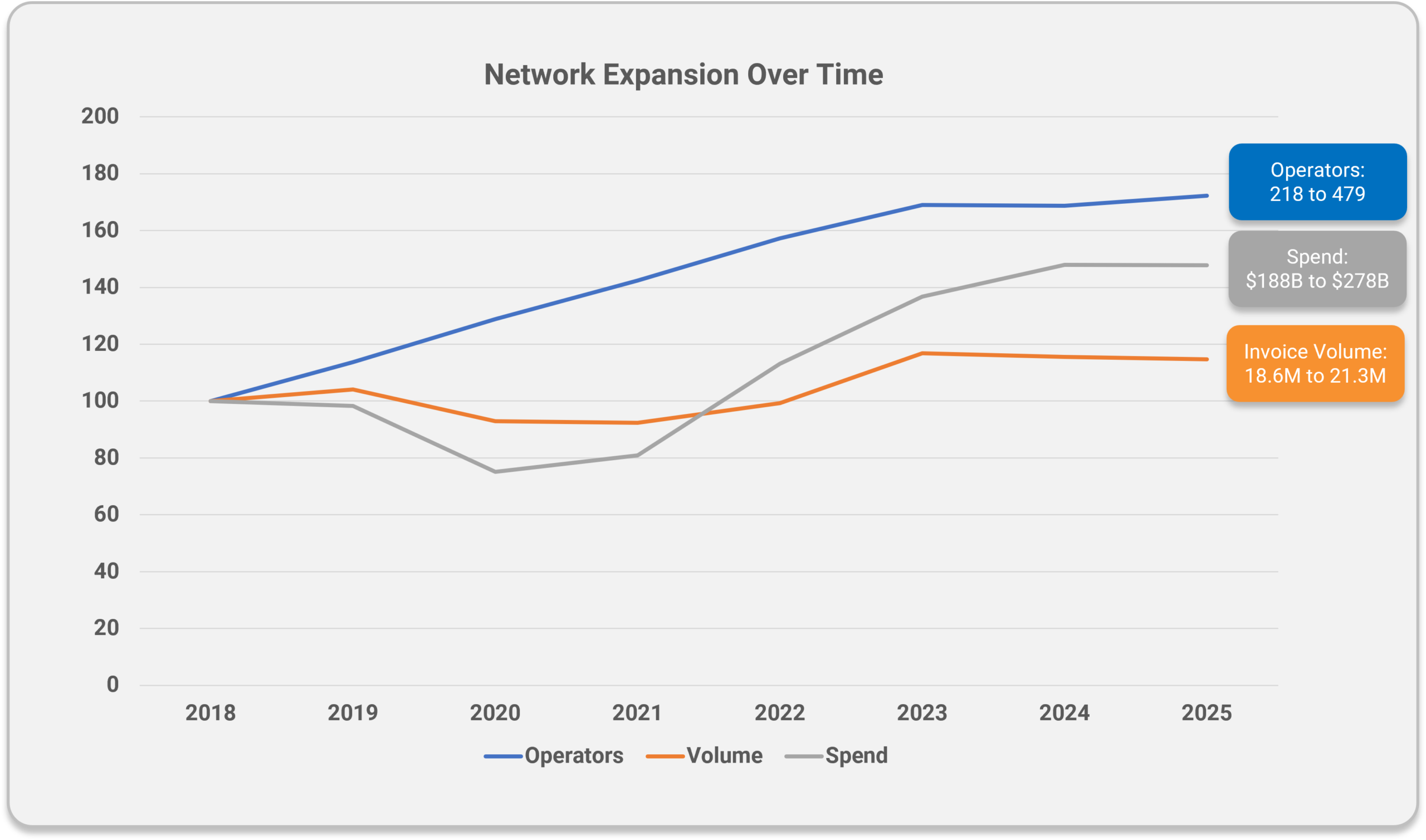
One of the cleanest ways to measure S2P performance is invoice submit‑to‑paid cycle times (the elapsed time between supplier invoice submission and payment). Over the last several years, that metric has improved materially for users on our network. Since 2018, OpenInvoice customers reduced their average invoice submit‑to‑paid time from nearly 50 days to roughly 30 days. At the same time, our network also grew meaningfully. Operators increased from 278 (2018) to 479 (2025), while annual invoice volume rose from roughly 18.6 million to about 21.35 million, surpassing 21 million invoices per year. Additionally, annual spend processed through the platform increased from approximately $188B to $278B+, representing more than $90B in growth.
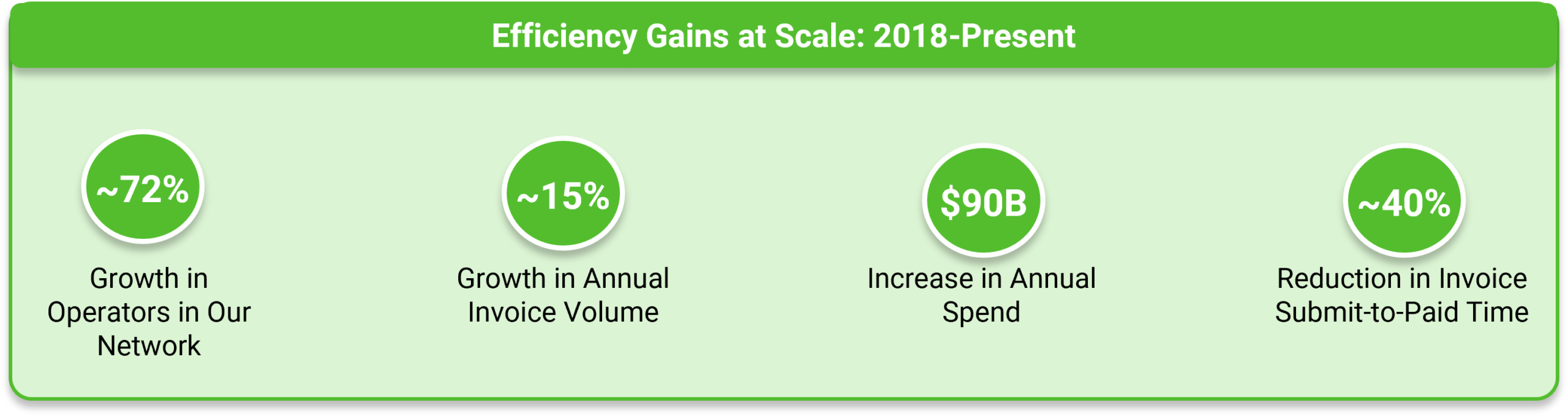
On their face, these numbers seem contradictory. How could operators on our network experience reduced cycle times during a time when more of their peers joined the network, while bringing increased spend and invoice volumes with them?
What’s driving these results isn’t a single change or feature. They reflect a development philosophy that focused on improving how work is documented, validated, and approved prior to the final step of the source-to-pay process, invoicing. As we moved more of this process into digital workflows—tickets, orders, and supplier‑collaborative price terms—and as automation expanded inside those workflows through routing, auto approvals, smart coding, matching, and exception handling, our system actually became better at absorbing growth without adding friction.
Invoice processing looks straightforward on paper: suppliers submit invoices, and the buyer reviews, approves, and pays. In practice though, it is a high‑volume and high‑variance workflow that spans finance, operations, and supply chain, and it carries more complexity than most organizations can reasonably handle while also ensuring daily operations move smoothly.
There are several reasons invoice cycle time tends to lengthen as a business scales.
These challenges were also present with our users. Some experienced more demanding documentation complexity due to different systems and processes resulting from mergers, while others took on new territory which in turn increased their service spend and, by extension, the number of invoices they processed. By 2018, digital invoicing on the Enverus OpenInvoice platform was already well established across much of the industry. Even so, roughly 50 days from invoice submission to payment was widely accepted as normal.
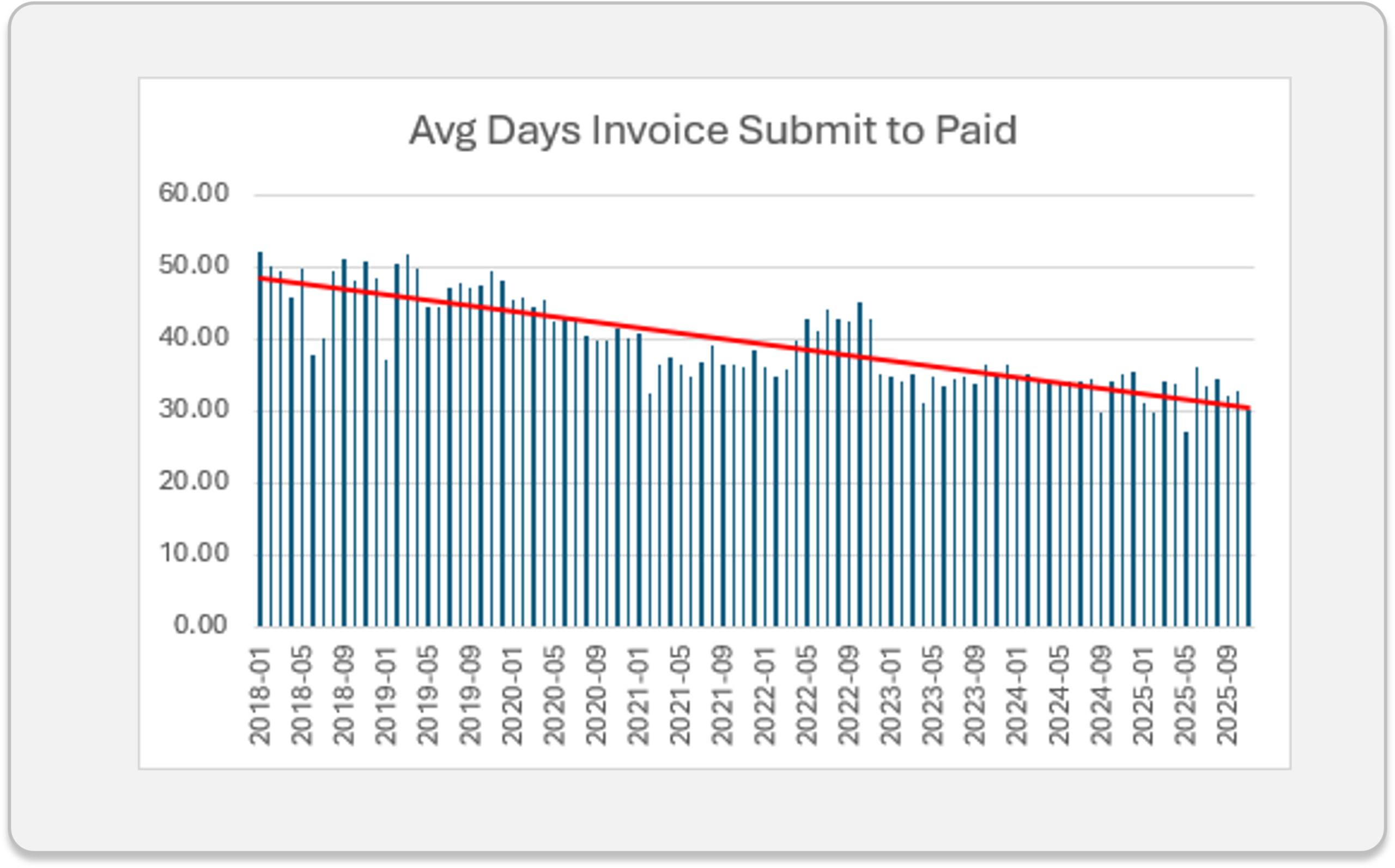
That wasn’t because accounting teams in the industry lacked tools, but because the broader process hadn’t yet caught up. As invoice volumes, suppliers, and spend continued to grow, the expectation was that cycle times would stay flat at best, or even drift longer. The fact that they moved meaningfully in the opposite direction sets up the real question: what changed in the process to make that possible? Before getting to the answer to the question, it’s important to consider what happens before an invoice is even created in the first place.
What we had been hearing from our users for some time, was that waiting until an invoice reaches accounting to discover errors was a bad way of conducing business. By that point, most of the conditions that determine how quickly invoices can be approved and paid have already been set.
As invoices sit at the end of a longer chain that includes sourcing, ordering, ticketing, and supplier collaboration, each step in that chain either reduces friction or adds to it. So, when upstream documents are missing, delayed, or inconsistent, invoices turn into problem‑solving exercises that consume time and resources. Accounting teams are forced to track down context, reconcile discrepancies, and make judgment calls with incomplete information. That work doesn’t just slow things down; it increases variability and creates bottlenecks that compound as volumes grow.
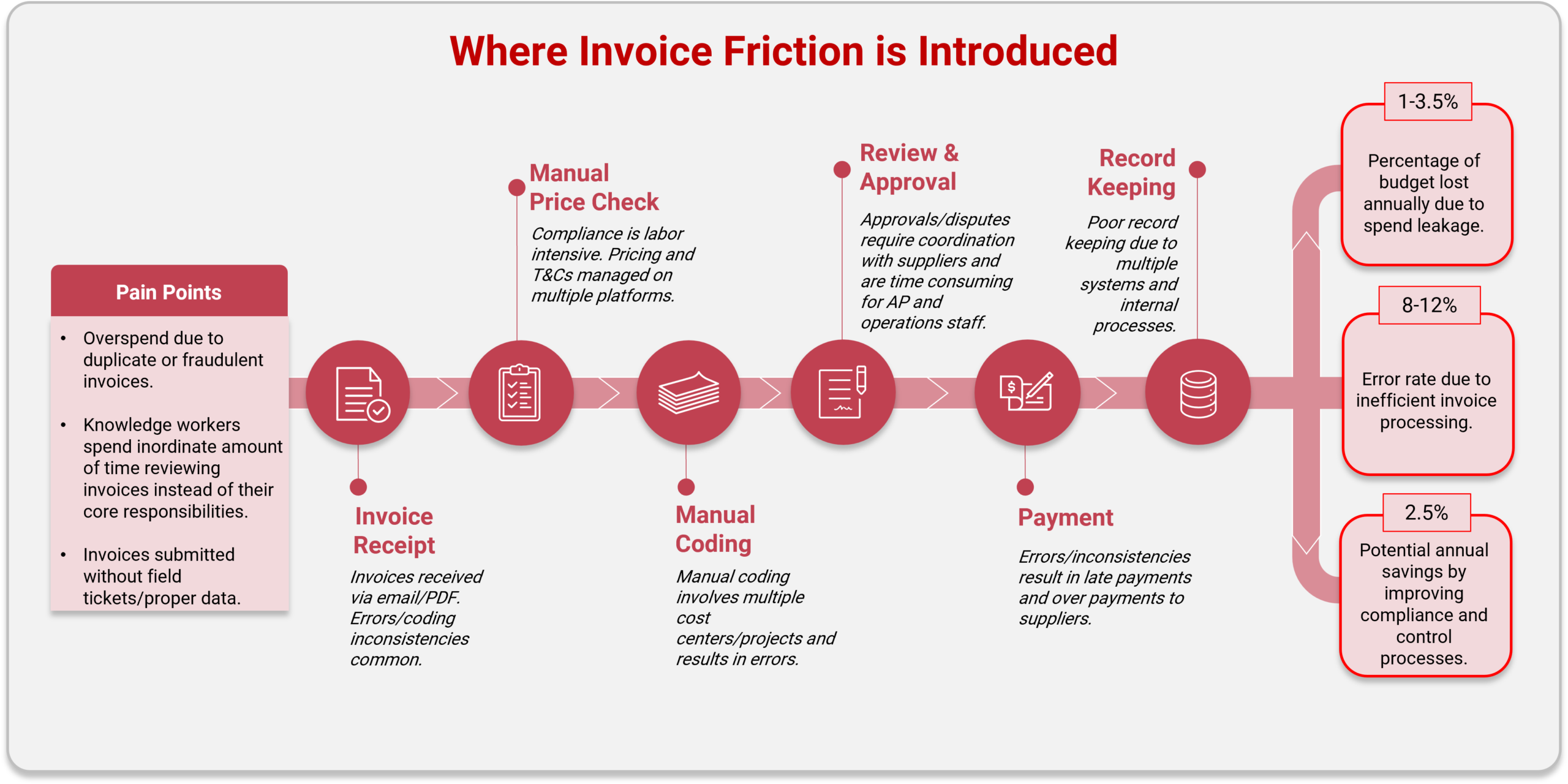
By this time, we were well-versed in the problems facing accounting, supply chain, and operations teams in the industry. The challenge was coming up with the solution. So, we started to work towards a vision where:
In this new environment we were working toward, invoices were the finished product in an interconnected system that favors spend visibility, smoother handoffs between different teams, digital documentation (rather than paper), and less manual work. On top of all this, everything would be tied together by automating validation of prices against agreed upon rates and conditions.
This systems view is critical. Invoice cycle time reflects the maturity of the entire source‑to‑pay process, not just the invoice workflow itself. From this approach, we knew that faster approvals aren’t the result of pushing harder at the end of the process. They’re the outcome of better information, clearer validation, and fewer surprises earlier on.
We began to see that improvements in submit‑to‑paid are less about invoicing speed and more about how consistently the upstream parts of the process are digitized and aligned. That perspective set the stage for the next question: which parts of the source‑to‑pay lifecycle have the biggest impact when they’re digitized first, and how do those changes reduce friction before an invoice ever reaches approval?
If invoice efficiency is created upstream, the most important question becomes where it starts to take shape. At a macro level, the biggest driver is the digitization of the documents that define spend before an invoice ever enters the process.
In high‑volume environments, invoice delays are rarely caused by the invoice itself. They usually trace back to uncertainty earlier in the lifecycle: what work was performed, what was ordered, what was received, and what pricing should apply. When that information lives in paper, emails, or disconnected systems, invoices carry that ambiguity forward. When it’s captured digitally and consistently, much of the friction is removed before accounting ever gets involved.
That’s why we directed much of our software development towards digitizing the core documents across the source‑to‑pay lifecycle that have such an outsized impact on cycle time.
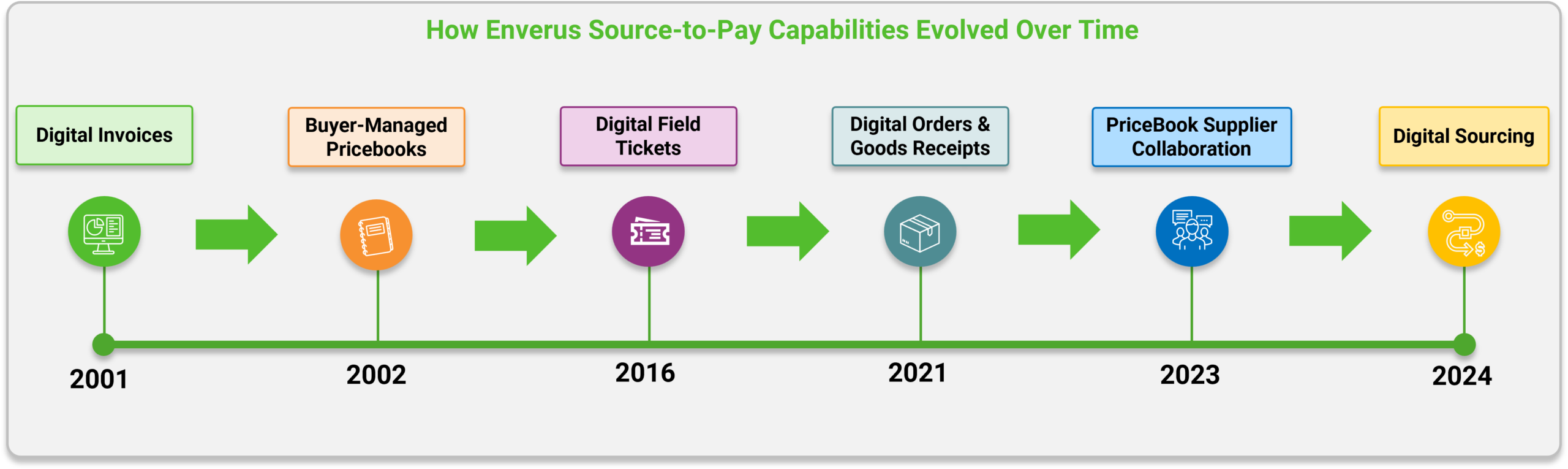
Together, these changes shift work earlier in the process. Digitization improves accrual accuracy, increases visibility into spend, and reduces the number of downstream exceptions. Just as importantly, it creates consistent data the process can rely on later.
That consistency is what enables the next layer of efficiency. Once upstream information is digital and connected, teams can rely less on manual intervention and more on rules, validations, and exception‑based review. This is where automation begins to compound the gains created by digitization.
Digitization creates the foundation, but it doesn’t carry the load on its own. As volumes increased, it also became clear that upstream operators needed more than better data. They needed a way to apply the same rules and standards consistently, without adding manual effort every time invoice counts grew.
That’s where workflow automation comes in. Much of our investment at this level was driven by the operational reality customers faced at scale: approvals slowing under volume, coding inconsistencies creating rework, and a growing backlog of exceptions that consumed time without improving outcomes. In this case, it was important to keep in mind that automation wasn’t about removing judgment. It was about reducing unnecessary touchpoints and letting accounting, supply chain, and operations teams focus on the cases that actually required attention. As such we focused on:
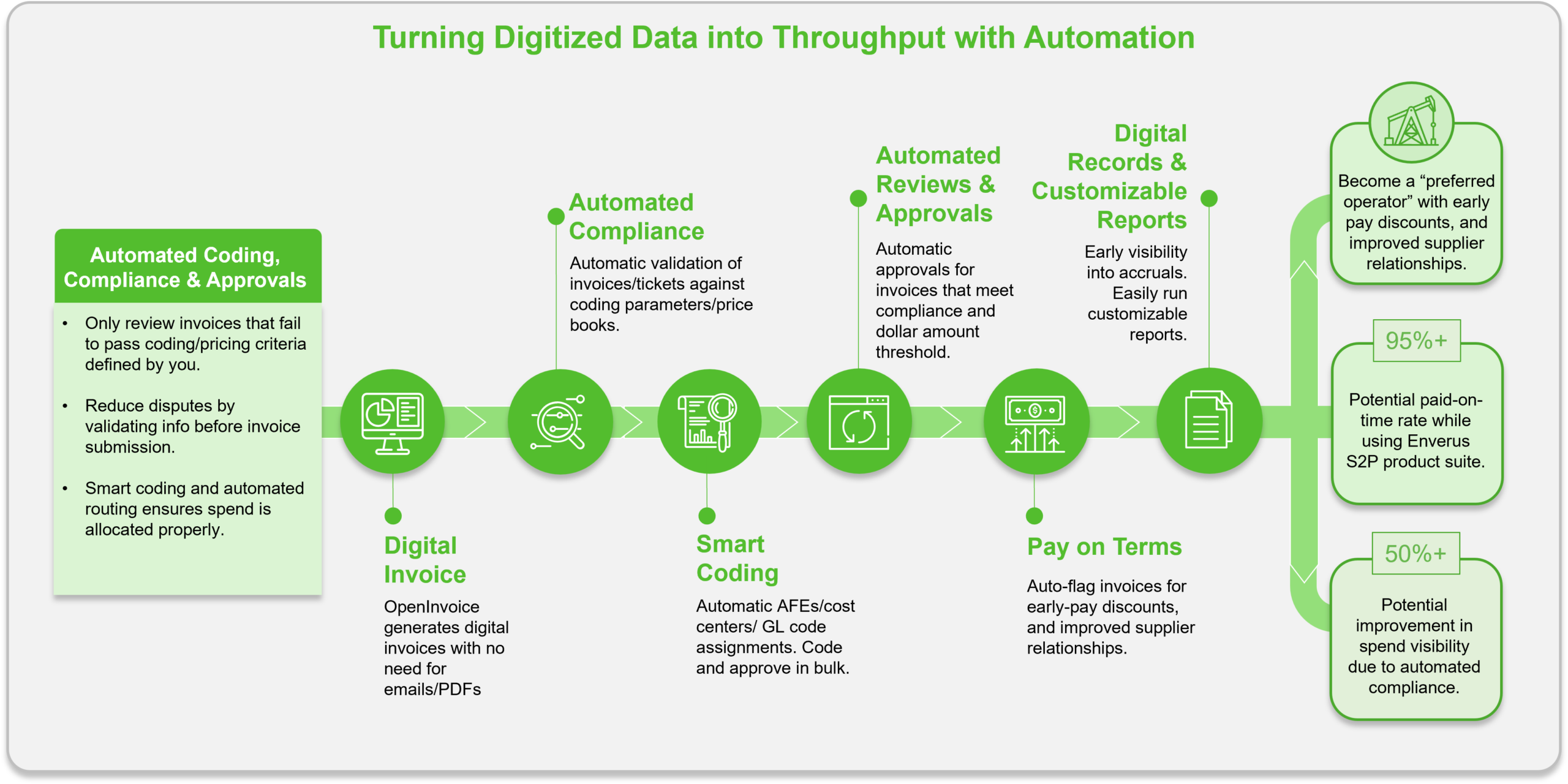
Together, these capabilities turn upstream digitization into real throughput. They allow the process to absorb growth more predictably, without relying on additional headcount or informal workarounds that create problems down the line.
The submit‑to‑paid story ultimately reflects operational maturity. Moving from nearly 50 days to roughly 30 days while operators, invoices, and spend all grew significantly demonstrates what is possible when source‑to‑pay is treated as a connected system rather than a set of isolated tasks.
The next phase of S2P efficiency will be realized through the adoption of Artificial Intelligence technology. The advances in capability are staggering, from scanning backup documents to ensure alignment with submitted invoices, interpreting contract clauses to determine invoice adherence with contracted terms, and checking for duplicate documents and determining accurate coding based on appropriate history.
These are only a few of the opportunities for the future. Efficiency gains will not only be measured in reduced cycle time, but also minimizing personal contact with the process, releasing valuable human resources to focus on more value-adding work.

Alberta oil sands producers waiting for $100 oil while weighing CCUS costs, pipeline choices and market volatility.

Most upstream operators run competitive sourcing events, but event-driven sourcing rarely becomes strategic. Learn how Enverus RFx drives sourcing strategy.
This is the sixth installment in our series of blog articles dealing with source-to-pay and upstream oil and gas. Read the previous blog here. For finance leaders in upstream oil and gas, invoice accuracy has long been the standard of...
Compress hours of bid comparison into a focused, AI-assisted session. Instant Analyst is now live in Enverus RFx for upstream sourcing teams.

In the oil and gas industry, automated clearing house (ACH) fraud and change-of-bank scams create real exposure on both sides of a royalty payment. For operators, a fraudulent account update can mean sending funds to the wrong place — and...
This is the fifth installment in our series of blog articles dealing with source-to-pay and upstream oil and gas. Read the previous blog here. For a lot of supply chain leaders in upstream oil and gas, the contract still feels like the...
Save time with automated price validation workflows and optimize spend with price compliance reporting and spend analytics.
OpenOrder, a purchase order software made for oil and gas, increases spend visibility and controls without burdening operations, with flexibility to issue, approve and track procurement of services and materials with a purchase order.
Gain complete inventory oversight. Track the quantity and value of inventory by location and accurately log material transfers in your accounting system.
With Enverus Instant Analyst™, you receive answers you can trust, delivered in seconds. Sourcing from 25+ years of vetted data and research on the most trusted SaaS platform designed exclusively for energy.
Accelerate invoice approvals and payment with cloud-based digital field ticket management.
Digitize and automate invoice processing and approvals with oil and gas enterprise accounts payable software.
Save time and reduce costs with a single streamlined solution to handle joint venture and AP invoice approvals in one system.
Enverus RFx is an AI-powered sourcing solution that simplifies bid management, expands supplier networks and provides transparent insights into pricing and activity. Streamline procurement and focus on your bottom line with Enverus RFx’s advanced technology.
Outsource mineral phone and print and mail, so your land and accounting teams can focus on critical work.
EnergyLink software provides secure and convenient online access to oil and gas owner statements and account information — available 24/7.
Enverus consulting services are provided by a team of technology experts, designed to optimize customer usage and maximize ROI of their OpenInvoice solutions.
Let’s get started!
Let’s get started!
We’ll follow up right away to show you a quick product tour.
Ready to Subscribe?
Ready to Get Started?