Your Guide to Protect Profitability in a Tight Market
Oilfield services operate in a capital-intensive environment where margins, utilization and cash flow must work together. While activity levels and pricing move in cycles, the mechanics of profitability remain consistent.
This guide is designed as a practical playbook for Oilfield Services Executives, Finance Leaders and Back Office Teams who want to improve cash flow performance. It breaks down the variables that influence profitability, explains why they matter in field-heavy operations and outlines the steps that strengthen financial performance across cycles.
Introduction: The Oilfield Services Profit Equation
In oilfield services, profit can be viewed through a straightforward equation:
Margin per job × job volume – the cost of working capital required to deliver and collect.
Most leadership teams follow margins and job volume closely. Those variables are visible, measurable and operationally familiar. However, the third component of cost and timing of cash conversion tends to receive less attention, even though it influences liquidity just as much.
Profitability in the oilfield depends on consistent execution across the order-to-cash lifecycle. Companies that standardize workflows, codify billing rules, automate approvals, and tighten collections often outperform even when demand softens. This process-centric mindset treats profitability as the outcome of the following daily behaviors:
Commercial discipline (clear terms and pricing)
Operational excellence (accurate field data and job capture)
Financial rigor (invoice quality, compliance and timely collections).
Relationship management (active engagement with customer AP teams)
It’s important to note that pricing and utilization are the main drivers for revenue, but the speed and reliability of cash conversion determines whether that revenue is available to fund growth, reduce debt and support operations.
In this process you have one controllable lever: how efficiently operational and accounting activity converts into cash. And the most clear indicator of that alignment is Days Sales Outstanding (DSO).
What is Days Sales Outstanding (DSO)?
DSO measures the average number of days it takes a company to collect payment after a sale has been made. In simple terms, it answers the question: How long does it take for completed work to become cash in the bank? The standard formula is:
For example, if accounts receivable is $6 million at quarter-end and credit sales are $18 million over a 90-day quarter, DSO = (6 ÷ 18) × 90 = 30 days. This means you are effectively funding 30 days of operations before receiving payment.
Extended billing cycles are common in oilfield services but it does carry financial implications. Higher DSO generally means:
More capital tied up in receivables
Greater reliance on credit facilities
Reduced flexibility for equipment investment or fleet upgrades
Less predictability in cash forecasting
Lower, more stable DSO means:
Confident forecasting
Reduced reliance on credit facilities
Streamlined financial performance due diligence
For owners and leadership teams, it may also support strategic options over time, including being a stronger acquisition candidate or having the cash flexibility to pursue acquisitions when the opportunity arises
Why Low DSO Is Especially Critical in Oilfield Services
Oilfield services rely on field-intensive operations, where billing depends on rigorous documentation and strict customer-specific compliance. Each job can generate multiple tickets, change orders and cost elements that must align precisely with contracts. Because billing is complex, the risk of disputes and therefore longer DSO is higher than in many other industries.
Many operator agreements also include defined documentation and submission windows. If those timelines are missed, certain charges may become unbillable, meaning revenue is lost rather than simply delayed.
Understanding trends in DSO over time
It’s important to track DSO by customer, segment and region alongside order volumes and order types (for instance, more completion jobs versus maintenance) to help separate operational issues from market shifts.
Rising DSO without a change in terms often indicates process issues (late ticket approvals, mismatched rates, missing field signatures, or disputes).
Falling DSO usually reflects better documentation, faster invoicing, and effective collections.
What constitutes a good or bad DSO
The benchmarks vary by sub industry and customer mix. Many oilfield service companies target 30 to 45 days in steady markets. A DSO under 35 days is often considered strong, while consistent readings above 60 days signal cash strain, often stemming from invoice quality issues or customer payment practices. The right target depends on contract terms, customer approval cycles and your ability to invoice promptly. In practical terms, what is a good DSO is the number you can sustain without extraordinary collections pressure.
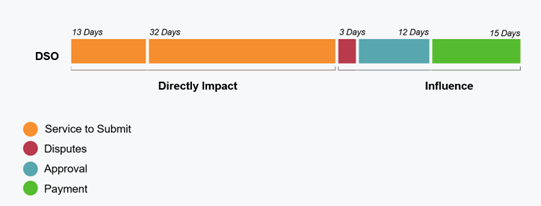
In many oilfield service companies, the total timeline from ticket creation to invoice submission can approach several weeks before formal payment terms even begin. With net 45 or net 60 structures, overall cash conversion can extend significantly.
Strategies to Optimize Days Sales Outstanding
1. Capture Information at the Source (field → back office):
Invoice accuracy begins with job documentation. When job details are complete at the time of service, including pricing references, customer approvals and required attachments, back-office teams spend less time correcting invoices. Clear validation before leaving location reduces adjustments and shortens billing timelines.
Each time data is re-entered, reformatted or manually transferred between systems, the risk of delay and inaccuracies increases. Common friction points include:
Rekeying ticket data into accounting systems
Manually attaching supporting documentation
Searching for updated customer billing requirements
Routing invoices through email-based approval chains
OpenInvoice users who manually rekey invoices from their ERP
Standardizing documentation and minimizing duplicate workflows reduces administrative effort and variability. Over time, fewer manual touchpoints translate into more predictable invoice cycle times.
3. Increase Visibility for Finance Leadership:
A single DSO number does not explain the cause of delay. Tracking supporting metrics provides context, including:
Average days from job completion to invoice
Percentage of invoices requiring correction
Aging by customer and reason code
Dispute resolution cycle time
This visibility allows leadership teams to separate customer payment behavior from internal process gaps.
4. Automating End to End Workflows:
Companies that connect field documentation, billing validation and AR monitoring within a cohesive workflow reduce cycle times. The benefit is not limited to faster collections. It includes fewer disputes, more predictable forecasting and lower administrative burden.
What Are Other Oilfield Service Companies Doing to Improve DSO?
With the roll out of the field ticketing app, we've gone from around 10% of tickets being sent back to literally zero. This has tremendously lowered our DSO Read More
Michael Buffington | Director of Administration, Casing Division
SupplierLink is a great solution for Tally because it has allowed us to grow our business into a full service provider, while enabling us to manage accounting AR at increasing scale and grow our team at a pace that is cost effective to us. Read More
Beverly Railborn | Accounts Receivable Manager
The key with SupplierLink in terms of being a great blessing is definitely the way they set up with the client…It makes it really simple for me to share the load of invoicing and completing the things that have to be completed for invoice submission. And FundThrough has been amazing at making sure we’ve had the cash flow to purchase the materials we need to take on those big POs, to be able to meet payroll for those big POs, especially jobs that go two to three months in length. Read More
Lisa Hawthorne | Bulletproof Electric
The great thing about invoicing funding and digital field ticketing in particular was being able to invoice and then get the cash. That helped us accelerate growth and grow quicker than we’ve ever grown before. Read More
Ken Miller | Owner
From start to finish, OSS has been a huge driver for improvement. We have all the information and functionality we need in one system. This has eliminated ticket errors and tremendously improved our DSO. Read More
Misty Turner | Office Administrator, AR and AP
Electronic field ticket suite saved us a ton of money in our workforce, a ton of time, and made our customers, employees and bank account happier! Read More
Marla Lookabill | Business Manager
Suppliers love working with us because we process invoices quickly and pay faster with more transparency into the process. With the automation of OpenInvoice, we can communicate in real time and expedite disputes and invoice questions. It’s been a great universal accounting tool that we would highly recommend for streamlined processes and cost reduction. Read More
Cheryl Lucas | AP Program Manager
The change in our processes was so profound that the team size was reduced from seven to three, yet we process more invoices than ever before. We transitioned from a state of frustration and stress to a more positive work environment. This shift has allowed us to redirect our focus to other areas of the business that require attention. Read More
Tina Royal | Assistant Corporate Controller
Automating Order-to-Cash for DSO Improvement
Reducing DSO is a cross-functional effort spanning sales, operations, finance and IT. The objective is to remove friction from the order-to-cash lifecycle to get paid faster.
As transaction volumes grow and customer requirements become more complex, manual processes tend to introduce variability into the order-to-cash lifecycle.
Automation is typically most effective when it focuses on three areas:
1. Integrated Ticket and Invoice Workflows
When job documentation flows directly into billing systems, accounting teams avoid duplicate data entry. Reducing manual input lowers error rates and shortens invoice preparation time.
2. Structured Compliance Checks
Operator billing requirements often include detailed coding, documentation and approval standards. Embedding these requirements into the invoicing workflow reduces avoidable rejections and improves first-pass acceptance.
3. Real-Time Performance Monitoring
Centralized visibility into invoice status, aging and dispute drivers allows finance leaders to identify patterns early. Instead of reacting to rising DSO, teams can address specific bottlenecks in submission, approval or follow-up.
Building Sustainable Profitability Through Cash Flow Discipline
Strong profitability in a tight market comes from disciplined execution. DSO is a practical, actionable metric that translates operational quality into financial strength. When asked what is DSO or what does DSO mean, point to the everyday steps, field data capture, invoice compliance, aligned payment terms, and automated handoffs, that move cash faster. Define what is a good DSO for your business, then back it up with process improvements and technology that reduce rework and disputes.
Purchase order automation has the power to relieve oil and gas operators and OFS companies of many headaches in the procure-to-pay process. Energy companies continue to manage the procurement process using tedious, manual workflows that result in the same issues...
In the oilfield services space, not every company is well equipped for international growth. There’s a distinct risk profile that comes with working overseas. Commercial risk, compliance, geopolitical issues, logistics… it requires additional resources and investment to do properly. To...
Valaris Ltd. will issue $350 million in 8.375% senior secured second-lien notes due 2030 as it prepares to buy two newbuild drillships currently in South Korean shipyards, more than 10 years, two mergers and one bankruptcy after the rigs were...
Transocean Ltd. secured a 1,080-day contract for a high-specification seventh-generation ultra-deepwater drillship in the Mexican sector of the Gulf of Mexico (GOM) at one of the highest day rates the company has commanded in years. The contract will contribute $518...
As others look to specialize, Patterson-UTI Energy Inc. has seized the opportunity to become a diversified U.S. onshore oilfield services company. Patterson-UTI agreed in July to acquire drill bit designer and manufacturer Ulterra Drilling Technologies LP, just weeks after the...
Understanding the timing of each stage of preproduction, known as efficiency metrics, is imperative for having confidence in forecasting cycle times of operators and service companies. This helps ensure equipment is fully utilized and groups know what’s needed for each...
Unlike the energy industry’s pre-pandemic growth, today’s market is focused on lean operations, asset optimization and sourcing reserves as efficiently as possible. The current oil and gas development landscape presents many pitfalls and abundant opportunities, making it imperative to do...
Operators and oilfield service companies need to keep pace with the volatile and rapidly evolving energy industry. However, if you are relying solely on public filings to make investment decisions or anticipate future activity, you’re shortchanging yourself. Public data often...
With Enverus Instant Analyst™, you receive answers you can trust, delivered in seconds. Sourcing from 25+ years of vetted data and research on the most trusted SaaS platform designed exclusively for energy.
Tune out the noise, get unbiased evaluations and uncover hidden opportunities with advice you can trust from experienced energy and power intelligence advisors.
OpenOrder, a purchase order software made for oil and gas, increases spend visibility and controls without burdening operations, with flexibility to issue, approve and track procurement of services and materials with a purchase order.
Arm yourself with the knowledge to inform strategic decisions and grow your business with one source for insights across oil and gas, renewables, carbon capture and ESG.
Expedite your growth in the dynamic world of oil and gas by boosting your marketplace presence. List your services and locations, to become more discoverable to operators actively looking for your services and increase your chances of winning new contracts.
Accelerate your understanding of the oil and gas landscape with near real-time rig analytics. Track rig activity across North America, enhancing your strategic planning and decision-making processes to stay ahead of the curve.