
Calgary, Alberta (November 22, 2022) — Enverus Intelligence Research (EIR), a subsidiary of Enverus, the most trusted energy-dedicated SaaS platform, has released a report exploring risks and evaluating considerations for carbon sequestration (CCS) in southern Louisiana, and the risk profiles of recently announced CCS projects in Louisiana and the closely surrounding area.
In its report, EIR focused on four key themes:
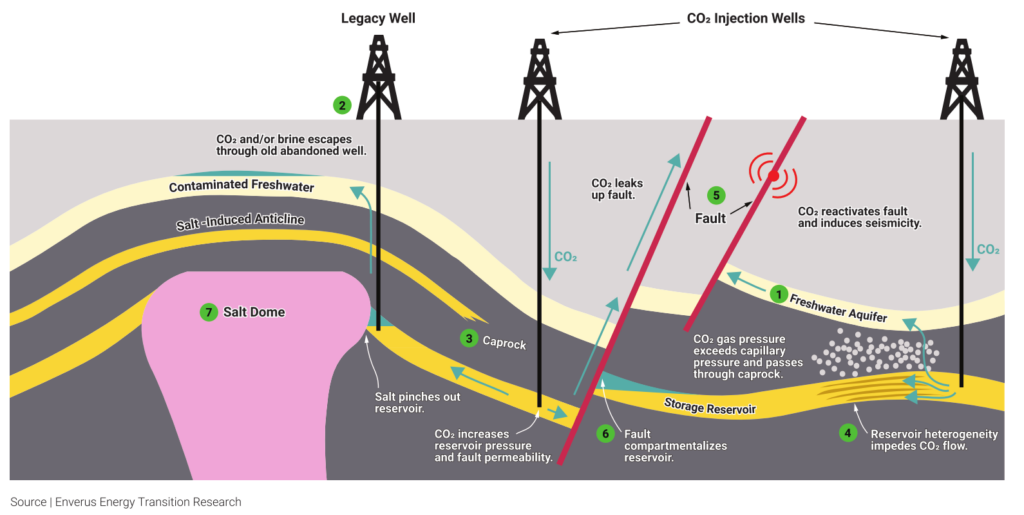
- What subsurface risks are prevalent in the region and their potential to add complications to or impact long-term CO2 projects.
- How the risks stack up to show low-risk versus high-risk regions.
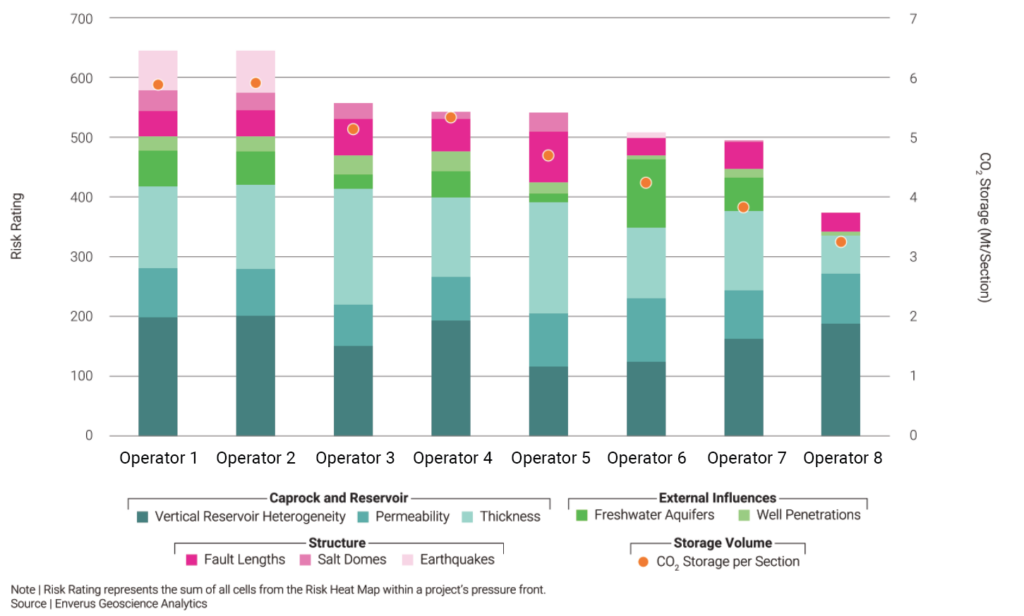
- How the recent southern Louisiana projects are benchmarked against one another in terms of risk profiles.
- Comparing and assessing what makes one project riskier than another looking into the unique factors elevating or diminishing the project’s risk factor.
“Louisiana screens as a top-tier region for CCS activity, but even with the greatest reservoirs, elements of risk can complicate a project’s success and viability. Thus, these risks must be delineated and understood,” said Evan MacDonald, senior geology associate at EIR.
“To firmly understand the total risk associated with a CCS project, multiple elements must be analyzed. Combining those elements to define a scaled, cumulative risk factor can help with future project screening efforts. This report aims to not only daylight and analyze the risks as they may impact the projects that have been announced thus far, but to also provide a look at how those risks should be baked into future efforts to delineate sequestration sites in the future.”
Key takeaways from the report:
- Subsurface risk features could trigger CO2 migration and containment losses as well as introduce additional safety, reputational and financial risks. The contamination of freshwater aquifers by the migration of CO2 or pressurized brine requires extensive measurement, monitoring and verification (MMV) and is a key consideration of the Class VI permit process.
- The northern half of the Oligocene-Miocene area of interest (AOI) features the highest potential risk due to the presence of freshwater aquifers, high caprock permeability and deep legacy wellbores. Most disclosed projects are situated in the southern half of the AOI where there are fewer freshwater aquifers and thicker less permeable caprock.
- DEN’s Donaldsonville and Assumption St. James projects are subject to the most risk despite holding some of the highest CO2 storage capacities. Conversely, the operator’s New Orleans project screens as the lowest-risk project, while also exhibiting the lowest CO2 storage potential.
- Projecting the impact of storage risks is complex and will ultimately require injection before these systems are fully understood. Higher-risk areas require added planning and costs to ensure those features are managed appropriately.
View EIR’s previous report: CCUS Inventory Unlocks Hidden Potential.
Members of the media should contact Jon Haubert to schedule an interview with one of Enverus’ expert analysts.
About Enverus
Enverus is the most trusted, energy-dedicated SaaS platform, offering real-time access to analytics, insights and benchmark cost and revenue data sourced from our partnerships to 98% of U.S. energy producers, and more than 35,000 suppliers. Our platform, with intelligent connections, drives more efficient production and distribution, capital allocation, renewable energy development, investment and sourcing, and our experienced industry experts support our customers through thought leadership, consulting and technology innovations. We provide intelligence across the energy ecosystem: renewables, oil and gas, financial institutions, and power and utilities, with more than 6,000 customers in 50 countries. Learn more at Enverus.com.
About Enverus Intelligence Research
Enverus Intelligence Research, Inc. is a subsidiary of Enverus and publishes energy-sector research that focuses on the oil and natural gas industries and broader energy topics including publicly traded and privately held oil, gas, midstream and other energy industry companies, basin studies (including characteristics, activity, infrastructure, etc.), commodity pricing forecasts, global macroeconomics and geopolitical matters.
Media Contact: Jon Haubert | 303.396.5996