
MARC is where the minerals and royalty world comes to compare notes. This year, I came away with a clear sense that the macro environment is finally forcing the conversations the industry has been putting off — inventory quality, capital discipline, where the real deal flow is. And Enverus was in the middle of all of it. Here’s what stood out.
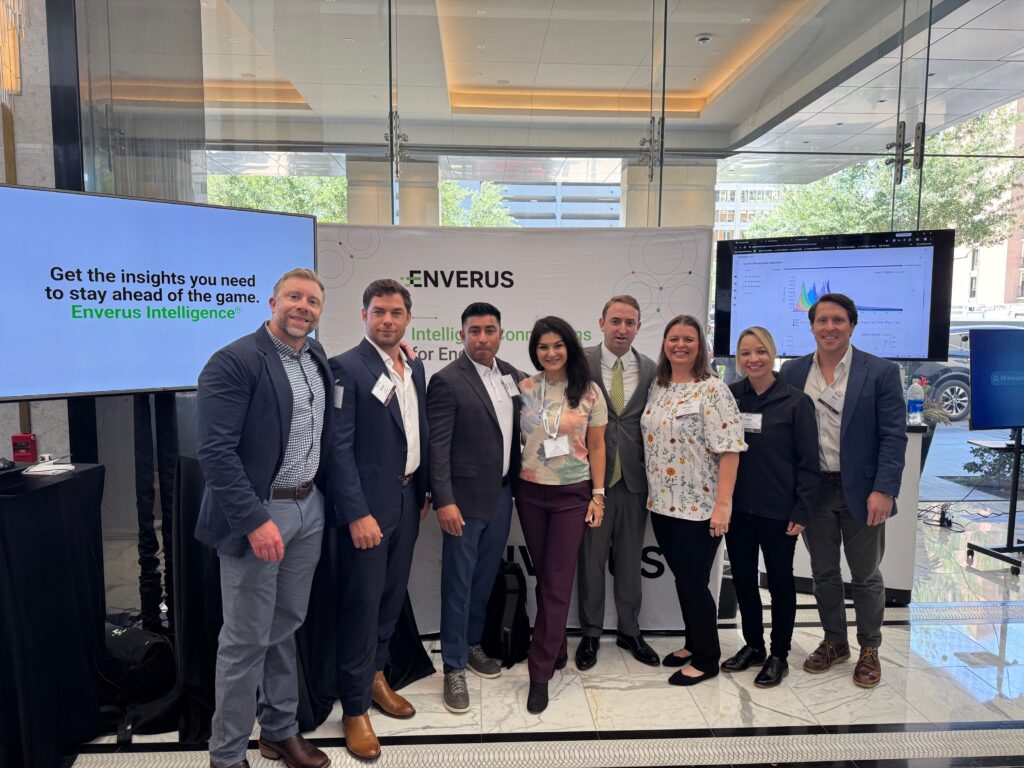
A First for Enverus: Sponsoring Women in Minerals
One of the moments I’m most proud of from MARC didn’t happen on a conference stage. It happened at lunch.
Enverus sponsored the Women in Minerals luncheon for the first time, and it was one of the best-attended events of the conference. I had the chance to speak, and what I said then is worth repeating: this industry is stronger when more voices are at the table. Organizations like Women in Minerals matter because they signal to the next generation of women entering minerals, royalty, and non-op that there’s a community waiting for them.
At Enverus, this space isn’t an afterthought; it’s a priority. We were proud to be in that room, and we’ll be back.
Signal 1: The U.S. Supply Advantage Is Structural — Not Cyclical
The conference opened with a clear macro framing, the U.S. has become the world’s swing producer and LNG anchor. The Iran conflict has removed about 10 mmbbl/d from global markets causing a rapid drawdown in global inventories and setting up a higher crude price for 2027. The Permian Basin is now the world’s marginal barrel. U.S. LNG is Europe’s primary gas backstop. Neither reverts in any foreseeable political cycle.
The supply disruption scorecard tells the story plainly: ~8–10 mmbbl/d has been disrupted, rerouted, or put at risk since 2022 — equivalent to nearly 10% of total global demand. Russia, Iran, Houthis/Red Sea, Venezuela, Libya. The U.S. has been the non-OPEC offset to every single one. That’s not a coincidence, it’s a structural role that won’t unwind without a fundamental political reset that nobody on stage was predicting. The Enverus Intel Research data added a specific anchor to the macro picture. Oil equities are currently implying ~$70/bbl WTI — well below EIR’s price forecast — which means the market is being more conservative than the underlying supply fundamentals suggest. Gas equities are implying ~$4/Mcf Henry Hub despite near-term softness. The gap between what equities are pricing in and what the structural supply picture supports is one of the more actionable observations from the session.
The public company panel reinforced this from the asset side. Black Stone Minerals called out the Haynesville gas story specifically — noting that the pull on Haynesville molecules tied to LNG demand has just begun, and that long-duration mineral positions in gas-producing basins with infrastructure access to LNG markets are exactly where they see structural long-term asset growth. Freehold, a Canadian royalty company, noted that 50% of their revenue now comes from U.S. production — a deliberate strategic shift that signals where sophisticated royalty capital sees the most durable upside.
What this means for minerals: The structural price floor for U.S. barrels is better-anchored today than it was three years ago — not because of a temporary geopolitical spike, but because the global supply architecture has rewired itself around U.S. production in ways that don’t reverse easily. For minerals buyers underwriting through-cycle value, the worst realistic case for oil prices is less bad than it used to be. And the gas story tied to LNG demand is still in early innings.
Signal 2: Capital Is Selective and the Bar Has Moved Permanently
Capital isn’t absent from minerals — but it has become disciplined in ways that aren’t reversing. Upstream-focused private equity peaked at 131 fund commitments in 2017 and has hovered around 20–24 since 2022. Public upstream equity and debt issuances rebounded to $62B in 2024 and $52B in 2025 — but that capital is concentrating around larger, diversified platforms in core basins with clear development visibility.
One of the more interesting undercurrents at MARC was the growing presence of family office capital in the minerals space. Four years ago they were just starting to show up. Now they’re an established buyer class — drawn in by yield, low capex requirements, and a risk profile that looks attractive relative to direct E&P ownership. As one panelist put it, east of I-35 are family offices, and they’ve been coming in looking to put capital to work in this space for several years now.
What family offices want is specific: yield, lack of capex, low risk, and G&A that is lean relative to enterprise value. They’re benchmarking management fees tightly at roughly 2% of enterprise value — a little higher for non-op/op platforms — and scrutinizing G&A closely. They prefer managers who are heavily invested in the asset alongside them, and many are outsourcing business development and mineral management rather than building large internal teams. That raises the bar for third-party operators and managers to demonstrate credibility, data fluency, and disciplined underwriting.
What institutional investors want is consistent: scale, cash flow visibility, downside protection, and exposure to LNG, AI power, and reshoring demand. Assets with clear development visibility in Delaware/Midland for oil and Haynesville/Marcellus tied to LNG and data center power for gas are consistently attracting capital. Everything else is working harder to get attention. The 65% of PE mineral commitments since 2023 that are focused on the Permian Basin — per Enverus M&A data — tells you exactly where institutional conviction is concentrated.
What this means for minerals: The buyer universe has gotten broader but more demanding. Family offices are now a real part of the capital stack — patient, yield-oriented, and cost-conscious. Portfolios with visible inventory, quality operators, low G&A, and infrastructure access are commanding the premiums. And for mineral managers competing for that capital, the ability to show organized, coherent data about your own assets is increasingly the price of entry.
Signal 3: Inventory Quality Is the Defining Question and the Clock Is Ticking
The Enverus Intel Research session led by Andrew McConn was the most data-dense hour of the conference — and the most consequential for anyone making acquisition decisions right now. The headline is straightforward: the Permian has 8 years of sub-$50 WTI breakeven inventory remaining at PV-10. But the gap between PV-10 and PV-50 location counts is significant — and worth understanding before you underwrite a deal. 76,000 locations clear the $50 breakeven at PV-10. Only 12,900 do at PV-50. That’s a wide range, and where you land in that range has a material impact on what you should pay.
The trajectory from here is equally important. By 2040, the activity-weighted breakeven in the Permian reaches $95/bbl and the marginal breakeven hits $110/bbl. Core inventory depletion isn’t a distant concern — it’s already showing up in well economics today. In the Midland, oil EURs are dropping 0.9 Mbbl per 1,000 feet with each incremental well added to a DSU. Operators are pivoting to shallower targets in the Delaware core as the best intervals get drilled up. The market has already started pricing this — operators with less than five years of sub-$50 inventory are trading at PDP value, with no premium for undeveloped upside that isn’t credibly there.
There are genuine upsides, and Andrew was specific about them. The Barnett-Woodford interval in the Midland exceeded base performance by more than 30% in 2025 — a real upside surprise that’s expanding the opportunity set. Northern Delaware resource expansion is continuing, concentrated in New Mexico with inventory being unlocked primarily in KPLA Plus across Bone Spring units. On the gas side, 42,500 locations clear the $3/MMBtu breakeven at PV-10, but only 5,700 at PV-50 — and Haynesville inventory with direct access to LNG markets is already pricing at a premium to everything else. By 2040, the gas activity-weighted breakeven reaches $4.80/MMBtu with marginal at $5.50. The window on quality inventory is real and the data is showing it.
The public company panel added a practitioner layer to this. Black Stone Minerals — one of the largest publicly traded mineral and royalty companies in the U.S. — shared how they think about long-term value creation through mineral aggregation and legacy asset positions assembled over decades. With 2M leased acres, their focus isn’t on drilling — that’s the operator’s job — but on how they structure leases and operator relationships to ensure their acreage gets developed on terms that maximize long-term mineral value. That includes lease provisions that hold operators accountable to development timelines and capture value across multiple productive intervals. The Haynesville gas position was highlighted specifically — the pull on those molecules tied to LNG demand has just begun, and long-duration, well-structured mineral positions in that basin are exactly what benefits from that tailwind.
What this means for minerals: The inventory story is more nuanced than the headline numbers suggest. The Permian is still the most defensible basin for minerals capital — but the quality gradient within the Permian is steepening. Understanding the gap between PV-10 and PV-50 location counts before you underwrite a deal isn’t a technical exercise — it’s the difference between paying the right price and overpaying for inventory that looks better on paper than it performs in practice.
Signal 4: Deal Activity Is Real — But Execution Edge Is the Differentiator
Mineral M&A reached nearly $12 billion in 2025, led by Permian acquisitions — per Enverus M&A data. Royalty deals averaged 9x EBITDA in 2024–25. The market has bifurcated, with increasingly high valuations paid for Permian interests versus non-Permian. Viper has led all mineral buyers by value since 2023, and nearly $2B in additional transactions closed in the past year, including the Warwick/GRP acquisition of Viper assets at $670M, WhiteHawk’s acquisition of PHX Minerals at $187M, MAP Energy’s GP-led continuation fund, and the Coronado recapitalization in Eagle Ford and Haynesville.
What drives capital to winning platforms: proven management, a defined acquisition thesis, sourcing advantage, data-driven underwriting, and the technical capability to evaluate geology, production modeling, and asset economics with speed. The competitive gap isn’t always about capital — it’s about how quickly a team can form a directional view of an asset and decide whether it deserves their time.
The panel was candid about the mistakes that derail mineral managers: not making decisions, pursuing the wrong deal at the wrong time, overpaying without guardrails, and putting yourself behind the eight-ball on a first deal that needs to be successful to establish credibility. The pattern across every one of those mistakes is the same — insufficient conviction at the moment of decision, usually because the data wasn’t organized well enough to act on.
What this means for minerals: The market is active and the premiums are real — but they’re concentrated. Permian is commanding a bifurcated premium over everything else. And the teams closing deals consistently have solved the speed and conviction problem — they’re not rebuilding the model from scratch for every opportunity.
Signal 5: The Capital Coming into Minerals Is Structurally More Creative
A dedicated session on minerals fund structures highlighted something that doesn’t get enough attention on the buy side: the capital coming into minerals deals today is structurally more creative than it was five years ago. GP-led secondaries, 1031 fund structures, GP-LP flips for IDC tax efficiency, and continuation vehicles are all expanding what’s possible on both sides of a transaction.
Private equity, family offices, strategics, and structured credit are all active in the market with different return profiles, time horizons, and deal requirements. In a slower traditional fundraising environment, GP-led secondaries and structured capital are filling the liquidity gap and facilitating transactions that wouldn’t have cleared under older financing frameworks.
New financing structures are also lowering the cost of capital for a new class of buyers and expanding who you’re competing against. Asset-backed securitization in particular is giving buyers access to cheaper financing than traditional credit facilities — which means they can pay more for assets and still hit their return targets. That’s a meaningful shift in the competitive buyer universe that wasn’t a factor five years ago and is now an active part of how deals are getting done.
One perspective from the panel worth holding onto: 95% accuracy is good enough if you’re planning to exit. But the longer you hold assets, the more revenue precision becomes the priority. That’s a fundamentally different operating posture — and it requires a different kind of data infrastructure underneath it. As one panelist put it, this business is a grind. Pause and celebrate the wins. Your team will appreciate it.
What this means for minerals: Buyers who understand the full range of capital structures in the market — and can speak to them fluently in conversations with sellers and investors — are better positioned to structure offers that win. The financing creativity is a real edge, but only if you understand what each structure requires and how to use it. And knowing that ABS-backed buyers may have a structural cost-of-capital advantage over competitors using traditional credit facilities is the kind of market intelligence that changes how you think about who you’re bidding against.
Signal 6: AI Is Already Working in Minerals — Just Not Where You’d Expect
The AI conversation at MARC wasn’t about chatbots or generative summaries. It was about workforce math and operational drag. The companies who spoke most specifically about AI weren’t describing a future state — they were describing what’s already changed in how their teams function.
One operator noted they grew their business while adding only 3–4 people. AI is why. The framing wasn’t “AI instead of people” — it was AI enabling a small team to do what used to require a much larger one. Better idea generation, faster evaluation loops, tighter decision cycles. The estimate on the table: 20–25% better cycle time on deals when the right tools are in place.
But the more honest part of the conversation was about where AI is actually being used day-to-day — and it wasn’t the flashy stuff. It was title complexity. Unit interpretation. Plat management. Lease provisions. Mispayments. The infinitely complex, manually intensive work that sits underneath every minerals portfolio and quietly consumes time that should be going toward decisions. The message from the room was direct: deglitch the things that shouldn’t be this hard. That’s where AI is earning its keep right now.
The data foundation point tied it together. Claims data is still the biggest challenge in minerals. You can have the best tools in the world, but if your data isn’t organized and coherent on your side, you can’t have a productive conversation about your own assets — let alone act on them. As one panelist put it: having the data organized on your side so you can come together and have a coherent discussion is the prerequisite. Everything else follows that.
What this means for minerals: The AI edge in minerals isn’t coming from the biggest platforms or the best-funded teams. It’s coming from operators who made a decision to stop tolerating operational drag and started treating technology as a multiplier. The use cases are less glamorous than the headlines — title complexity, ownership interpretation, payment accuracy — but the time savings are real and compounding. For non-op managers specifically, the AFE and ownership complexity problems are exactly where this is landing first. The work that used to require days buried in PDFs and spreadsheets is becoming a workflow that runs in minutes, with an auditable output ready for approval. That’s not a prediction. It’s already live.
What Enverus Brought and What the Room Said
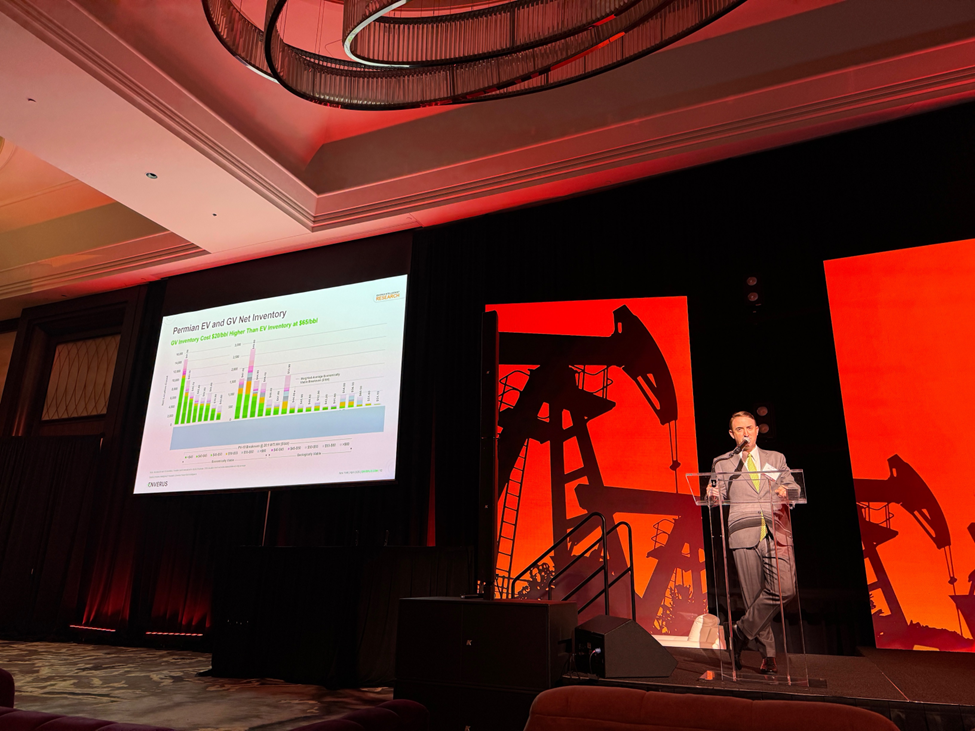
Beyond the research session and product launches, the most validating moment at MARC came from somewhere we didn’t script.
During a public company minerals and royalties panel, the moderator asked which AI and technology platforms the industry is relying on. Chris Steddum (CFO, TPL), Susan Nagy (VP, Business Development, Freehold Royalties), and Taylor DeWalch (President, Black Stone Minerals) all called out Enverus unprompted. Three public company leaders, on stage, at the industry’s premier conference — none of them prompted, none of them our customers on a panel we organized. That kind of validation speaks louder than anything we could say about ourselves.
At MARC, Enverus showcased the launch of Minerals Evaluate & Acquire for true end-to-end acquisition workflows, Intel Research insights on inventory and price outlook, the new Tracts partnership for title and ownership intelligence, The AFE Evaluation Report flow within Enverus ONE® for non-op management, and Minerals Marketplace connecting buyers and sellers directly. The research session gave the room a clearer view of where quality inventory remains and where capital is moving.
Minerals Evaluate & Acquire gives teams the speed and confidence to act on that view. The Tracts partnership removes the title bottleneck that slows deals down at the worst possible moment. The Marketplace puts 300+ active listings in front of the right buyers, directly. And the AFE Evaluation report starts closing the gap between data and decision on the non-op side.
Strong showing from the Enverus product, Intel Research, and Customer Success teams — and clear evidence the work is resonating where it counts most.