
Trading and Risk

What is a Forward Curve? A Beginner’s Guide (Part 1)

byLaura Blewitt

The industry that drives global commerce and ensures our highest standards of living is underpinned by the complex and fascinating world of commodity trading.

Without commodity trading, our lives would be vastly different. The exchange of physical commodities like crude oil, natural gas, metals and power guarantee that we can do everything from turning the lights on, to receiving packages in the mail, to charging our cell phones.

The intricacies of commodity trading are hard to grasp without the right language, and several of the terms and definitions used by traders are unique from those used by the buyers and sellers of other assets like stocks, bonds, equities or even cryptocurrencies.

Since forward curve management stands at the foundation of Enverus’ key risk management solutions for the energy industry, I figured it might be helpful to take a step back and define what a forward curve is, and why it’s integral to any trading operations’ bottom line. We all have to start somewhere. This post is dedicated to the newbies.

What is a forward curve, and why is it important for risk management?

Simply put, a forward curve is a snapshot representation of what a commodity is currently worth today based on a possible buy or sell in the future. Using a forward curve, I can tell you what the price of WTI crude futures is currently for barrels that would change hands in 2024. Tomorrow, the forward curve will likely determine a different price.

A forward curve is built using the current day’s price values to exchange a commodity at some point in the future, and the commodity’s value will change as time progresses. This is why forward curves are not a price forecast like the formal weekly, monthly, or annual predictions that our analysts produced based on more in-depth fundamentals data. Instead, it’s an indicator based solely on the bids and offers in the marketplace for that day.

Let’s pause and view an example of how prices can be sewn together to create a forward curve. It’s easiest to explain using an instrument called a futures contract, which is exactly what it sounds like: a contract that traders exchange for a determined volume and commodity at a future time period.

While these contracts are bought and sold virtually on exchanges like ICE or Nymex, they represent the buying or selling of a real, tangible product. If you purchase a contract and forget about it, you will be responsible for taking delivery of the commodity you ordered.
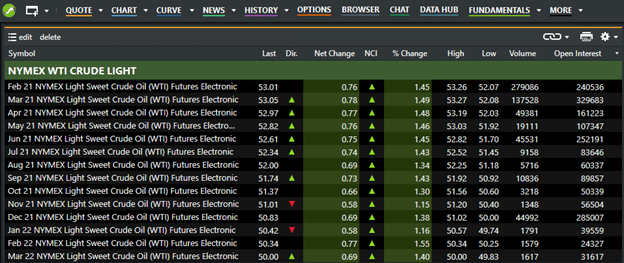
Figure 1: Nymex WTI crude futures as of 1pm CT, January 12, 2021. Futures prices shown through March 2022 via MarketView Desktop.

At any given moment in a trade day, there are absolute values for futures contracts far into the future – you can see here that even for contracts delivering crude in March 2022, there are thousands of trades taking place. Each of these transactions influences the movement of the price of futures for the various contract months.

This list of monthly contract prices that we have from the above data, between February 2021 and March 2022, is the foundation of a forward curve. But it makes a lot more sense plotted out in a chart, like this:
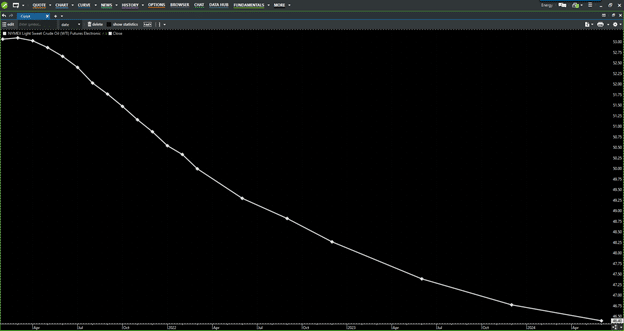
Figure 2: Nymex WTI crude futures forward curve shown via MarketView Desktop.

A trader can look at a chart like the one above and quickly tell you if the market is oversupplied or undersupplied – and will define the market structure as either backwardated or contango.

Do you now find yourself asking, “backward-what-now?”

Trust me when I say that I did not just make up those words. Stay tuned for part 2 – where we will dive into the difference between backwardation and contango and share the ways that forward curves can be utilized as a risk management tool for merchants executing complex commodity trades.

The great news for now: you don’t have to be a quant to build complex forward curves. Enverus CurveBuilder gives all people in a commodity trade floor – from storied traders to brand new market analysts – the power to build complex forward curves.


Picture of Laura Blewitt

Laura Blewitt

Subscribe to the Enverus Blog

A weekly update on the latest “no-fluff” insight and analysis of the energy industry.

Related Content

Enverus Intelligence® Research Press Release - Recap: How the Trump Administration is reshaping energy markets
Energy Market Wrap
ByEnverus

Diamondback boosts drilling efficiency, Chord scales four‑mile laterals, Expand Energy cuts Haynesville breakevens, Diversified buys East Texas assets, and Bay du Nord progresses.

Enverus Press Release - Enverus releases Investor Analytics: Refined, actionable financial insights at your fingertips
Energy Transition
ByThomas Mulvihill

This week’s ETT reviews PJM’s extension of its capacity market price collar through 2030 and new expedited interconnection track. While aimed at boosting new capacity, EIR finds the measures temporary as load forecasts remain more bullish than ours.

Carbon storage in question: Illinois regulation could threaten key CCUS projects
Business Automation
ByIan Elchitz

Artificial Intelligence (AI) has become a constant topic in enterprise software conversations. For finance and supply chain leaders in oil and gas companies, however, many of those conversations feel disconnected from reality. Promises are big, terminology is vague, and outcomes...

Enverus Intelligence® Research Press Release - Haynesville operators calculate remaining growth
Analyst Takes Trading and Risk
ByAl Salazar, Enverus Intelligence® Research (EIR) Contributor

Recent joint U.S.- Israeli military strikes in Iran and the ongoing geopolitical tensions in the region cast a significant shadow over global energy markets. As the world watches closely, the potential for regime change and the implications for oil and...

Enverus Press Release - Undo the queue: Enverus acquires Pearl Street Technologies to solve for a more reliable, resilient grid
Oilfield Services
ByAdriana Bickford

Oilfield service companies have seen this pattern before: a new growth opportunity emerges, capital flows and early movers reshape their business models. You’ve lived through the shale revolution, through consolidation waves, through efficiency cycles. Some pivots worked. Some didn’t. What makes this moment different is the structural shift in electricity demand. ...

Enverus Press Release - Class VI wave expected to hit US
Energy Market Wrap
ByEnverus

BP delivers strong 2025 results, Oxy boosts onshore efficiency, ConocoPhillips advances Surmont, Whistler sanctions Bay Runner, and Kinetik explores a potential sale.

Enverus Press Release - Heightened natural gas price volatility expected amid supply and demand challenges
Energy Transition
ByNoor Qureshi

The clean fuels story has turned a corner. EIR’s 2026 Clean Fuels Fundamentals finds an industry in recalibration: credit exposure, policy clarity and margin durability have replaced breakneck expansion as the sector's defining priorities.

Enverus Intelligence® Research Press Release - Canada’s Montney and Duverney: North America’s most abundant unconventional resource plays
Analyst Takes Trading and Risk
ByAl Salazar, Enverus Intelligence® Research (EIR) Contributor

Alberta's economy frequently grapples with the inherent volatility of oil prices, a challenge that can significantly impact provincial coffers and lead to substantial deficits.

U.S. oil and gas M&A slumps as low crude prices keep buyers in the dugout
Business Automation
ByIan Elchitz

Accounts Payable in oil and gas has never been more important. AP teams are under increasing pressure to reduce disputes, close faster, improve accuracy, and provide confidence in spend. Many organizations have invested heavily in AP automation and process improvement,...

Let’s get started!

We’ll follow up right away to show you a quick product tour.

Let’s get started!

We’ll follow up right away to show you a quick product tour.

Sign up for our Blog

Ready to Subscribe?

Ready to Get Started?

Ready to Subscribe?

Sign Up

Power Your Insights