
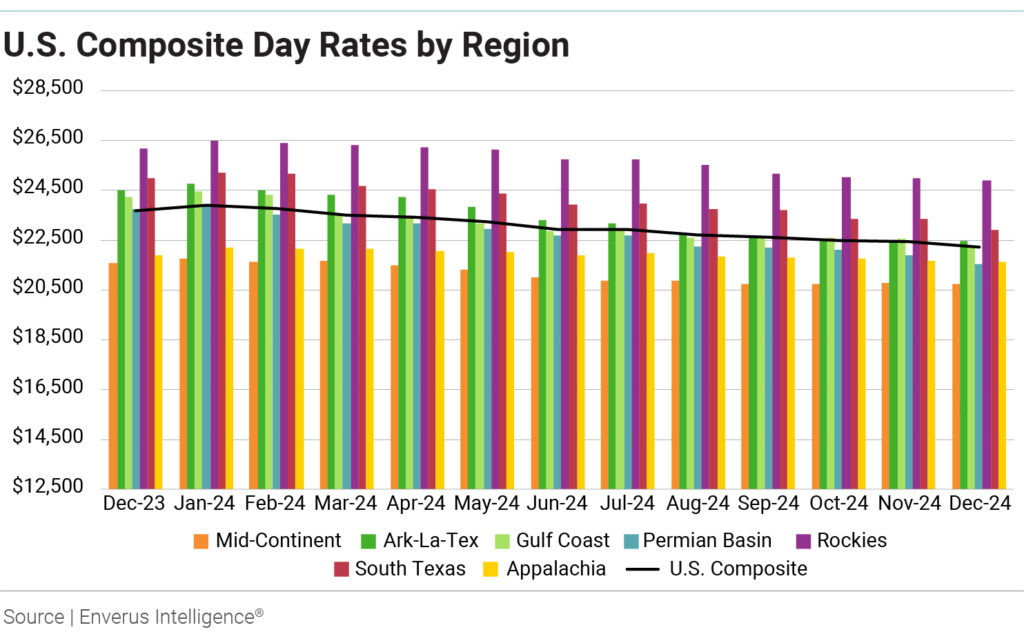
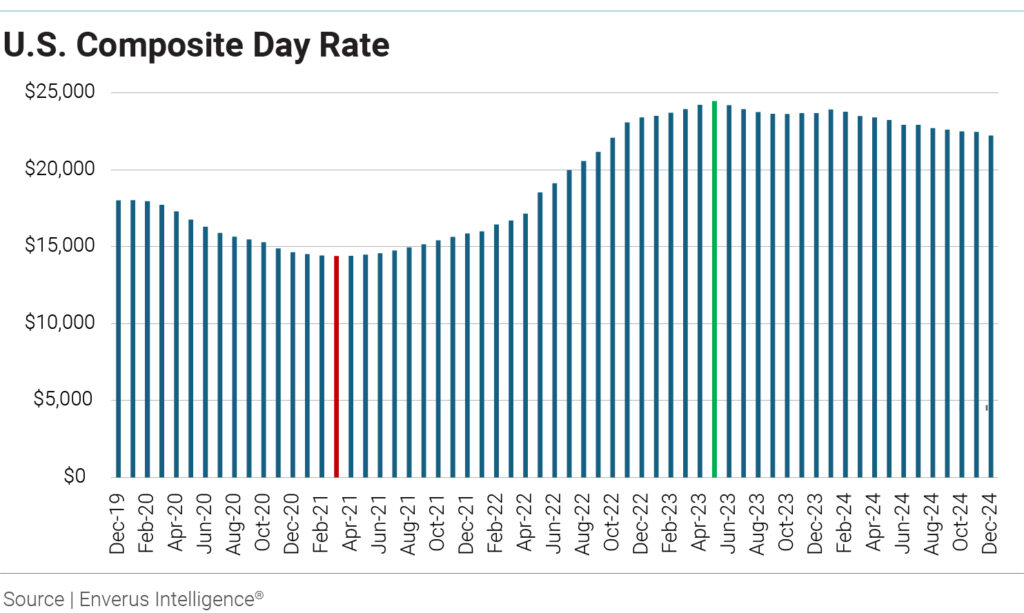
U.S. drilling day rates took a tumble in 2024, finishing the year lower than they began for the first time since the COVID-19 pandemic. The Enverus Day Rate Survey’s U.S. composite day rate declined for the 11th consecutive month to $22,220 in December, down $229 (1.02%) from November and $1,457 (6.19%) from December 2023. Most surveyed drillers are upbeat for 1H25, however, predicting stable leading-edge day rates under a new federal administration likely to ease drilling restrictions.
“We’re getting more phone calls to put more rigs into service than we were three months ago,” a Rockies driller told the survey team. More than 70% of survey participants predicted work volumes will grow during the next six months, with almost 60% reporting increasing bid inquiries.
Others are tempering their enthusiasm. Client feedback had one Gulf Coast driller telling the survey team, “It won’t be substantially better, but better.” Over the next six months, 65% of survey respondents expect no pricing changes. The remaining 35% were mixed on their outlook with some predicting increases and some decreases.
Some drillers told the survey team the price of WTI still needed to gain some altitude before a big push in new drilling programs can take place. The current futures curve has WTI in the low $70s through Q3, then dipping into the high $60s for Q4.
Enverus Intelligence® Research (EIR) is also skeptical of a strong rebound in U.S. activity, predicting in its 2025 Global Energy Outlook that the country’s crude production will only rise 120,000 bbl/d to a 2025 exit level of 13.5 MMbbl/d. The Permian is expected to add 230,000 bbl/d of production, offsetting declines elsewhere in the Lower 48 states. Haynesville production should rise in 2025 as Louisiana benefits from stronger LNG demand, EIR said.
Any progress would be welcomed after 2024, which struggled against numerous bearish factors. The Henry Hub gas spot price averaged $2.21/MMBtu last year, the lowest average annual price in inflation-adjusted dollars ever reported, according to the EIA. Drillers interviewed for the Enverus Day Rate Survey regularly cited Biden administration drilling restrictions throughout the year as causing low activity. In addition, the E&P landscape in the Permian Basin was transformed by historic acquisitions in late 2023 and early 2024.
The rig utilization rate ended December at 74.01%, the lowest of the year. “There is no wait time for just any rig, but a short wait time to engage a specific rig,” an Ark-La-Tex driller told the survey team.
All seven regions in the survey ended 2024 with sequential declines, some with a December thud. Three regions saw their composite drilling day rates fall $345 or more in the month, led by South Texas and its $475 (2.04%) drop to $22,877.
The Permian Basin had a brutal 2H24, falling $1,142, including $378 in December. The region was also the year’s biggest loser, falling $2,221—a 9.35% decline, almost a full percentage point more than any other region. “There is zero backlog and rigs are readily available,” one Permian driller told the survey team.
Permian day rates had a brutal 2H24, falling $1,142 as rigs moved there from gassy basins.
Other regions moved rigs to the oily Permian amid 2024’s natural gas doldrums, allowing them to rebalance at West Texas’ expense. While both the Gulf Coast and Ark-La-Tex lost more than the Permian in 1H24, they lost less than it during 2H24. The Gulf Coast roughly halved its decline from $1,373 (5.66%) in 1H24 to $650 (2.85%) in 2H24, while the Ark-La-Tex went from a $1,200 decline (4.90%) to an $855 drop (3.67%).
The pressures drillers faced last year are illustrated by Independence Contract Drilling, which filed for bankruptcy in December. ICD averaged 19.4 active rigs in 1H23, with nearly half of the contracted fleet in the Haynesville. As natural gas prices cratered, ICD moved rigs to the Permian, only to find underwhelming activity amid “customer consolidation, moderating and fluctuating oil prices, increased associated-gas takeaway constraints, continued fiscal discipline by E&P customers and increasing operating efficiencies,” CEO Anthony Gallegos said in the bankruptcy petition.
Consolidation left drillers sparring for fewer clients. The 15 largest E&P customers represented 62% of the industry’s operating rig count this November, compared with 43% at the start of 2023, Gallegos said. In that same span, the five largest contract drillers increased their share of the Top 15’s rig count to 84% from 80%, spurring “more intense” competition between ICD and other smaller contractors, he said. Three ICD rigs received notice of terminations in September after their clients’ merger closed, and ICD predicted it would average just 10.7 active rigs in 4Q24.
There were some silver linings in 2024 day rates’ dark cloud. For one, the ongoing current slide of $1,685 in 11 months has not been as relentless as the COVID-19 collapse when the U.S. composite fell $3,641 in 14 months. The U.S. composite rate hit bottom in March 2021 at $14,380—$7,840 below the December 2024 mark. During the pandemic drop, every region’s composite fell every month for 13 straight months; this go-round, every region has posted one or two sequential increases.
The best day rate performers in 2024 were Appalachia and the Mid-Continent. Appalachia’s composite rate fell just $279 (1.27%) to end the year at $21,609. The Mid-Con dipped $827 (3.83%) on the year to $20,754, and actually rose $12 in 4Q24, thanks to a $54 increase in November and miniscule declines the other two months.
To see the full results of the Enverus Day Rate Survey for July, check out the latest issue of Oilfield Pulse.
About Enverus Intelligence® Publications
Enverus Intelligence Publications presents the news as it happens with impactful, concise articles, cutting through the clutter to deliver timely perspectives and insights on various topics from writers who provide deep context to the energy sector.