As most insurers back away from fossil fuels, two giants dive in

byJoseph Gyure, Editor, Enverus Intelligence®

Insurance companies are largely backing away from making investments in fossil fuel producers. However, two major exceptions, Berkshire Hathaway and State Farm, have increased their holdings so much that they skewed the entire sector’s results, according to a report from the Wall Street Journal. More than half the 238 property-and-casualty insurers in the analysis reduced their investments in oil, gas and coal companies over the past decade, sending their median percentage down to 1.8% of insurers’ 2023 portfolios compared with 3.4% in 2014. By contrast, Berkshire Hathaway and State Farm increased their fossil fuel positions by around $200 billion in that period—so much that it pushed fossil fuels’ presence to 4.4% of the insurance industry’s cumulative portfolios from 3.8%.

For half of insurers, fossil fuels make up 1.8% or less of their portfolios.

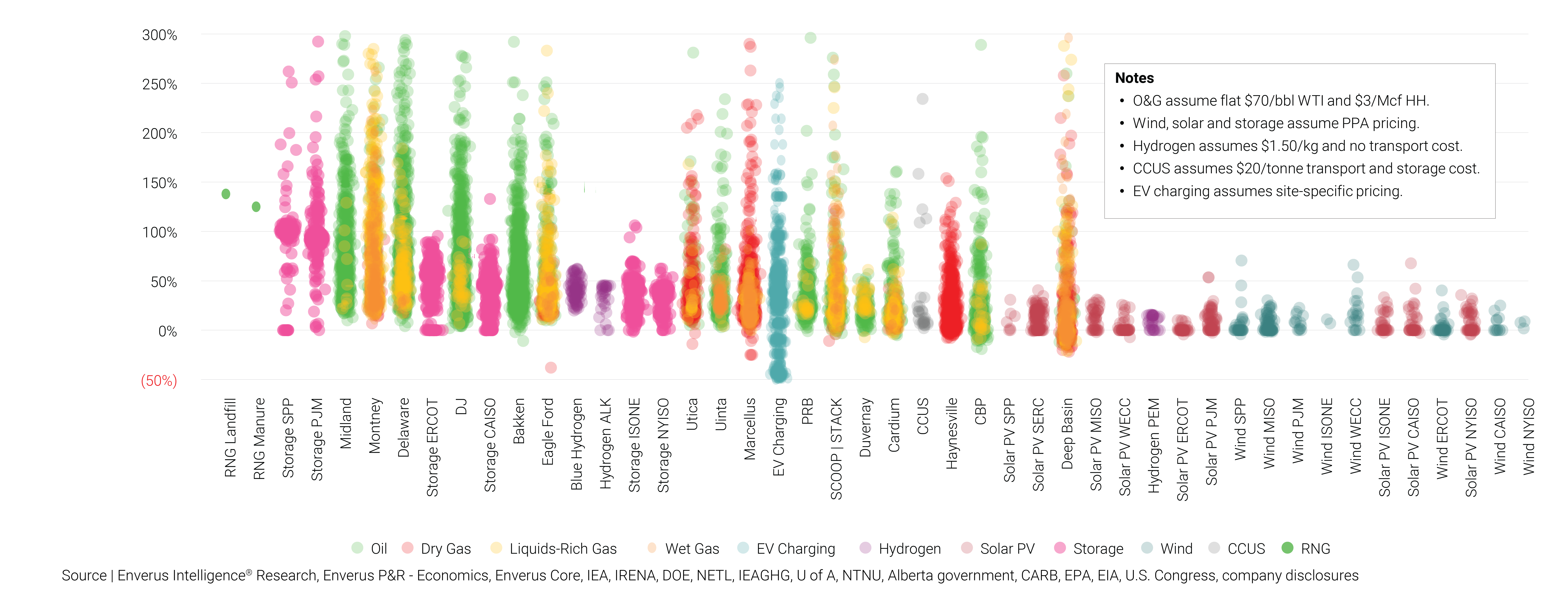
Climate change was cited as a reason most insurers reduced their fossil fuel holdings. Facing higher claims from wildfires and storms associated with a warming planet, some companies are questioning whether supporting fossil fuel companies is counterproductive. To reject fossil fuel companies, however, crosses off valuable investment opportunities in a sector that will be the core of the energy mix for the foreseeable future. An Enverus Intelligence® Research (EIR) analysis last December, available to EIR subscribers, found that oil and gas assets have stronger returns on average than renewables projects.
Berkshire Hathaway, the Warren Buffett-led company whose insurance arm includes not only namesake companies but also auto insurer Geico, owns stock in just two oil and gas companies, Occidental Petroleum and Chevron Corp., and it has invested heavily in both.

Berkshire is the leading shareholder in Oxy, owning 27.3% of its equity, a stake worth $16.1 billion at the end of Q2, according to SEC filings. It also is the third-largest institutional shareholder in Chevron, owning a 6.5% stake worth $18.6 billion at the end of H2. Combined, the two holdings make up 9.6% of Berkshire’s portfolio, the company reported.

State Farm holds nearly $4.8 billion in stocks and bonds of companies including Chevron, ExxonMobil and Diamondback Energy, according to the Wall Street Journal. State Farm owns less than 1% of those companies’ shares, unlike Berkshire’s large equity positions. However, Exxon makes up 3.0% and Chevron 1.7% of the equity portfolio of State Farm’s investment arm.

Property-and-casualty insurance companies collected a combined $930 billion in premiums in the U.S. during 2023, money that needs to be invested somewhere until they need to pay out claims. State Farm ranked as the largest such insurer by direct premiums in 2023 with $88 billion, while Berkshire was third with $58.1 billion.

Find more great news and exclusive data on deals, finance and operations in the E&P sector in the latest issue of Upstream Pulse.

About Enverus Intelligence Publications

Enverus Intelligence Publications presents the news as it happens with impactful, concise articles, cutting through the clutter to deliver timely perspectives and insights on various topics from writers who provide deep context to the energy sector.

Picture of Joseph Gyure, Editor, Enverus Intelligence®

Joseph Gyure, Editor, Enverus Intelligence®

Joseph Gyure has covered midstream and oilfield services since 2017 and joined Enverus from PLS. He previously worked at ICIS, the Houston Chronicle, and the Waco Tribune-Herald. Joseph is a graduate of the University of Texas at Austin.

Subscribe to the Enverus Blog

A weekly update on the latest “no-fluff” insight and analysis of the energy industry.

Related Content
power-grid-congestion
Post
Power Trading, Utilities
ByEnverus

Based on the Enverus Winter Power Market Outlook webinar for ERCOT and SPP, presented by Adam Jordan, Director of Power Analytics. ERCOT has produced only 15 to 30 hours above 60 GW of net load in each of the last...

Enverus releases Top 50 Public E&P Operators of 2025
Post
Operators
ByRyan Hill

Operators are testing overlooked Osborn and Cherokee zones in Oklahoma as core inventory thins. See what Enverus data shows about remaining inventory.

Time-to-power gap Big generation’s Achilles’ heel in the AI data center race
Post
Power & Renewables, Power Trading
ByEnverus

PJM has 113.6 GW of announced large-load capacity, far more than the 28.5 GW under construction. See what the gap means for reliability and planning.

U.S. natural gas prices face power demand drag
Post
Power & Renewables, Power Trading
ByEnverus

ERCOT data shows large loads ramping at different rates as solar and battery additions keep pace, with new supply expected to slow in 2027.

Global energy markets brace for supply shock and further price gains
Post
Trading & Risk
ByAl Salazar, Enverus Intelligence® Research (EIR) Contributor

Bank of Canada energy inflation risks stagflation as oil spikes push headline inflation higher ahead of a pivotal rate decision.

Enverus Press Release - Speed through records with Enverus Instant Analyst™ - Courthouse
Post
Financial Services
ByColton Wright

Where will future oil inventory come from? Explore the Barnett-Woodford estimate and the spacing and cost assumptions investors should test.

Enverus Press Release - E&Ps with natural gas + CCS pave way for model data center development
Post
Analyst Takes
ByTom Liskey

Read Part 2: Guyana Oil and the Venezuela-Essequibo Dispute The ICJ Will Rule. Governments Will Change. Why Essequibo Still Matters.  Oil companies are accustomed to thinking in decades.  Governments rarely operate on the same timetable.  The Essequibo dispute demonstrates what...

minerals-management
Post
Minerals
ByTemi Oyetayo

Explore our reliable well log library for standardized logs, depth-registered rasters, and workstation-ready LAS files—start your subsurface analysis faster.

Enverus Press Release - Prioritizing renewable PPA offtaker targets proves more challenging than expected
Post
Power & Renewables
ByThomas Popa

Senate’s bipartisan permitting bill data centers grid interconnection could curb speculative queues and speed transmission buildout.

Let’s get started!

We’ll follow up right away to show you a quick product tour.

Let’s get started!

We’ll follow up right away to show you a quick product tour.

Sign up for our Blog

Ready to Subscribe?

Ready to Get Started?