
Calgary, Alberta (July 14, 2022) — Enverus Intelligence Research (EIR), a subsidiary of Enverus, the leading energy data analytics and SaaS technology company, is releasing its summary of 2Q22 upstream M&A. Overall, Q2 was a challenging quarter for negotiating deals as volatility roiled both commodity and equity markets. Despite that, about $12 billion was transacted in upstream M&A as numerous private equity (PE) firms brought their investments to market looking to cash in on high oil and gas prices; PE sellers accounted for about 80% of the quarter’s deal value.
“As anticipated, the spike in commodity prices that followed Russia’s invasion of Ukraine temporarily stalled M&A as buyers and sellers disagreed on the value of assets,” said Andrew Dittmar, director at Enverus Intelligence Research. “High prices, though, also encouraged a rush by PE firms to test the waters for M&A. While not everyone that is going into the market is getting what they deem to be a suitable offer, enough are to drive modestly active upstream M&A.”
U.S. Deal Value by Region Last 12 Quarters
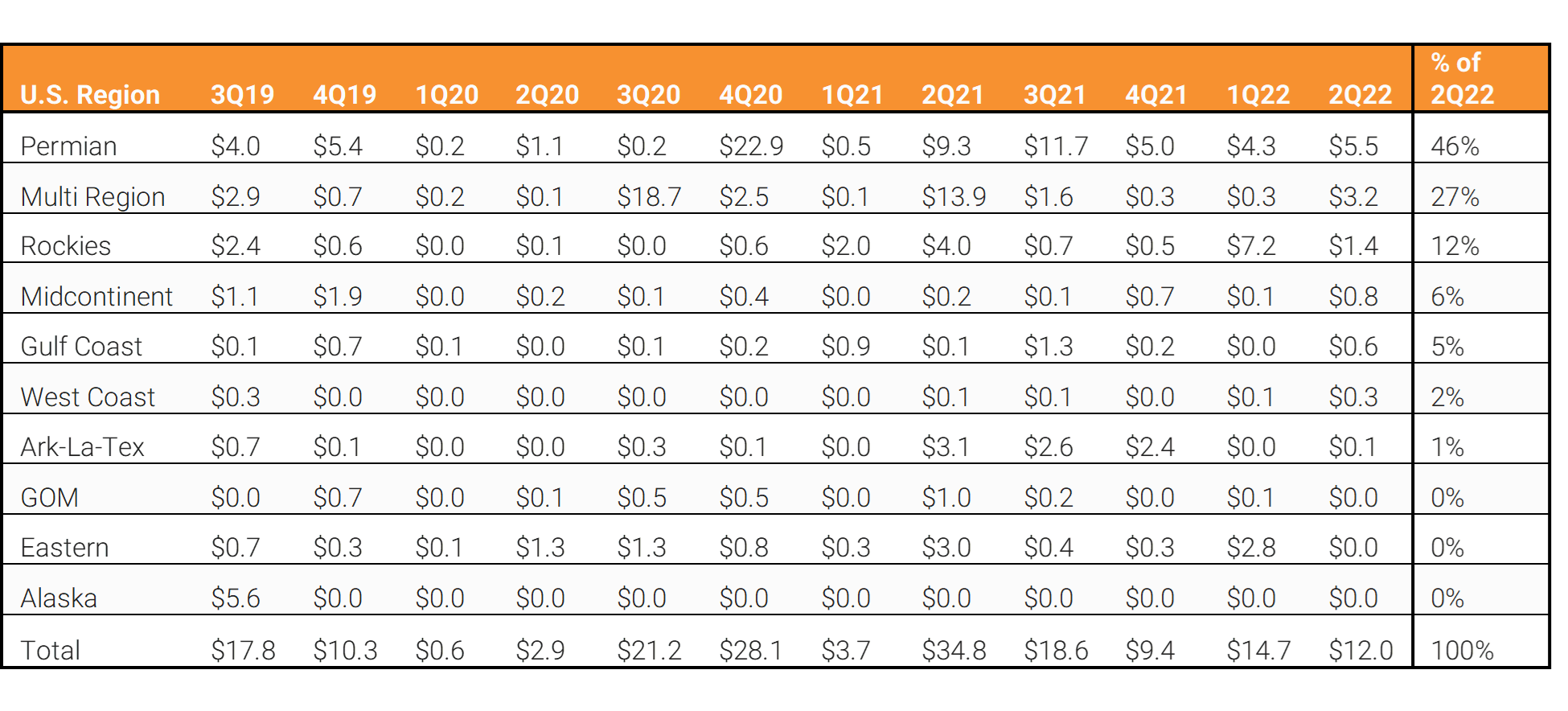
The Permian Basin was the largest contributing play to deal value, and it remains the main engine of Lower 48 M&A. About one-third of the quarter’s total deal value came from a merger of equals between private Colgate Energy Partners III, which is focused on the Delaware Basin part of the Permian, and public Centennial Resource Development. For the bigger private operators like Colgate, a merger with a similarly sized public counterpart can be an attractive move as it achieves larger scale and a public listing at the same time.
Looking beyond the Permian, large multi-region deals for non-operated interests contributed a substantial part of Q2 M&A value. One of these was an agreement between Grey Rock Energy Partners and Paul Ryan-affiliated Executive Network Partnering Corp to form Granite Ridge Resources. The $1.3 billion combination formed a new public non-operated working interest owner with further consolidation plans. It also showed how special purpose acquisition companies or SPACs can be used to circumvent the challenges of IPO markets.
“Public equity markets are retaining a multi-year trend of being essentially closed for private E&Ps to launch a traditional IPO,” added Dittmar. “That leaves M&A as the main exit route. There is appetite on the public company side to buy out private E&Ps, but public companies need to keep the valuation paid on these deals in line or less than where the market is pricing their own stock. With E&P equity valuations still modest, in many cases there may not be much room to raise offer prices.”
The disconnect in perceived value between buyers and sellers is affecting both producing assets and undeveloped future inventory. Historically, existing production was a bit more straight forward to value, but at current commodity prices buyers want to bake downside protection into their offers. Untapped inventory is even more challenging to estimate value on, and right now buyers are only willing to pay for high-quality locations in well-established areas.
One way for public companies to get more deals done is to increase the use of relatively cheap debt financing in M&A. In recent weeks, there has been an uptick in the use of debt to pay for deals. By using debt, companies can drive accretion to their key shareholder return metrics, and the additional cash flow from the new assets can also be used to pay down the loans and keep leverage in check. Provided banks continue to be willing to lend and E&Ps willing to borrow, this has the potential to fuel further deals.
“Looking forward I don’t think we will see any shortage of assets available for sale by private equity firms across every major shale play,” concluded Dittmar. “The challenge is finding buyers willing to pay their asking prices. Public E&Ps remain chiefly concerned with getting capital back to shareholders and being too aggressive on M&A can smack of growth investors don’t want. That said, the flood of offerings should create opportunities for shrewd deal makers to unlock value with M&A and, if we avoid a major recession, the fundamentals for energy prices still look strong.”
Members of the media can contact Jon Haubert to request a media version of the full report or to schedule an interview with one of Enverus’ expert analysts.
About Enverus
Enverus is the leading energy SaaS company delivering highly-technical insights and predictive/prescriptive analytics that empower customers to make decisions that increase profit. Enverus’ innovative technologies drive production and investment strategies, enable best practices for energy and commodity trading and risk management, and reduce costs through automated processes across critical business functions. Enverus is a strategic partner to more than 6,000 customers in 50 countries. Learn more at Enverus.com.
About Enverus Intelligence Research
Enverus Intelligence Research, Inc. is a subsidiary of Enverus and publishes energy-sector research that focuses on the oil and natural gas industries and broader energy topics including publicly traded and privately held oil, gas, midstream and other energy industry companies, basin studies (including characteristics, activity, infrastructure, etc.), commodity pricing forecasts, global macroeconomics and geopolitical matters.