
Enverus connects the physical drivers behind every price move directly to your dispatch, hedging, and optimization decisions, so your teams know why a constraint is binding, not just that it is. Load forecasts proven to outperform ISO benchmarks mean fewer surprises for your fleet and your ratepayers, and answers that hold up when regulators ask why.

2,100+
Generators
Monitored in real time
33k+
Power
Constraints monitored
25+
Years
Of forecasting that outperforms the ISOs
Load, renewables, outages, and dispatch behavior feed into a clear picture of why prices moved, which constraint bound, and how it’s likely to resolve, without waiting for lagging ISO data. That same intelligence extends forward into the scenario analysis your FTR and asset teams need to plan ahead. The decisions built on it carry consequences for your fleet and your ratepayers, and they’re built to hold up under regulatory scrutiny.
Enverus load and renewable forecasts are proven to outperform ISO benchmarks under the stress conditions that drive the costliest exposure. Built on 25+ years of power market experience, they hold when weather turns and demand spikes, giving your team a stable foundation for hedging and dispatch decisions when it matters most.

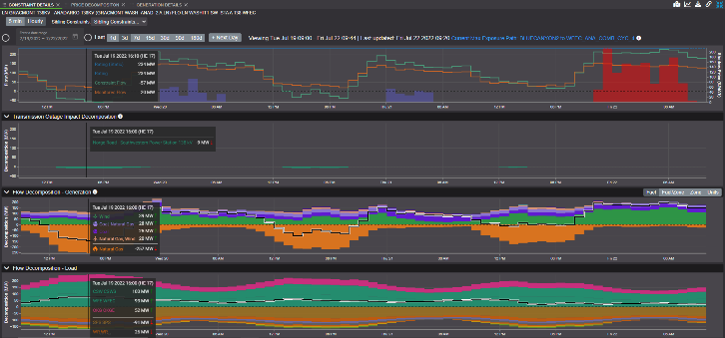
Enverus decomposes congestion into its physical drivers like load, renewables, outages, and dispatch, in real time, at the node. Most organizations are flying without that view. Your trading and asset optimization teams see exactly what’s moving a constraint and how it’s likely to resolve, so decisions are grounded in what’s actually driving the market, not what happened after the fact.
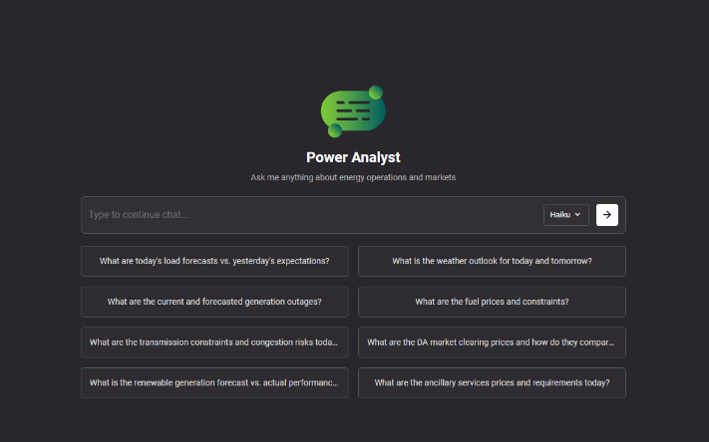
Enverus AI delivers structured, data-grounded answers in minutes by automating the integration of ISO data, forecasts, and grid models your team would otherwise stitch together manually. Your analysts spend less time on data preparation and more time on the decisions that affect your fleet and your ratepayers.
Nodal-level forecasts, real-time congestion intelligence, and scenario analysis connect directly to asset-level decisions across different fuel types, on one consistent foundation instead of a patchwork of tools per asset class. Every dispatch decision and bid protects margin and keeps costs defensible for the ratepayers who ultimately pay for it.
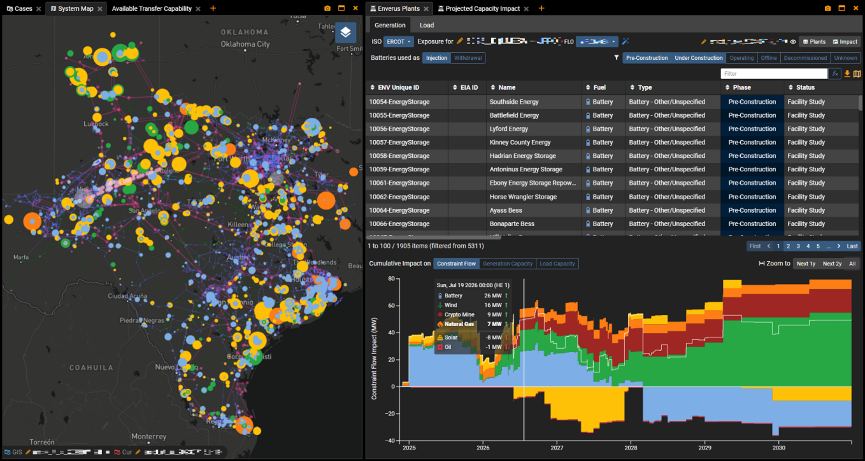

The biggest thing is the improved context. You get both the big-picture context and more analytical depth. Raw data — there's plenty of places to get that — but contextualized data, like where the data centers are coming, what gas pipelines and power pipelines are nearby, lets you see the full 360-degree view of the energy market.

Former Senior Director of Derivatives Trading, Vistra Corp

VP Power Trading
1
Real-Time and Day-Ahead Traders
2
Head of Asset Optimization
3
When your team sees why the grid moves before the market does, every hedging, dispatch, and optimization decision across your organization gets stronger. Enverus gives your teams a consistent, defensible intelligence foundation that reduces costly surprises and protects what you’ve committed to deliver.

Real-time congestion decomposition and forecasts proven to outperform ISO benchmarks mean higher conviction on every position, every interval.

When dispatch and bidding decisions are grounded in real-time grid behavior, your fleet captures value it would otherwise leave on the table. Enverus connects nodal-level forecasts and congestion intelligence directly to every asset decision your team makes.

Scenario-based forecasts that look 20 years into the future. Confidently plan around evolving grid dynamics, identify profitable opportunities and support strategic decisions with the most trusted long-term view in power.
Automates grid modeling and interconnection studies end-to-end, reducing engineering analysis time by up to 200x. Integrates with industry-standard power flow modeling tools.
Automates substation, transmission, and distribution design with connected BOM generation. Cuts design cycle times by up to 90%. Built on AutoCAD and Revit.
Automates site analysis, layout design, and substation engineering for utility-scale solar and storage. Cuts design time by up to 90% and lowers LCOE by 5%.
Advanced grid insights with accurate load forecasts and extensive monitoring enhance trade execution and profitability.
Ask power market questions in plain language and get expert-level answers in minutes. Grounded in your Mosaic and Panorama data, it retrieves the right data automatically and explains what it means for your positions.
Comprehensive coverage of power markets and insights into emerging energy technologies and project economics.
Forward-looking grid simulations built into Panorama. Model congestion, nodal pricing, and transmission constraints under realistic future grid conditions, with no separate modeling platform required.

Senate’s bipartisan permitting bill data centers grid interconnection could curb speculative queues and speed transmission buildout.

Validate data center natural gas supply: check pipeline capacity, contracts, routing, and long‑term durability before you commit.

See how Enverus called ERCOT's August 2026 coincident peak a day early and pinpointed the exact peak hour, beating ERCOT's own load forecast accuracy.
Learn how utilities, hyperscalers, and developers can score assets, align stakeholders, and structure power agreements that close faster and withstand scrutiny.

Learn how utilities, hyperscalers, and developers can score assets, align stakeholders, and structure power agreements that close faster and withstand scrutiny.
MISO hit its $10,000/MWh cap on Sept. 2 as evening load surged, solar output collapsed, and imports weakened, triggering an EEA2 alert.
Let’s get started!
Let’s get started!
We’ll follow up right away to show you a quick product tour.
Ready to Subscribe?
Ready to Get Started?