
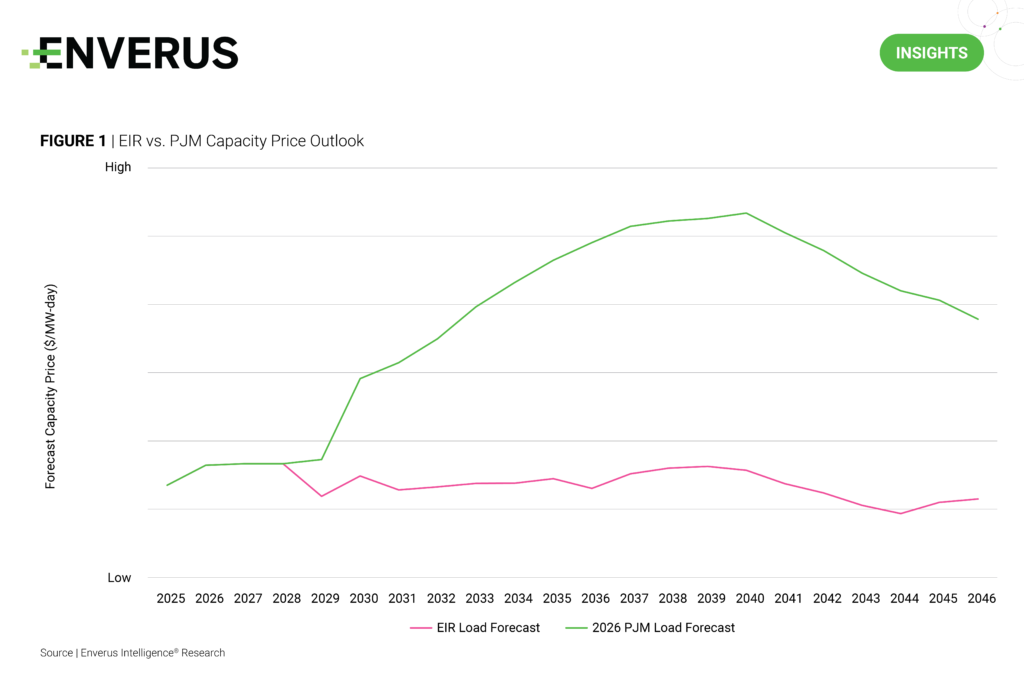
Building on a recent downward revision to its load forecast, PJM capacity market is now extending the price collar. Originally scheduled to expire in 2028, the collar remains between $175/MW and $325/MW but will stay in place until 2030. With the extension, PJM hopes to continue incentivizing new capacity to come online, as the ISO continues to forecast high load growth.
In addition to the extension, PJM implemented Expedited Interconnect Track Procedures, offering a new pathway for shovel-ready requests to come online. The process sunsets at the close of 2027 and allows for up to 10 projects of at least 250 MW to be considered. Enverus Intelligence® Research (EIR) considers these policies good temporary solutions, but not robust enough to solve long-term supply-demand mismatches.
While the measures favor new capacity additions, PJM’s load forecast still calls for an unprecedented 11 GW of new capacity post-2030 to address demand. EIR’s outlook indicates a more moderate path, our estimate of 6 GW of new capacity after 2030 is about half of the ISO’s projection (Figure 1). Until long-term load forecasts align with realized demand and substantial new capacity comes online, such policies will not ensure reliability, and the price collar and short-term queue measures will persist.
This blog offers just a glimpse of the powerful analysis Energy Transition Research delivers on the trending themes. Don’t miss the full picture.
Research Highlights:
- CO2-EOR – Path to Profitable Carbon Storage – Using anthropogenic carbon dioxide in place of natural supply allows 45Q credits to transform CO2 from a sunk operating cost into a source of revenue for permanently stored volumes. This report leverages EIR’s CO2-EOR cost model to analyze how converting an existing operation from natural to anthropogenic CO2 impacts financial returns.
- Clean Fuels Fundamentals – Discipline Over Hype – The 2026 Clean Fuels Fundamentals analyzes how evolving policy frameworks, investment shifts and feedstock dynamics are shaping today’s clean fuels landscape. We review updates across major federal and global programs, trends in pathway selection and CCS integration and how producers are approaching transportation and export markets.
- IPP NAV Compass – Underappreciated PPA Upside – We examine the relative value of public independent power producers based on our latest NAV analyses and how this impacts long and short trading strategies.
DID YOU KNOW?
PJM failed to meet its reserve margin target by about 5 percentage points in the latest round of the capacity market auction.
Key Takeaways
Why is the PJM capacity market extending its price collar?
PJM extended the $175–$325/MW price collar through 2030 to maintain investment incentives as it continues to forecast strong load growth. The move supports near-term reliability but doesn’t solve long-term supply challenges.
What is the Expedited Interconnect Track in the PJM capacity market?
It’s a temporary process allowing up to 10 large (250+ MW) shovel-ready projects to fast-track interconnection through 2027, helping bring new capacity online faster.
Do these changes fix PJM’s long-term capacity needs?
Not fully. PJM projects 11 GW of new capacity post-2030, while EIR estimates about 6 GW. Short-term reforms may persist until demand and new supply better align.
About Enverus Intelligence® | Research
Enverus Intelligence® | Research, Inc. (EIR) is a subsidiary of Enverus that publishes energy-sector research focused on the oil, natural gas, power and renewable industries. EIR publishes reports including asset and company valuations, resource assessments, technical evaluations, and macro-economic forecasts and helps make intelligent connections for energy industry participants, service companies, and capital providers worldwide. See additional disclosures here.