
Blog Topics International

Offshore Drilling Keeps Getting Deeper

byDai Jones

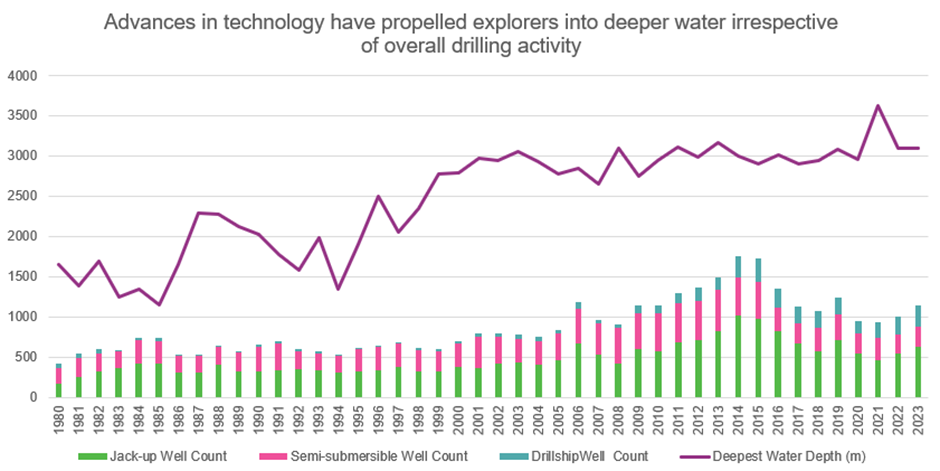
In 2024, we expect a new world record water depth to be set for an oil and gas well when Occidental drills the Komodo-1 NFW in the Caribbean Sea offshore Colombia, potentially breaking the 4,000m mark. The current record is held by the Ondjaba 1 well, which was drilled by TotalEnergies using the Maersk Drilling “Maersk Voyager” drillship offshore Angola, reaching 3,628m in 2021.

The advancement of offshore drilling technology has enabled E&P companies to consistently push into ever deeper frontier acreage since the first deepwater wells were drilled in more than 200m of water in the 1970s. By the 1980s, exploration had started to push into ultra-deep waters below 1,500m.
advances-in-technology

Jack-up rigs, first built in the 1950s, resembled the earlier drilling barges still used today. They floated into location in shallow water deltas, swamps and lakes. However, being fixed to the seabed on extendable legs, they provided a stable platform able to operate in rougher waters offshore. Jack-ups quickly opened up oil and gas plays on the world’s continental shelves in water depths up to around 200m and have remained the dominant rig types in the global fleet ever since.

Semi-submersible rigs first appeared in the 1960s and began to push beyond the jack-ups’ limitations, restricted as they were by the length of their legs. Floating into position, the semi would be partially submerged for stability and then anchored to the seabed. This allowed drilling into deeper waters, but the need to anchor the rig for stability continued to limit water depth.

By the 1970s, dynamic positioning systems using satellite data and thrusters meant semi-submersibles and new drillships no longer needed fixed moorings and could operate in the deep waters beyond the continental shelf. Over time, other technological advancements, including enhanced drilling systems, well control and real-time  data monitoring, have pushed water depth limits beyond 3,000m. The proportion of wells drilled in deep and ultra-deep water by dynamically positioned rigs has been steadily increasing.

While the technology exists to support it, the trend toward ever deeper drilling shows no sign of stopping. With increasing global energy demand and a need for national energy security in a world of uncertain geopolitics, many countries are looking toward their deep waters for a solution. Supermajor E&P companies are increasing exploration budgets for spending on deepwater projects led by hotspots around the Atlantic Margin driven by recent success in countries such as Brazil, Guyana, Namibia and Cote d’Ivoire.

The Enverus Global Offshore Rig Tracker provides the most accurate weekly insight into the activity of the 800+ mobile rigs making up the worldwide drilling fleet. Up to date rig locations are supplemented with details on drilling contractor, current E&P operator and future contracts plus current activity linked to the Enverus well, block and field attributes. 

Picture of Dai Jones

Dai Jones

Dai joined the Enverus team as one of the founding members of DI International in 2009 and has been responsible for building the global scouting data content and teams. Prior to joining Enverus he worked for over 10 years with IHS Energy in scouting data and management positions. His career began with Baker Hughes in wellsite mudlogging and wellbore surveying operations across Europe, Africa and Asia. He graduated from Plymouth University with a BSc (Hons) in Applied Geology in 1990.

Subscribe to the Enverus Blog

A weekly update on the latest “no-fluff” insight and analysis of the energy industry.

Related Content

Enverus Intelligence® Research Press Release - Recap: How the Trump Administration is reshaping energy markets
Blog Topics Operators
ByEnverus

In today’s upstream operations, pricing is rarely as simple as a fixed rate. Market volatility, supply constraints, labor dynamics, and regional variations make it increasingly difficult to manage service and material costs through static contracts. Most operators already acknowledge this...

Enverus Intelligence® Research Press Release -
Energy Market Wrap
ByEnverus

This week’s energy headlines were shaped by a landmark Haynesville acquisition, early stage shale consolidation talks, expanding refined products connectivity to the West Coast, a major commercial reset in the Permian and new momentum for Gulf Coast LNG.

Enverus Intelligence® Research Press Release - Waha prices expected to go negative (again)
Business Automation Operators
ByEnverus

Discover the overlooked vulnerabilities in owner data workflows—from ACH updates to revenue distribution—and learn how layered identity verification and proven security at scale help upstream operators protect owners, prevent fraud, and maintain audit‑ready controls.

Enverus Intelligence® Research Press Release - The data center decade has arrived
Power and Renewables
ByEnverus

In mid-December 2025, a powerful winter storm accompanied by an Arctic cold outbreak affected much of the central and eastern United States between December 13–15. A strong surge of frigid air spread southward from Canada, producing widespread below-zero temperatures (°F)...

Enverus and Pexapark Press Release - Enverus Enhances Global Trading & Risk Platform with Pexapark’s Benchmark Renewables Pricing and Market Intelligence
Energy Transition
ByBrynna Foley, Enverus Intelligence® Research

Vistra (VST) is wasting no time in 2026, positioning itself as a highly viable solution to the grid’s "reliability gap." By acquiring 5.5 GW of dispatchable gas assets via a $4.7B Cogentrix deal, VST has secured its spot in constrained...

Enverus Press Release - Price forecast downgraded in latest Fundamental Edge report
Minerals
ByTemi Oyetayo

Learn how mineral valuation empowers smarter decisions. Understand key factors like pricing, production, geology & operator health before selling your minerals.

midstream-octg-thumbnail
Energy Transition
ByCarson Kearl, Enverus Intelligence® Research (EIR) Contributor

Aerospace-energy crossover Boom Technology, Inc. (trade name Boom Supersonic) is making waves beyond aviation with a recent deal to supply 29 Superpower 42 MW natural gas turbines, derived from its Symphony supersonic jet engine, to Crusoe. The AI infrastructure provider...

Breaking news alert on the impact on oil prices due to Israel attacking Iran
Blog Topics News Release
ByEnverus

Gain forward‑looking insights from Enverus’ 2026 Global Energy Outlook, including forecasts for oil and gas prices, rising U.S. supply, evolving power‑grid demands and selective low‑carbon investment trends. This concise analysis highlights key market drivers shaping reliability, capital allocation and energy...

Enverus Press Release - Looking past the CCUS power plant pipe dream
Analyst Takes Trading and Risk
ByAl Salazar, Enverus Intelligence® Research (EIR) Contributor

Unpack the Venezuela oil impact on Canadian energy as we analyze market shifts and the resilience of Canada's energy sector amid global changes.

Let’s get started!

We’ll follow up right away to show you a quick product tour.

Let’s get started!

We’ll follow up right away to show you a quick product tour.

Sign up for our Blog

Ready to Get Started?

Ready to Subscribe?

Register Today

Sign Up

Power Your Insights

Connect with an Expert

Access Product Tour

Speak to an Expert