
Unlock real-time, actionable energy insights. This blog offers just a glimpse of the powerful analysis Energy Transition delivers on today’s markets. Don’t miss the full picture. Click here to learn more.
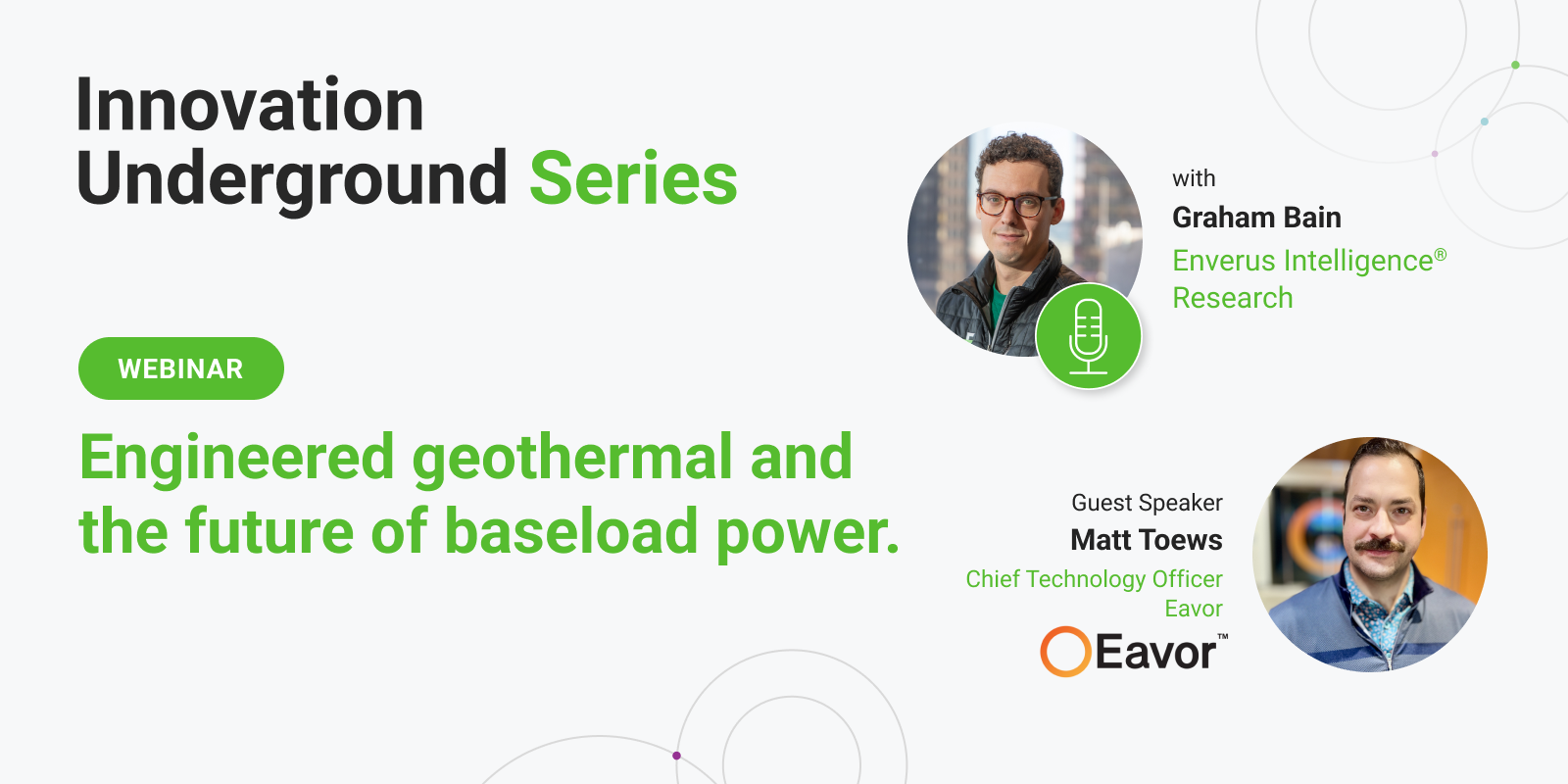
The future energy mix demands a power source that is not only scalable and low-carbon but also capable of providing true baseload, around-the-clock energy. Advanced Geothermal Systems (AGS), particularly closed-loop technology, are emerging as a compelling solution to this critical need. As the lead of the Subsurface Innovation team here at Enverus Intelligence® Research, I’ve had the privilege of exploring these advancements, including a recent conversation with Matt Toews, Chief Technical Officer at Eavor. This discussion highlighted how innovative approaches are solving the reliability puzzle and shaping the next wave of energy. Join me as we delve into the transformative potential of closed-loop geothermal and its implications for a sustainable future.
From Oil Sands to Subsurface Heat: A Transferable Expertise
The transition from traditional oil and gas to renewable energy often sparks curiosity about transferable skills, and Matt Toews’ journey is a prime example. With seven years as a reservoir engineer in the Canadian oil sands, focusing on SAGD (Steam-Assisted Gravity Drainage) operations, Matt pivoted to co-found Eavor. He emphasizes the striking parallels between SAGD and Eavor’s closed-loop geothermal approach, noting that 90% of Eavor’s staff come from oil and gas backgrounds. Both fields operate with a “resource plate” mindset, where the resource location is known, shifting the focus from exploration to deploying technology, engineering, and manufacturing to drive down costs through scale and improved operations. While SAGD injects heat into the ground, Eavor’s system extracts it, leveraging similar technical skill sets in thermal well design, long wells, thermal facilities and thermodynamic modeling.
The Eavor-Loop Advantage: Predictability and Scalability
Eavor’s closed-loop system, known as Eavor-Loop, is essentially a subsurface heat exchanger, a radiator underground that collects heat through thermal conduction from a volume of rock. Water, with specific additives, circulates through the system, passively picking up heat for use in district heating, electricity generation, or other applications. This approach aims to create a reliable, predictable, and manufactured product, much like a solar panel. A key differentiator is its ability to eliminate geological uncertainty, as it doesn’t rely on specific geological formations or a permeable reservoir. Once built, the system is designed to be highly predictable and reliable over decades, offering significant benefits such as minimal water use or loss, no fracking and no induced seismicity, which are crucial for broader stakeholder acceptance.

Germany’s Geothermal Breakthrough: A Commercial Milestone
Eavor recently achieved a significant milestone with its Geretsried project in Germany, where the first loop came online in December, generating both heat and electricity. This project was conceived as a first-of-its-kind commercial-scale demonstration, proving economic viability in Europe’s district heating market. While the journey presented considerable operational, technical, and financing challenges, Eavor successfully navigated them. Building on insights from their Eavor-Lite pilot in Alberta, which has operated for five years with less than a 1% difference between predicted and actual output, the Geretsried project goes deeper at 4.5 kilometers, featuring 3000-meter lateral lengths. It utilizes six inlet and six outlet multilaterals that intersect at the toe using magnetic ranging while drilling, a world-first technology. This advanced drilling technique has dramatically improved efficiency, reducing the time to drill the most recent legs from 100 days to as little as 8 days, a tenfold reduction that directly impacts project costs.
Operational Efficiency and Societal Impact
A notable advantage of Eavor’s closed-loop system is its exceptionally low opex. Eavor projects typically see 80-90% capex and only 10-20% opex, a stark contrast to traditional hydrothermal or EGS projects (50/50) or natural gas power plants (10% capex, 90% opex). This efficiency stems from eliminating common cost categories such as injector well redrills, large downhole pumps, and extensive water treatment, thanks to the controlled, closed-loop water chemistry. Furthermore, the system addresses public perception concerns by minimizing water loss, as low as 0.1% of daily throughput, significantly lower than open systems, and avoiding induced seismicity risks. This mitigation of environmental impacts is particularly important in densely populated European regions, where district heating, a market valued at over $40 billion annually, offers a substantial opportunity to replace coal or natural gas-fired centralized boilers.
Powering the Future: AI, Deep Drilling, and the Geothermal Holy Grail
The demand for reliable, carbon-free power is escalating, particularly from sectors like AI and data centers, with Microsoft already an investor in Eavor. While current closed-loop geothermal technology may not make a significant dent in the immediate three-year power demand, it is poised to be a major player in the 2030 timeframe. Eavor’s technology development program focuses on going deeper and hotter, with a clear line of sight to deliver electricity at competitive prices, below $100 per megawatt-hour, even in average geothermal gradients. The modular nature of Eavor’s system, allowing for scaling in smaller, manageable chunks, offers a distinct advantage over mega-projects like nuclear power plants, which often face capital overruns. The company is actively designing a drilling system capable of reaching 15 kilometers in depth, pushing the boundaries of what’s currently achievable and leveraging innovations like insulated drill pipe for active cooling in extreme temperatures. This pursuit of the “geothermal anywhere” vision represents a significant step towards a truly sustainable and dispatchable energy future.
Conclusion
The journey from oil sands expertise to pioneering advanced geothermal systems demonstrates a powerful convergence of innovation and necessity. Eavor’s closed-loop technology offers a reliable, predictable and environmentally conscious solution to the global demand for baseload, low-carbon energy. By addressing key challenges in cost, scalability and public acceptance, companies like Eavor are redefining geothermal’s potential. The path forward involves continued execution, technological refinement and strategic partnerships, but the clear line of sight to affordable, dispatchable power anywhere in the world paints an optimistic picture for geothermal’s role in our energy future.
Key Takeaways
What is the core innovation of Eavor’s closed-loop geothermal system?
Eavor’s system acts as a subsurface heat exchanger, extracting heat via conduction without requiring a permeable reservoir or significant water use, making it predictable and scalable.
How does Eavor address the challenge of high operational costs in geothermal?
By eliminating the need for injector well redrills, downhole pumps and extensive water treatment, Eavor significantly reduces operational expenditures, making its projects 80-90% capital-intensive upfront.
What is Eavor’s long-term vision for geothermal energy?
Eavor aims to deliver low-cost electricity (below $100/MWh) from geothermal anywhere in the world by developing technology to drill deeper and hotter, eventually reaching depths of 15 kilometers.
DID YOU KNOW?
This blog is just a preview of the insights from Graham Bain’s Innovation Underground. Explore the full series to see what’s shaping today’s energy markets.
About Enverus Intelligence® | Research, Inc. (EIR)
Enverus Intelligence® | Research, Inc. (EIR) is a subsidiary of Enverus that publishes energy-sector research focused on the oil, natural gas, power and renewable industries. EIR publishes reports including asset and company valuations, resource assessments, technical evaluations, and macroeconomic forecasts and helps make intelligent connections for energy industry participants, service companies, and capital providers worldwide. See additional disclosures here.