
Energy Analytics

Attacking Methane Emissions Beyond Oil and Gas

byMark Nibbelink

A recent Associated Press article titled “Biden’s climate plan aims to reduce methane emissions” states, “The centerpiece of U.S. actions is a long-awaited rule from the Environmental Protection Agency to tighten methane regulations for the oil and gas sector.”

It also says, “The oil and natural gas industry is the nation’s largest industrial source of methane.”

The logic seems straightforward, that drilling for hydrocarbons produces methane, the infrastructure for moving that product stream around the country will naturally have less than perfect containment, ergo, regulate.

In 2020, the U.S. produced 8,288,717 metric tons of methane. The sum of all the categories in Enverus’ greenhouse gas data set that represent both upstream oil and gas and midstream — production, pipelines, compression gathering and boosting, for example — accounts for about 37% of total 2020 methane. That’s a significant source of methane, to be sure, and one that operators in oil and gas must work harder to minimize.

But the data show underground coal mines are responsible for nearly 14% of methane production in the U.S., and municipal landfills account for nearly 41% of our methane emissions footprint. Together, coal and landfills are responsible for 55% of our methane problem, and are a bigger source of methane pollution than oil and gas.

To get a sense of the scope of the problem, it’s important to realize there are 1,121 municipal landfills in the EPA data set. The screenshot below shows methane points of emission in North Carolina binned and colored by total emitted volume. The most burdensome emitters are the dark red dots, and they are all municipal landfills.
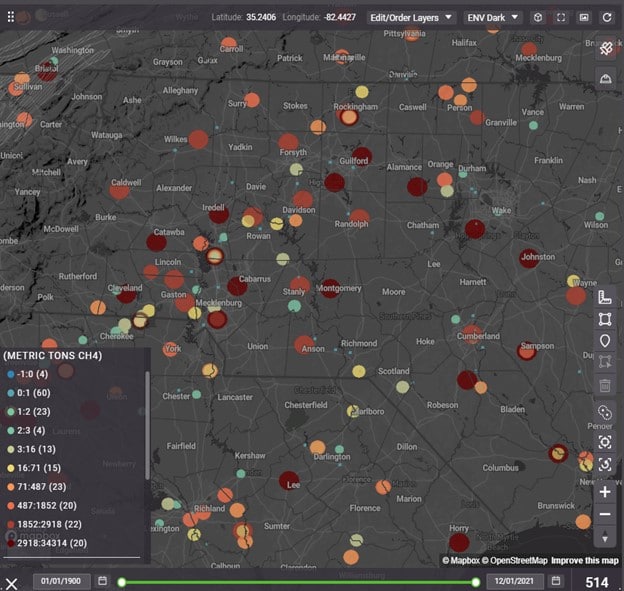
Source: Enverus coded EPA data; screenshot of Enverus PRISM GHG data.

The screenshot below of southwest Pennsylvania shows a concentration of coal mines, two onshore production emitters and power plants.

The mines in the screenshot accounted for more 2020 methane emissions than all U.S. offshore oil and gas methane generation or natural gas processing emissions.
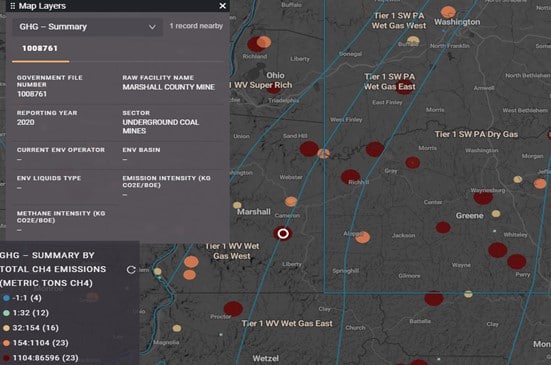
Source: Enverus coded EPA data; screenshot of Enverus PRISM GHG data.

Setting aside the costs to reduce emissions in mines for a moment, coal mines will be a difficult problem to tackle, because unlike other sources of methane emissions, there is a higher percentage of problem mines than in other sectors.Chart showing Total CH4 emissions - underground coal mines
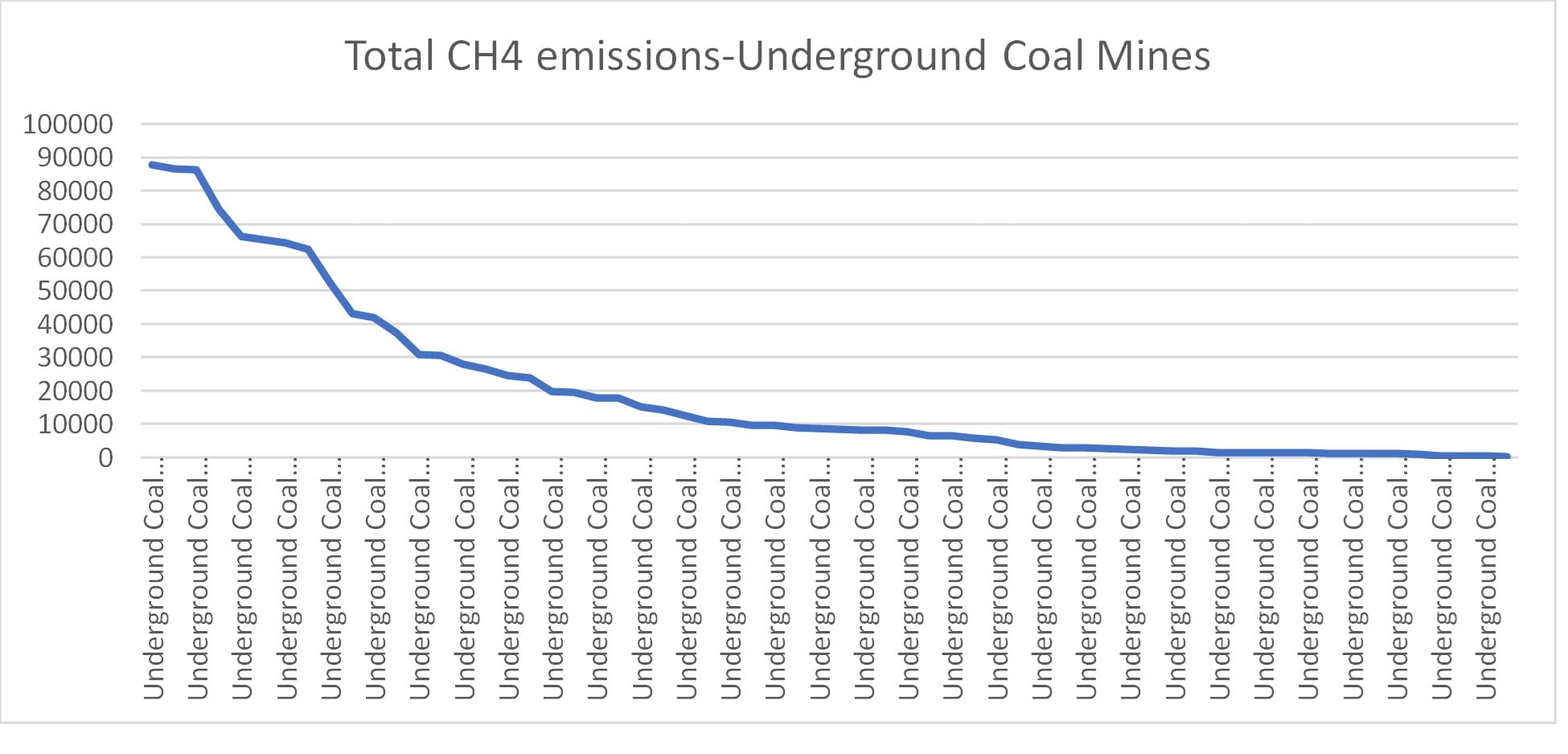
On the plus side, however, there are only 62 mine facilities, and 10 of those are responsible for over half the sector’s emissions. If we look at other sectors, it’s clear that their problematic emission impacts are concentrated in relatively few places.
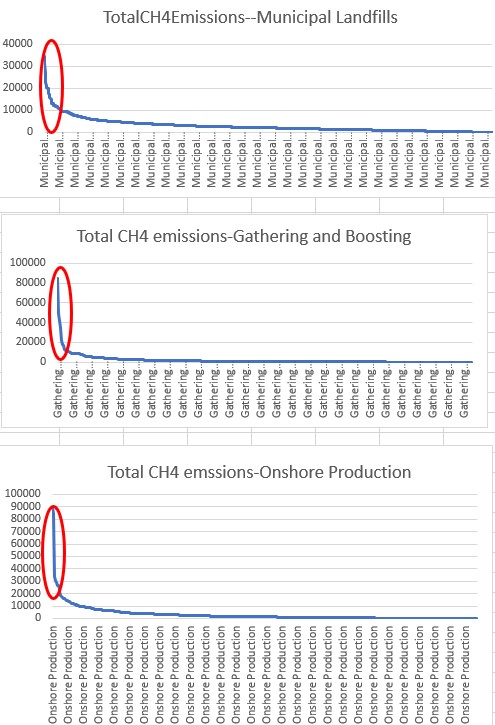
Charts displaying Total CH4 emissions

Focusing remediation on the top 20 problem sites within a sector will have major impacts without being too disruptive.

Sector No. of Entities Total CH4 in Metric Tons % of Total U.S. CH4 % From Top 20 Top 20 — % of Sector
Municipal Landfills 1121 3,392,882 41 12 2
Gathering and Boosting 744 792,661 10 46 3
Onshore Production 946 1,523,103 45 35 2
Underground Coal Mines 62 1,202,698 15 81 32

Assuming the EPA writes smart guidance, focusing methane remediation efforts in areas that also have CO2 problems would be an efficient way to deploy administrative and technical resources to execute on this plan.

Remediation in upstream oil and gas should be relatively straightforward — find the well with the leaking casing, or the gas compressor with a bad seal, or the pipeline that drones have identified as leaking, and go fix the emitting infrastructure. It’s easily identifiable and mostly mechanical in nature. Upstream and midstream operators should embrace leak detection and quickly eliminate those leaks. It’s good politics and ultimately improves the bottom line.

I don’t know what the process would be for capturing leaking methane from a coal mine or a landfill. My guess is that it’s much more complicated and probably expensive.

Perhaps the best course of action for the Biden administration — especially post-Virginia election — would be to broaden their focus from just oil and gas and tackle a couple of smaller landfill and coal mine projects.

Project costs would be smaller and climbing the learning curve will be quicker. Deploy those lessons learned to larger emitters and get a bigger impact, quickly.

Instead of using a federal sledgehammer, limited but targeted interventions by regional federal teams using both carrots and sticks could go a long way toward reducing the U.S. warming curve. Judiciously applied funds from the Build Back Better bill, when passed, could help the administration truthfully claim it is staying true to its climate policies by using smart money to make a noticeable difference in our national methane footprint.


Picture of Mark Nibbelink

Mark Nibbelink

Mark Nibbelink is co-founder and director of university outreach at Enverus. Before co-founding Enverus (formerly Drillinginfo) in 1999, Mark had a long career as a prospect geologist at Gulf Oil before beginning work as an independent geologist. Mark is responsible for quality control and data integrity. He received his Bachelor of Arts in geology and his master’s in geology and geophysics from Dartmouth College.

Subscribe to the Enverus Blog

A weekly update on the latest “no-fluff” insight and analysis of the energy industry.

Related Content

Enverus Intelligence® Research Press Release - Recap: How the Trump Administration is reshaping energy markets
Energy Market Wrap
ByEnverus

Diamondback boosts drilling efficiency, Chord scales four‑mile laterals, Expand Energy cuts Haynesville breakevens, Diversified buys East Texas assets, and Bay du Nord progresses.

Enverus Press Release - Enverus releases Investor Analytics: Refined, actionable financial insights at your fingertips
Energy Transition
ByThomas Mulvihill

This week’s ETT reviews PJM’s extension of its capacity market price collar through 2030 and new expedited interconnection track. While aimed at boosting new capacity, EIR finds the measures temporary as load forecasts remain more bullish than ours.

Carbon storage in question: Illinois regulation could threaten key CCUS projects
Business Automation
ByIan Elchitz

Artificial Intelligence (AI) has become a constant topic in enterprise software conversations. For finance and supply chain leaders in oil and gas companies, however, many of those conversations feel disconnected from reality. Promises are big, terminology is vague, and outcomes...

Enverus Intelligence® Research Press Release - Haynesville operators calculate remaining growth
Analyst Takes Trading and Risk
ByAl Salazar, Enverus Intelligence® Research (EIR) Contributor

Recent joint U.S.- Israeli military strikes in Iran and the ongoing geopolitical tensions in the region cast a significant shadow over global energy markets. As the world watches closely, the potential for regime change and the implications for oil and...

Enverus Press Release - Undo the queue: Enverus acquires Pearl Street Technologies to solve for a more reliable, resilient grid
Oilfield Services
ByAdriana Bickford

Oilfield service companies have seen this pattern before: a new growth opportunity emerges, capital flows and early movers reshape their business models. You’ve lived through the shale revolution, through consolidation waves, through efficiency cycles. Some pivots worked. Some didn’t. What makes this moment different is the structural shift in electricity demand. ...

Enverus Press Release - Class VI wave expected to hit US
Energy Market Wrap
ByEnverus

BP delivers strong 2025 results, Oxy boosts onshore efficiency, ConocoPhillips advances Surmont, Whistler sanctions Bay Runner, and Kinetik explores a potential sale.

Enverus Press Release - Heightened natural gas price volatility expected amid supply and demand challenges
Energy Transition
ByNoor Qureshi

The clean fuels story has turned a corner. EIR’s 2026 Clean Fuels Fundamentals finds an industry in recalibration: credit exposure, policy clarity and margin durability have replaced breakneck expansion as the sector's defining priorities.

Enverus Intelligence® Research Press Release - Canada’s Montney and Duverney: North America’s most abundant unconventional resource plays
Analyst Takes Trading and Risk
ByAl Salazar, Enverus Intelligence® Research (EIR) Contributor

Alberta's economy frequently grapples with the inherent volatility of oil prices, a challenge that can significantly impact provincial coffers and lead to substantial deficits.

U.S. oil and gas M&A slumps as low crude prices keep buyers in the dugout
Business Automation
ByIan Elchitz

Accounts Payable in oil and gas has never been more important. AP teams are under increasing pressure to reduce disputes, close faster, improve accuracy, and provide confidence in spend. Many organizations have invested heavily in AP automation and process improvement,...

Let’s get started!

We’ll follow up right away to show you a quick product tour.

Let’s get started!

We’ll follow up right away to show you a quick product tour.

Sign up for our Blog

Ready to Subscribe?

Ready to Get Started?

Ready to Subscribe?

Sign Up

Power Your Insights