
Transparent answers you can inspect, customize, and defend

Benchmark against peers. Validate your assumptions. Trace every insight to source data. All in one platform that your entire company can use.

Engineers and geoscientists are accountable for decisions that must stand up in technical reviews, partner discussions, and capital committees. That means understanding not only what the answer is, but how it was built; that means understanding the data and reasoning behind every decision.
Enverus combines deep industry intelligence with full model control. Analytics are powered by decades of energy data and research, then delivered through an open studio where engineers can adjust assumptions, test sensitivities, and apply their own expertise. Every knob and dial is exposed. Nothing is hidden. Results are transparent by design.

Ebook Hero

Engineers and Geoscientists choose Enverus

Hear from our experts:

Benchmarking That Stands Up In Peer Review

Confident benchmarking requires more than internal comparisons. Leadership relies on Enverus as an independent source of truth to understand how performance stacks up across the market and why differences in performance exist. Engineers use that same insight to improve development strategies and operating efficiency, informed by what is happening beyond their acreage. When performance is measured against data trusted by peers and investors, conclusions carry real credibility.

  • Start with normalized, like‑for‑like wells: Compare wells using consistent type curves and aligned development context. Control for formation, landing zone, vintage, spacing, and parent‑child effects so performance differences reflect reality, not noise.

  • Establish peer context beyond your acreage: Evaluate performance against relevant nearby operators to understand how development designs, execution, and operating practices compare across the market. Visibility beyond your fence line provides the competitive context internal data alone cannot.

  • Use peer and offset performance to test sensitivities and inform future development scenarios: Quantify how design and operational changes affect outcomes, and apply those learnings to guide productivity, cost, and capital decisions going forward.

  • Incorporate expert interpretation alongside analytics: Pair quantitative analysis with insights from Enverus industry experts and analysts who understand basin dynamics, operational constraints, and what the market is interested in.

  • Benchmark against data trusted by the market: Rely on datasets and methodologies used by leading operators, banks, and investors, not just internal data or deal‑specific data rooms. This alignment builds confidence with shareholders and external stakeholders.

  • Translate benchmarking into strategic action: Use insights to guide development planning, capital allocation, cost optimization, and investor communication. Benchmarking becomes a decision framework, not a static comparison.

The Most Accurate View of Rig Activity in the Market

Enverus monitors the U.S. land rig fleet using a hybrid data collection approach designed to deliver accurate and timely drilling intelligence. Our methodology incorporates:

  • GPS tracking technology deployed across the active fleet
  • Direct reporting from drilling contractors
  • State spud and permit filings
  • Dedicated ingestion and validation teams
  • Daily updates on rig activity vs. lagged weekly industry counts
  • In Canada, activity is captured through automated ingestion of CAODC/CAOEC data and matched to well licenses to determine drilling start and stop activity.

Only Enverus has physical GPS units on rigs, delivering 99% fleet coverage and tying movement directly to a dataset spanning 5.8 million wells and more than 560,000 active permits

Before a rig appears in Enverus systems, it must meet defined operational criteria to ensure it represents legitimate drilling activity. A rig must:

  • Be associated with a valid permit or well location
  • Be located at a verified drilling site (not in a rig yard)
  • Not be stacked or released
  • Have initiated drilling operations (spud date present)
  • Not be classified as a dedicated spudder or workover rig

Unlike standalone activity trackers, Enverus integrates rig and frac crew data directly into benchmarking, forecasting, and inventory analysis, so operational context is part of the model, not a separate spreadsheet.

Understanding who is drilling, completing, and building infrastructure near your acreage helps engineers anticipate parent-child effects, spacing pressure, and design shifts before production data fully reflects them.

Enverus provides basin-wide, continuously updated rig, spud, permit, and frac crew tracking tied directly to well context and development patterns, rather than isolated activity feeds. This level of detail and accuracy empowers how decisions are made.

  • Monitor true development cadence. Track rigs and frac spreads at the operator, pad, and formation level to understand pace and intensity.

  • Detect spacing and parent-child risk early. See when adjacent operators begin development that may impact pressure, depletion, or interference.

  • Validate execution performance. Compare cycle times, frac intensity trends, and development sequencing across peer operators.

  • Tie activity to outcomes. Connect rig and frac data directly to production performance, design variables, and rock context, instead of just surface-level counts.

This allows engineering teams to move from reactive analysis to proactive development planning.

Forecasting With Context, Not Just Curve Fitting

A forecast without context can appear precise while masking the drivers of performance. Enverus lets you define type curves that can incorporate rock quality, landing zone, spacing, area, completion design and operational variables directly to performance. Having the full picture in one platform gives you the upper hand on reliability.

Enverus also includes analyst‑vetted regional type curve frameworks you can use immediately, then refine with your own assumptions. You can run the work in Enverus or export outputs to the forecasting and economics tools your team already uses.

  • Forecast faster without sacrificing rigor. Run forecasts 10x faster than traditional curve fitting using pre‑generated well forecasts and consistent performance metrics to accelerate evaluations and keep engineers focused on sensitivity testing and decisions, not manual setup.

  • Run probabilistic forecasts with engineer‑controlled assumptions. Generate P10, P50, and P90 type curves and adjust decline parameters and inputs to match your asset reality and risk tolerance.

  • QA and refine forecasts using diagnostics, not guesswork. Compare forecasted versus actual performance, visually inspect results, and update curves in a repeatable way that improves reliability over time.

  • Export cleanly into your existing economics and reserves workflows. Move forecasts into common industry formats including ARIES, PHDwin, ValNav, and Excel so the work integrates with established reserves and valuation processes.

Result: Faster reviews, fewer debates about assumptions, and forecasts that stay explainable as conditions change because the inputs, context, and outputs stay connected.
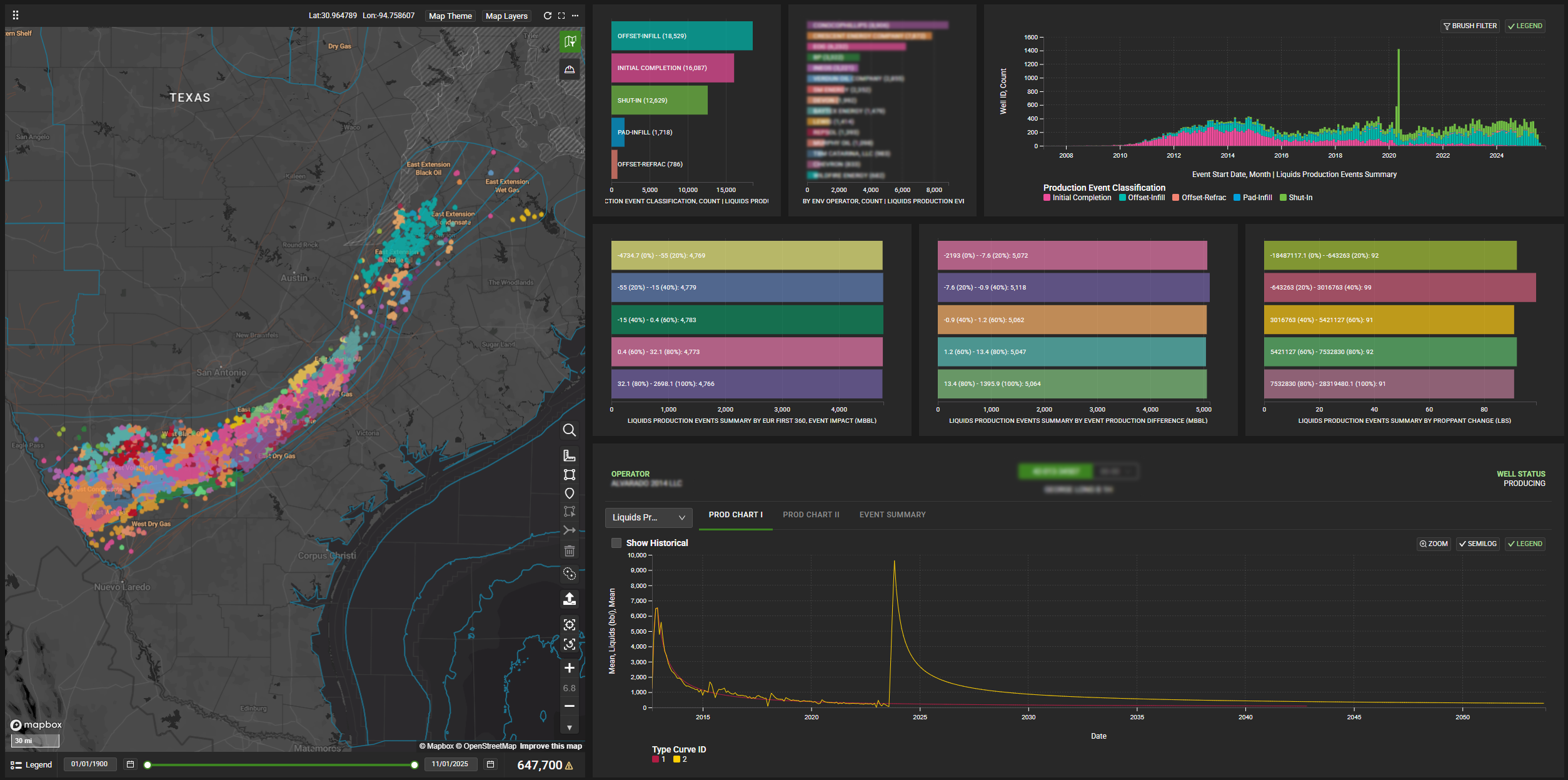
AI assisted, engineer verifiable

Enverus AI is built to accelerate analysis without hiding the logic. It works inside the same platform and uses the same vetted energy datasets and analytical context your team already relies on, so outputs remain consistent with the rest of your workflow. Every AI response is tied to traceable sources, so engineers can validate what changed, why it changed, and what data supports it.

AI speeds iteration. Engineers stay in control.

  • Generate summaries and insights: Ask questions, summarize patterns, and surface outliers using the same wells, areas, time ranges, and constraints you are already analyzing.

  • Trace every AI output to the supporting evidence: Click through to the underlying wells, tables, filters, and assumptions so you can validate before you share or act.

  • Adjust inputs and rerun quickly without rebuilding your workflow: Change key assumptions, narrow the analysis, or test alternatives and regenerate outputs in minutes instead of re‑creating views from scratch.

  • Share results with confidence because the evidence travels with the insight: Outputs remain connected to the data and context used to generate them, making reviews faster and reducing back‑and‑forth about where numbers came from.

Built to complement specialist tools

Enverus is designed to strengthen, not replace, dedicated reserves and economics software. Many teams will continue to use those tools for detailed scenario modeling, reserves booking, and regulatory workflows.

Enverus improves how those tools are used by ensuring everyone starts from the same, defensible foundation:

  • Establish like‑for‑like well groupings and accelerate interpretation: Normalize wells using consistent context so engineers spend time understanding results, not reconciling differences between datasets or selections.

  • Context and design assumptions: Define geology, landing zones, spacing, and development assumptions once, using best‑in‑class datasets, so downstream analysis reflects agreed‑upon inputs.

  • Provide traceable, auditable inputs: Deliver clean well lists, decline parameters, benchmarks, and assumptions with auditable workflows, supporting repeatable and review‑ready workflows.

  • Export governed inputs directly into downstream tools: Feed reserves and economics software with consistent, flexible inputs that integrate cleanly into existing workflows without rework.

The result: Less rework, faster technical and commercial reviews, and confidence that every analysis begins from the same assumptions across engineering, finance, and leadership.

The Enverus Platform Advantage

Point tools can answer narrow questions. Enverus governs decisions at scale.

  • Enterprise-scale data stewardship across upstream, power, land, infrastructure and finance
  • Governed “golden datasets” shared across assets, teams, and regions
  • Role-based access and data lineage so assumptions don’t drift
  • Outputs that flow downstream to BI tools, executive dashboards, and technical systems

Engineers get transparency. Leadership gets consistency. The organization gets alignment.

  • Proprietary shapefiles and internal lists integrate directly into shared views
  • Outputs flow to BI tools and executive reporting without rework
  • Assumptions stay aligned across assets, teams, and regions

Engineer & Geoscience Top 10 FAQs

Rock‑aware benchmarking beats tool‑only forecasting.

Can I see the data and filters behind any chart?

Yes. Every chart links directly to the underlying well lists, tables, filters, and date ranges. You can inspect the exact inputs driving the result and export them when needed.

Yes. You control the variables that matter, including spacing, completion design parameters, development era, and economics where supported. You can apply changes and rerun without rebuilding workflows.

The PRISM platform, which enables customers to upload proprietary data, is currently compliant with SOC 2 Type II requirements, ensuring the data is secure and never shared with other customers or used to train Enverus models.

Data from different customers is never mixed. All customer data is stored in a separate environment from Enverus data.

Yes. You can import and layer proprietary maps and other internal datasets directly into Enverus, then share the same governed views across teams.

You can evaluate how spacing, completion design, development timing, and operating choices influence performance using real offset and peer activity as context. This supports forward-looking decisions rather than relying only on internal history.

Dedicated reserves and economics tools are often optimized for reserves booking and reporting workflows. Enverus complements them by strengthening the inputs and reducing manual effort upstream. Enverus helps you build like-for-like well sets, lock rock and design context, and export traceable well lists, decline parameters, and benchmarks into downstream systems. That reduces rework because the origin of each number is clear.

No. Best practice is complementary. Use Enverus to screen opportunities, benchmark performance, and lock assumptions, then export well lists, decline parameters, differentials, and models into your preferred reserves system. When appropriate, you can also run pre-generated or customizable forecasts directly in Enverus.

You can generate well-level forecasts and type curves, including probabilistic cases, and export to common industry formats and workflows such as ARIES, PHDwin, ValNav, and Excel.

AI is an assistive layer that accelerates analysis using vetted datasets and the same analytical context you are working in. Experts stay in control by verifying outputs within established engineering and geoscience workflows rather than relying on opaque summaries.

How Enverus Builds Engineer-verifiable Insights

Enverus analytics are built on connected, contextualized upstream data — not isolated datasets or opaque models.

At a high level:

  1. You define the well set
    Filter by formation, spacing, interval, rock quality, engineering and development context.

  2. Context is aligned
    Production windows, geologic setting, and operational timing are normalized for apples-to-apples comparison.

  3. Drivers are attributed
    Completion design, subsurface properties, spacing, and operational variables are tied to performance differences.

  4. Results remain traceable
    Every chart, forecast, and AI summary links back to the wells, filters, and assumptions behind it.

You can inspect, adjust, and export every step.

Speak to an Engineer

Let’s get started!

We’ll follow up right away to show you a quick product tour.

Let’s get started!

We’ll follow up right away to show you a quick product tour.

Ready to Subscribe?

Ready to Get Started?

Ready to Subscribe?

Sign Up

Power Your Insights