
This whitepaper explores why point forecasting outperforms traditional Global Forecast System models in energy markets. It explains how hyper-local, AI-enhanced forecasts integrated into Enverus MarketView® deliver greater precision, timing accuracy, and actionable insights for natural gas price forecasting. Through real-world case studies, it demonstrates how traders can reduce risk, improve hedge timing, and gain a competitive edge using advanced weather intelligence.

Bias correction addresses systematic errors in weather models by learning from past mistakes and adjusting future predictions. Climavision’s AI accelerates this process for more reliable, directionally accurate outlooks.
Weather volatility remains one of the most significant drivers of price risk in natural gas markets. Traditional public models like the Global Forecast System (GFS) provide a broad view but often miss critical timing and magnitude shifts, leaving traders exposed to sudden price spikes and operational challenges. Proprietary point forecasting system (PFS) changes the game. By delivering hyper-local, asset-level forecasts with AI-driven bias correction and seamless integration into Enverus MarketView®, PFS enables traders to better anticipate the direction and timing of demand swings, hedge earlier, and reduce exposure to extreme volatility.
This whitepaper demonstrates how PFS provided clearer signals than GFS during three major cold events, giving traders the clarity to act ahead of the market.
Natural gas price forecasting lives and dies by weather. A single arctic blast can send prices soaring, disrupt supply chains, and expose traders to millions in unexpected risk. Publicly available models like GFS offer a global perspective, but their lack of precision and timing accuracy often results in missed opportunities and costly surprises. In today’s environment, traders need more than generic forecasts; they need actionable intelligence.
That’s where Climavision’s PFS comes in. Built for energy markets, PFS delivers hyper-local forecasts with extended lead times, hourly updates and AI-driven bias correction, all integrated directly into Enverus MarketView®. The result? A forecasting edge that translates into better hedging strategies, improved risk management and measurable financial gains.
Every degree matters when it can swing prices. GFS and PFS are both essential tools for anticipating weather-driven market dynamics. GFS provides a broad, global perspective that serves as a foundational benchmark for traders and analysts. However, in today’s fast-moving natural gas markets, precision and actionable insights are critical. That’s where PFS delivers a decisive edge, offering hyper-local, asset-level forecasts and integrated directly with market data. By combining high-resolution variables, extended lead times and continuous updates, PFS transforms weather forecasting from a generic input into a strategic advantage, enabling proactive decisions and reducing risk exposure.
The table below highlights the key differences between GFS and PFS, and why PFS, integrated within Enverus MarketView®, gives traders a measurable edge. Unlike standalone models, MarketView® combines hyper-local forecasts with real-time pricing, fundamentals and analytics, turning weather intelligence into actionable strategy.
Category | GFS | PFS |
|---|---|---|
Forecast Precision | Broad, global-scale forecasts lacking site-specific accuracy. | Hyper-local, asset-level forecasts tailored to plants, terminals and critical infrastructure. |
Timing Accuracy | Often misjudges arrival and duration of cold snaps or warm-ups. | Provides improved timing signals, giving traders earlier indications for intraday decisions. |
Bias & Reliability | Susceptible to overestimating or underestimating temperature swings. | AI bias correction improves directional accuracy and consistency of forecasts. |
Lead Time for Action | Shorter advance notice of extreme weather events. | Offers extended lead time (up to 15 days) with hourly updates, supporting more proactive hedging. |
Integration With Market Data | Standalone forecasts requiring manual correlation with pricing and fundamentals. | Seamlessly integrated into MarketView Sphere for instant, actionable insights. |
Risk Exposure | Higher exposure to unexpected volatility and financial losses. | Reduced risk through accurate, timely forecasts aligned with market signals. |
Update Frequency | Updates every 6 hours, which can leave traders vulnerable. | Updates hourly, more frequent than GFS, for timely insights. |
Competitive Position | Generic forecasts put traders at a disadvantage. | Proprietary, AI-supported forecasts offer a directional advantage over traditional models. |
Next, let’s look at three real-world scenarios where Climavision PFS, integrated within Enverus MarketView®, could have delivered a decisive advantage.
Event Summary
Winter Storm Elliott was a historic Arctic blast that swept across the central and eastern United States between Dec. 21–26, 2022, peaking on Dec. 23–24. The storm triggered dramatic temperature plunges as the front moved through, at Dallas-Fort Worth (KDFW); temperatures fell from 45°F at 8 a.m. on Dec. 22 to 23°F by 10 a.m., a 22°F drop in just two hours. These rapid swings, combined with blizzards, high winds and extreme cold, pushed power grids to the brink. ERCOT, PJM and SPP faced soaring demand and widespread outages. The Eastern Interconnection saw the largest controlled firm load shed in its history (5,400 MW), while natural gas infrastructure froze, cutting U.S. production by ~15 Bcf/d, including a 3 Bcf/d decline in the Permian Basin. In total, more than 127,000 MW of generation was unavailable, with 90,500 MW due to unplanned outages.
Market Impact
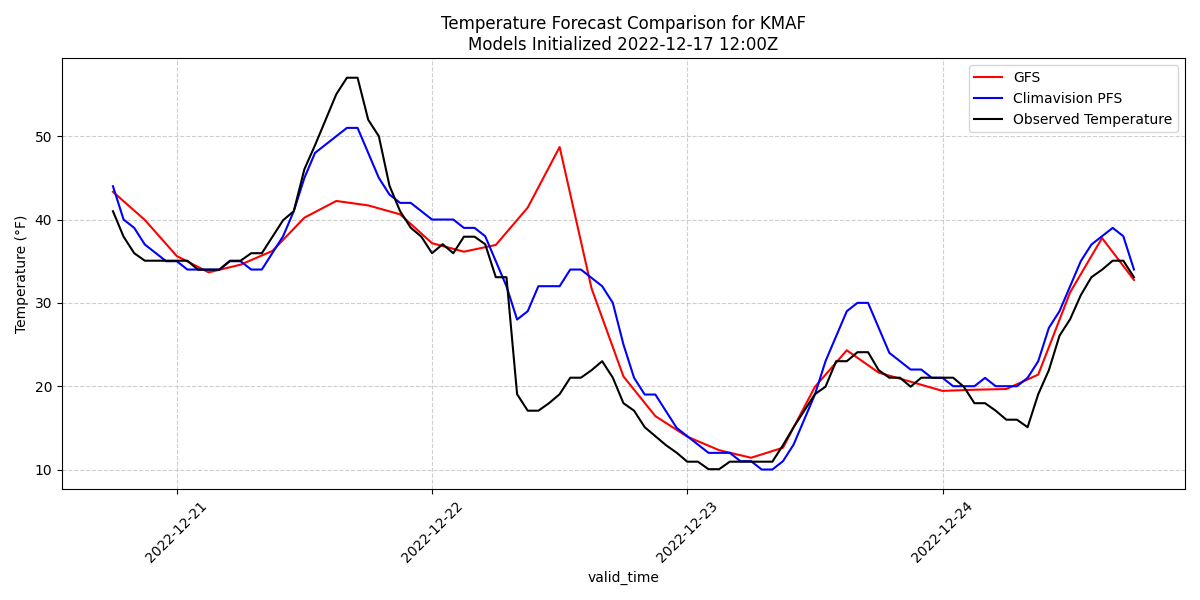
Natural gas markets reacted sharply. West Texas next-day gas surged ~22% to $9/MMBtu, the highest level since the 2021 freeze. Spot prices spiked nationwide before collapsing as temperatures rebounded. Futures reflected similar volatility: January Nymex rolled off at $4.705, while February fell to $4.475 after the initial spike. The combination of freeze-offs and surging heating demand created extreme price swings, exposing traders who relied solely on public models like GFS to significant risk. Accurate timing of the cold air’s arrival was critical; Climavision’s PFS provided earlier and more directionally accurate signals of the event seven days in advance, while GFS lagged in timing and showed a warmer bias during the lead-up, limiting traders’ ability to hedge early.
Forecast Comparison
This chart compares the Climavision PFS forecast and GFS forecasts, both issued 12z 12/17, to observed temperatures at KMAF (Midland, TX).While both models forecasted the minimum temperatures on Dec. 23, PFS more closely captured the timing of the initial cold air arrival on Dec. 22, whereas GFS was significantly warmer during the afternoon. This timing and directional advantage is critical, especially when integrated into Enverus MarketView®. Having the correct timing of the cold air’s arrival within MarketView® gives traders crucial lead time to anticipate intraday demand spikes, adjust positions, and capitalize on price volatility before the market reacts.
Event Summary
A brutal Arctic outbreak gripped much of the U.S. from Jan. 11–15, 2024, driving temperatures well below zero across the Midwest, Plains and into Texas. Extreme wind chills reached as far south as the Mexican border, Laredo, for example, saw wind chills near freezing, while winter storm warnings covered the Pacific Northwest, Rockies and Midwest. This prolonged cold pushed U.S. natural gas demand to record-breaking levels, peaking at 174.3 Bcf on Jan. 15, surpassing the previous record set during Winter Storm Elliott in December 2022. Residential and commercial consumption surged by 80% in six days, and natural gas-fired power generation hit 45.4 Bcf on Jan. 16, the highest winter level ever recorded.
Production was severely impacted by freeze-offs, cutting U.S. output to ~92 Bcf/d, a 9% decline from the prior week, with Texas alone down 11%. Market flexibility came from increased Canadian imports, reduced LNG feedgas demand and heavy storage withdrawals.
Market Impact
Henry Hub cash prices spiked dramatically, hitting $15/MMBtu at the peak before retreating to the $3.25 – $4.20/MMBtu range by Jan. 17. Spot prices across major hubs surged as traders scrambled to cover positions amid tightening supply and soaring heating demand. Nat-gas/power prices hit multi-year highs as freeze-offs cut supply while demand surged. Gas availability fell to around 9.6 bcfd during the extended cold snap.
Forecast Comparison
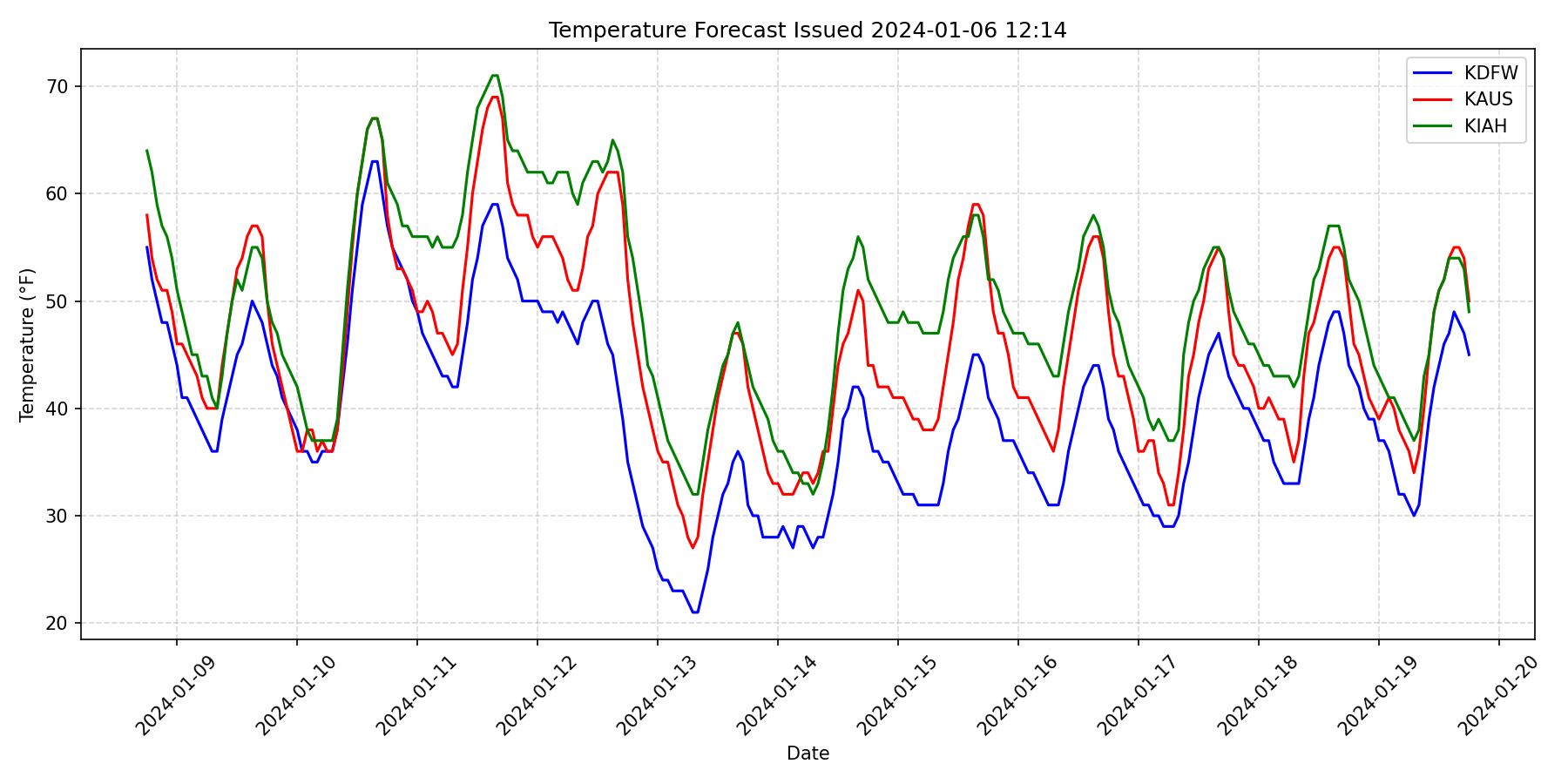
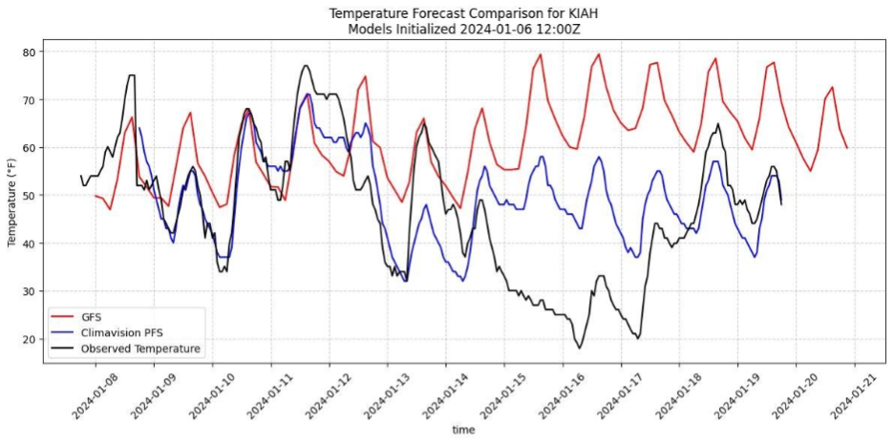
The Climavision Point Forecast system PFS indicated a sharp drop in temperatures across ERCOT 6-7 days in advance of the event. Publicly available models, such as the GFS, issued at the same time showed a less extreme temperature dip or even a rise in temperatures.
1. Climavision PFS temperature forecast for selected cities across ERCOT, issued 1/6, ~7 days before the event.
2. Comparison of the Climavision PFS forecast and GFS forecasts, both issued 12z 1/6, to observed temperatures at KIAH, showing that PFS provided a more directionally accurate forecast of the cold snap seven days in advance, while GFS indicated a less pronounced temperature drop.
3. ERCOT Hourly load from Jan. 10-20, showing the increase in load between Jan. 13 and 17 correlating with the cold temperatures that PFS more accurately forecasted.
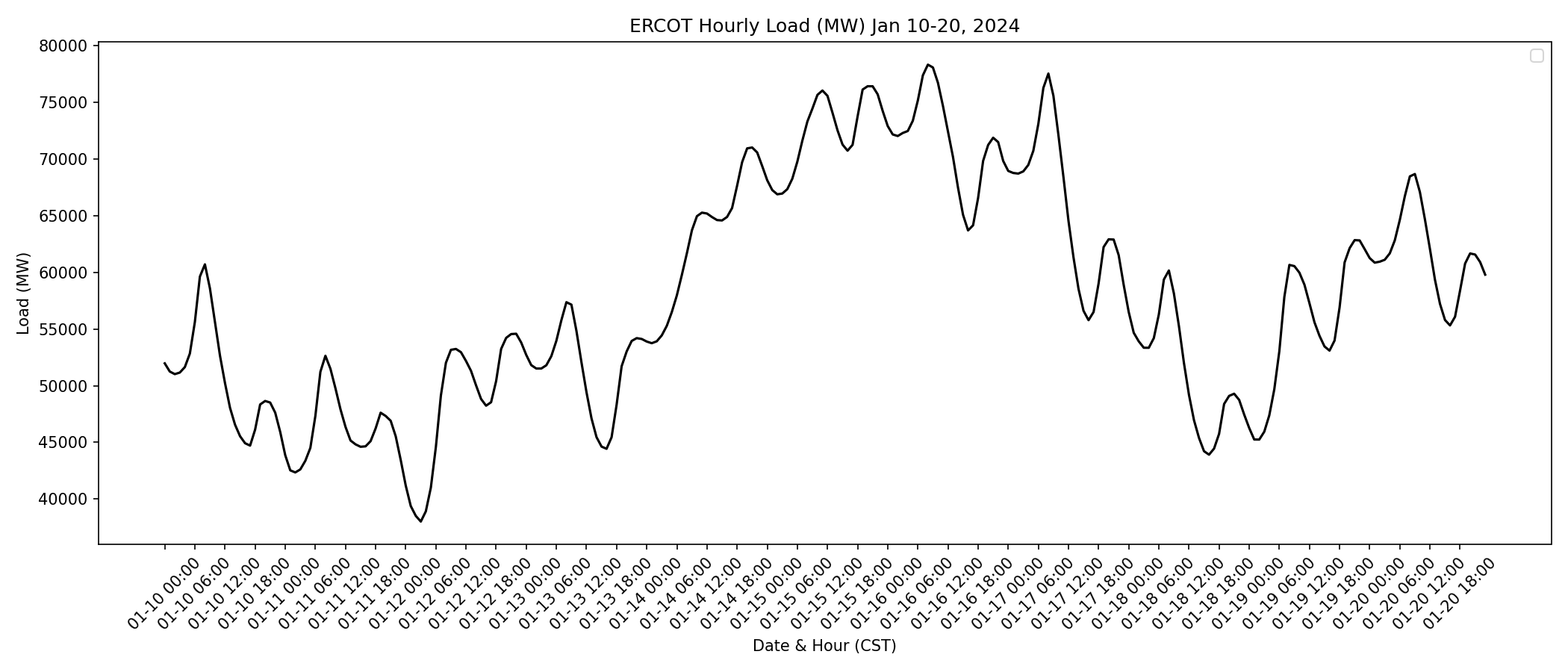
Gas traders relying solely on GFS missed early entry opportunities and faced elevated risk from sudden price surges, while Enverus MarketView® users leveraging PFS could have locked in lower prices ahead of the spike.
Event Summary
A powerful Arctic blast swept across the central and eastern U.S. during Feb. 19–21, 2025, bringing life-threatening cold and driving heating demand sharply higher. After a brief reprieve earlier in February, temperatures plunged well below seasonal norms, extending into the southern U.S. and creating severe stress on energy infrastructure. Freeze-offs disrupted natural gas production, compounding supply concerns as demand surged. Analysts noted that winter 2025 had already been more intense than expected, following record cold in January, and this late-season Arctic surge reinforced volatility across energy markets.
Market Impact
Financial press reported U.S. natural gas futures hitting their highest since 2022 as an Arctic blast drove record heating demand and freeze-offs; EIA/analyst notes the cold January raised the 2025 average price outlook.
Forecast Comparison
Climavision and the GFS model both predicted the initial cold air on Feb. 17 fairly well, five days in advance. However, when temperatures began to warm between Feb. 21 and Feb. 25, Climavision’s PFS model showed a clearer signal of the subsequent warm-up, while GFS remained too cold, highlighting PFS’s improvement in directional accuracy for extended forecasts.
Comparison of Climavision PFS and GFS forecasts, both issued 12z on 2/12, against observed temperatures at KPHL (Philadelphia). Both models captured the initial cold snap well in the 5-day outlook, but PFS provided a more accurate directional signal for the warm-up in the 10–15 day range, which is significant for longer-term planning.
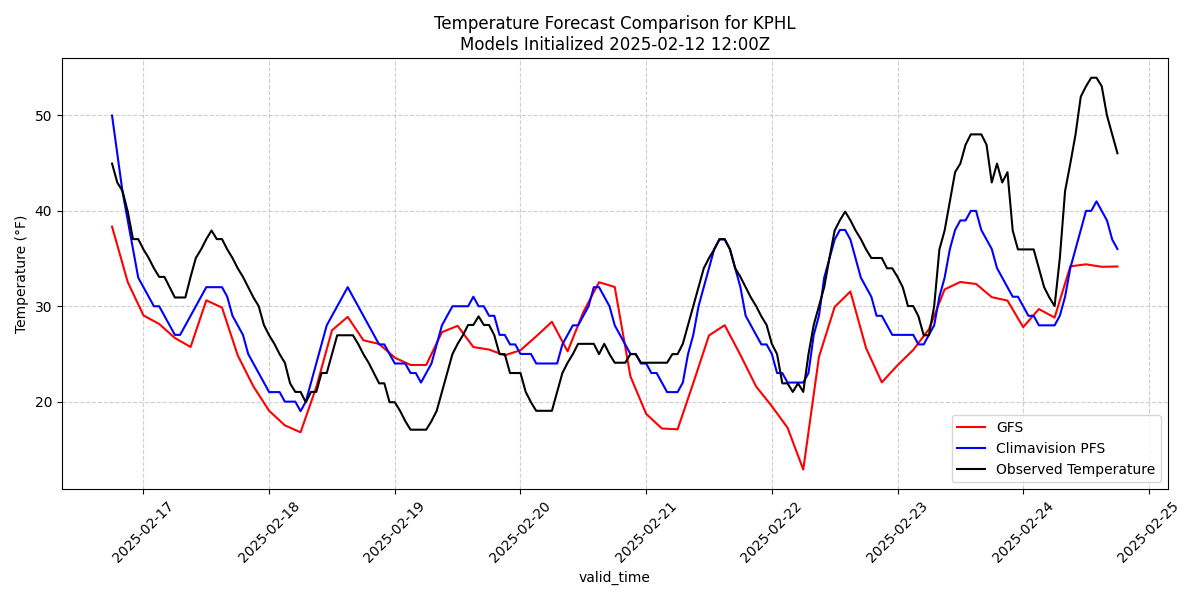
Within Enverus MarketView®, traders can instantly connect these long-range signals to real-time pricing, fundamentals and position analytics. Accurately forecasting the thaw nine days in advance allowed users to anticipate the drop in heating demand, adjust positions before price corrections, and capitalize on market shifts that GFS users would have missed.
Weather drives volatility across power, gas, renewables and aviation markets, but even the most accurate forecast is only as valuable as the platform that delivers it. That’s why Enverus Trading and Risk has partnered with Climavision to embed hyper-local weather intelligence, strengthened by AI, directly into MarketView Sphere, our advanced web-based analytics workspace. The AI component powers bias correction and model training, learning from past errors to improve future predictions and integrate multiple data sources for greater accuracy. This integration combines proprietary point forecasts with real-time market data, enabling traders and analysts to anticipate demand shifts, price movements and operational risks with confidence. With browser-based access, zero maintenance and continuous innovation, Sphere ensures you’re always equipped with the latest forecasting tools, without costly upgrades or migrations.
Climavision’s Horizon AI Point model delivers site-specific forecasts that provide more actionable, directionally accurate signals than generic public models, while Enverus MarketView® transforms those forecasts into actionable insights by integrating them with real-time pricing, fundamentals, and news, all in one seamless workspace. Users gain access to 15-day forecasts with hourly updates, 40+ weather variables and AI bias correction for improved directional accuracy. Whether you’re modeling DA/RT convergence, planning jet fuel demand, or optimizing renewable assets, this partnership gives you the clarity and confidence to act ahead of the market. The result? More timely and directionally accurate forecasts, supporting improved hedging strategies, and a competitive edge built on proprietary weather intelligence.
Don’t let the next cold snap catch you off guard. See how Enverus MarketView® + Climavision PFS turns weather intelligence into trading strategy.
Integrate hyper-local forecasts with real-time pricing and fundamentals.
Gain up to 15-day lead time with hourly updates.
Reduce forecast error and improve hedge timing.
Learn more about our partnership today.
PFS delivers hyper‑local, asset‑level precision with hourly updates and AI weather predictions that correct model bias, enabling earlier hedging and tighter alignment to demand swings. In contrast, the GFS offers broad, 6‑hourly updates that often miss timing and magnitude, increasing risk exposure.
AI bias correction learns from past model errors to improve directional accuracy and timing signals, reducing surprise price spikes tied to weather. Embedded in MarketView®, these AI weather predictions translate into more proactive hedging and lower volatility‑driven losses.
PFS signaled the earlier arrival and severity of the cold air roughly seven days ahead, while GFS ran warmer and lagged on timing—critical for natural gas price forecasting and operational readiness. Traders using PFS could hedge before spot spikes and freeze‑off impacts cascaded through the market.
PFS showed a sharp temperature drop 6–7 days in advance across ERCOT, whereas GFS suggested a less pronounced dip or even a rise, allowing MarketView® users to lock in lower prices ahead of cash surges. The more directionally accurate point forecasts supported intraday decisions as load climbed with the cold.
Both models captured the initial cold snap, but PFS more clearly signaled the subsequent warm‑up in the 10–15‑day window, enabling earlier position adjustments before price corrections. Its 15‑day horizon with hourly updates strengthens weather forecasting and natural gas price forecasting for medium‑term strategy.
Let’s get started!
Let’s get started!
We’ll follow up right away to show you a quick product tour.
Ready to Subscribe?
Ready to Get Started?
Ready to Subscribe?
Sign Up
Power Your Insights