
2026 ISO Dynamics and Market Trends

Explore interconnection queue activity, utility strategies, and policy shifts shaping grid access and investment opportunities across ISOs 

Research written by:
Enverus Intelligence Team

Investment advisory products and services provided by Enverus Intelligence® Research, Inc. Visit www.Enverus.com/disclosures for additional information.

Reviewed by:
Ryan Luther, Research Director, Enverus Intelligence® Research

ebook-laptop-hero-image

Executive Overview

To take advantage of federal tax credits, developers are accelerating solar deployments across all ISOs, while reliability driven market signals simultaneously drive gas and battery development. 

Figure 1 | Queued Capacity and Status
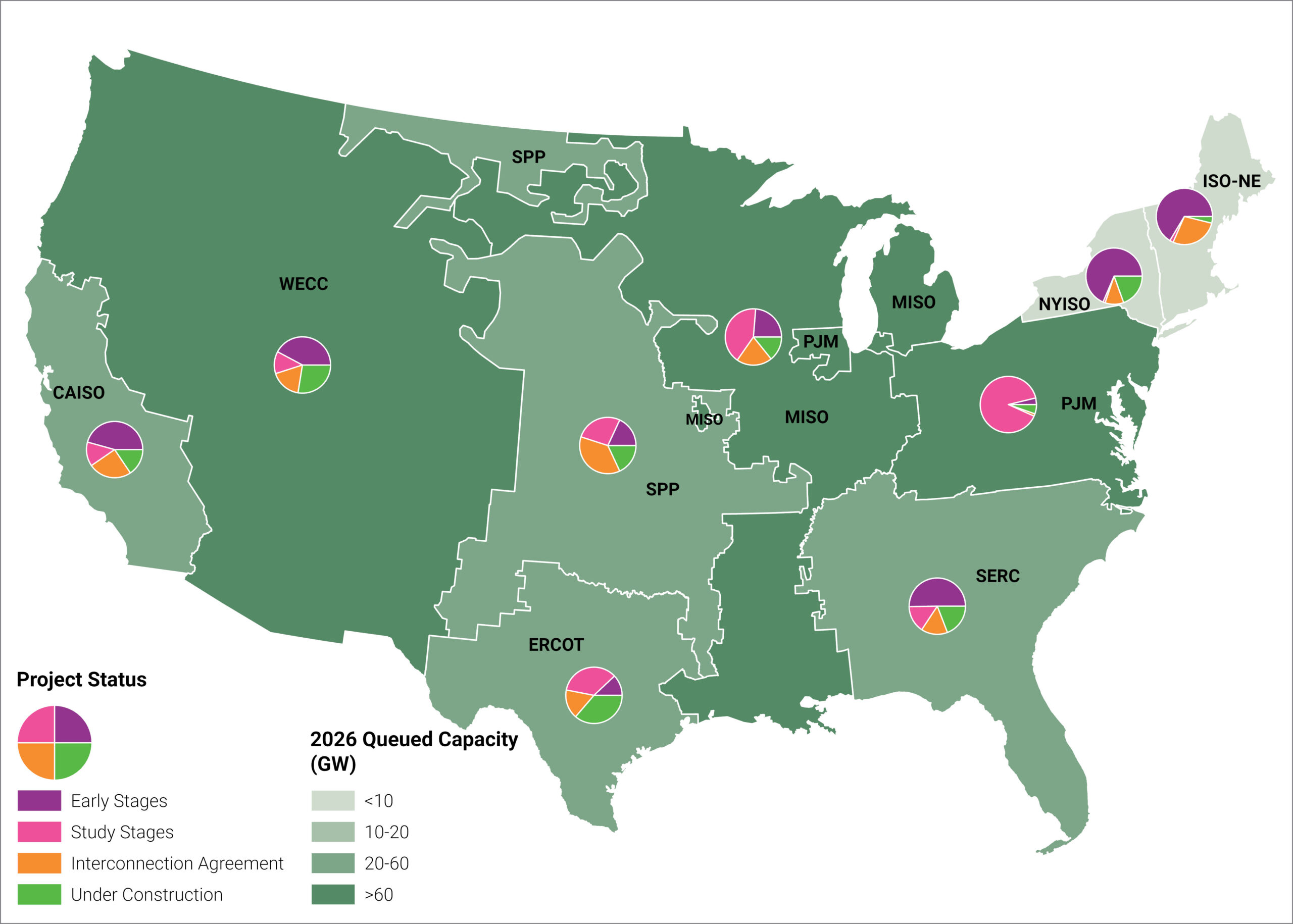
Source | Enverus Power & Renewables, Project Tracking Analytics 

Expiring federal tax incentives, queue backlogs, and new reliability-focused policies accelerate solar and storage development in the short run while constraining longer-term renewable growth. Across ISOs, only a fraction of the hundreds of gigawatts targeting 2026 are likely to reach operation, with faster-moving regions like ERCOT contrasted by slower, transmission-constrained markets. We will see gas and batteries gaining strategic importance as grid reliability and large-load growth take center stage; however, supply chains and interconnection timelines will constrain how much front-of-the-meter gas generation can be added.

OBBBA Reverses the Trend

The passage of the One Big Beautiful Bill Act (OBBBA) in July of 2025 triggered the phase-out of Inflation Reduction Act (IRA) tax credits. While the IRA originally provided a long runway for renewables, the OBBBA requires wind and solar projects to be placed in service by December 31, 2027, to remain eligible for the PTC and ITC tax credits. Projects failing to demonstrate they have begun construction, using the physical work test or the 5% safe harbor, by July 4, 2026, or the 2027 service deadline will lose access to these federal incentives. ITC remains available for grid-scale batteries through 2036.

OBBBA is expected to have a two-phase impact on renewable development. In the near term, solar development is likely to accelerate as projects rush to meet safe harbor requirements; solar is projected to lead 2026 capacity additions and project counts across most U.S. regions (Figure 1). Over the longer term, however, renewable development is expected to decline more significantly as federal incentives diminish. In markets with Renewable Portfolio Standards, or in energy-constrained areas, these dynamics are likely to result in higher Power Purchase Agreement (PPA) prices and an increase in renewable projects paired with energy storage.

To see how OBBBA shifts are impacting project valuations and queue survival rates, you can explore detailed economic modeling and regional viability analysis in the reports linked below: 

You must be an Enverus Intelligence® subscriber to access these reports.

Figure 2 | ISO Queue Planned and Operating Capacity
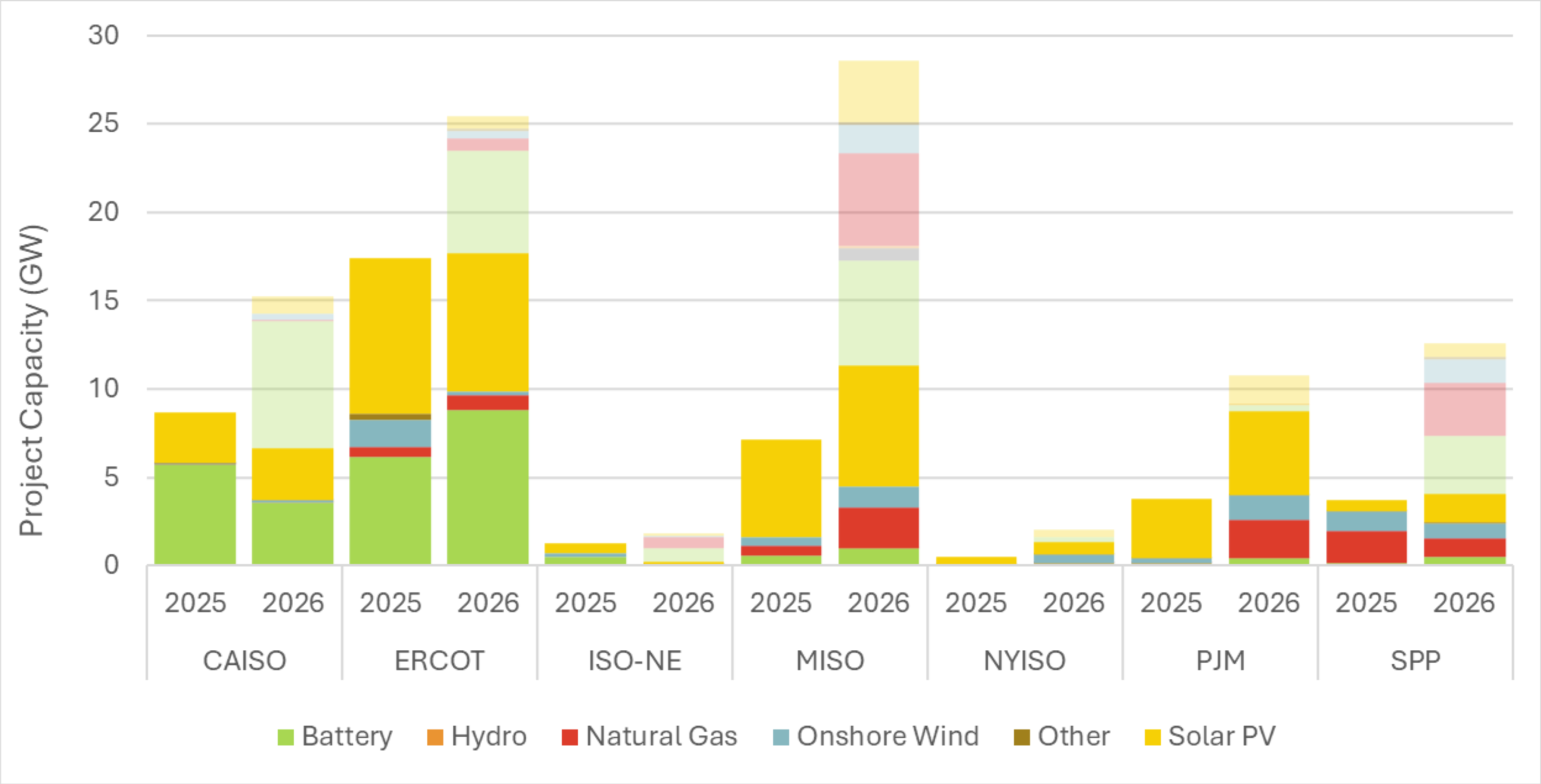
ISO Queue Planned & Operating Capacity
Transparent bars: Interconnection Agreement; solid bars: Under Construction

Source | Enverus Power & Renewables, Project Tracking Analytics

Reliability Takes Center Stage from Renewables

The shift in the energy landscape from renewable to dispatchable power is punctuated by Congress passing the Guaranteeing Reliability through the Interconnection of Dispatchable Power (GRID) Act in September of 2025. The Act is designed to address queue backlogs by mandating FERC to improve interconnection timelines with an emphasis on dispatchable generation when a clear reliability need is demonstrated.  Similar processes in PJM (Reliability Resource Initiative), MISO (Expedited Resource Adequacy Study), and SPP (Expedited Resource Adequacy Study) demonstrate that natural gas and battery storage are well positioned for greater market penetration in the second half of the decade as renewable expansion slows.  

Yet, these processes must also contend with the supply chain issues; a recent Enverus Intelligence Research (EIR) report anticipates that smaller generating units, such as aeroderivative turbines, reciprocating engines and fuel cells, and uprates/retrofits on existing facilities will be the main beneficiaries of these new queue reforms and processes until supply chain issues clear. As a result, natural gas additions in 2026 remain low compared to renewables, so new firm capacity will come primarily from battery storage. 

Backlog and Reforms Drive ISO Interconnection Pauses

The years 2022 through 2025 were defined by multi-year application pauses across the nation’s largest grid operators as they transitioned to the FERC-mandated “first-ready, first-served” cluster study model. PJM began reviewing their interconnection processes in 2021 and started transitioning to a new cluster-study model. CAISO postponed its application windows in both 2022 and 2024 to manage the backlog from Cluster 15. Meanwhile, both NYISO and ISO-NE concluded their old processes and dedicated 2025 to studying the massive “Transitional Cluster” of existing projects, effectively pausing new queue entries until their subsequent cluster windows open in future years.  

Collectively, these queue transitions have driven a nationwide slowdown in new queue additions (Figure 2). When combined with extended queue timelines and the resulting reduction in solar and wind project viability due to expiring tax incentives, 2026 is likely to represent a low-point in new queue additions. 

Figure 3 | Queue Capacity Additions by Year and ISO
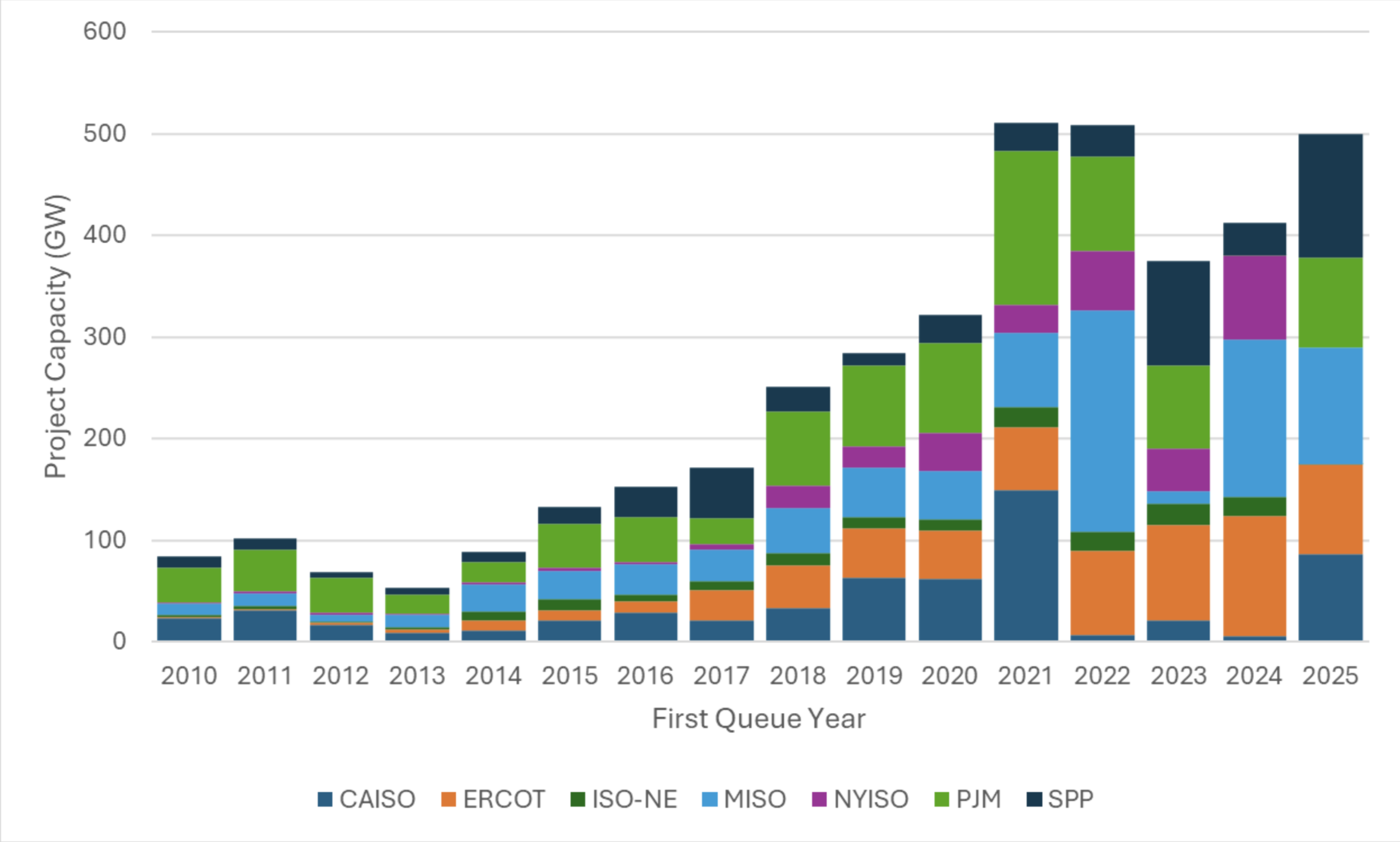
Source | Enverus Power & Renewables, Project Tracking Analytics

Projects are Behind Schedule

Nearly 600 GW of projects are slated for a 2026 first power date (Figure 3). However, projects that have not secured an interconnection agreement are unlikely to reach commercial operation within the year. Excluding these projects, we estimate that the 95 GW currently under construction are the most likely to come online in 2026, which is nearly double the 2025 additions.

Figure 4 | First Power Date of Queued Capacity by Status
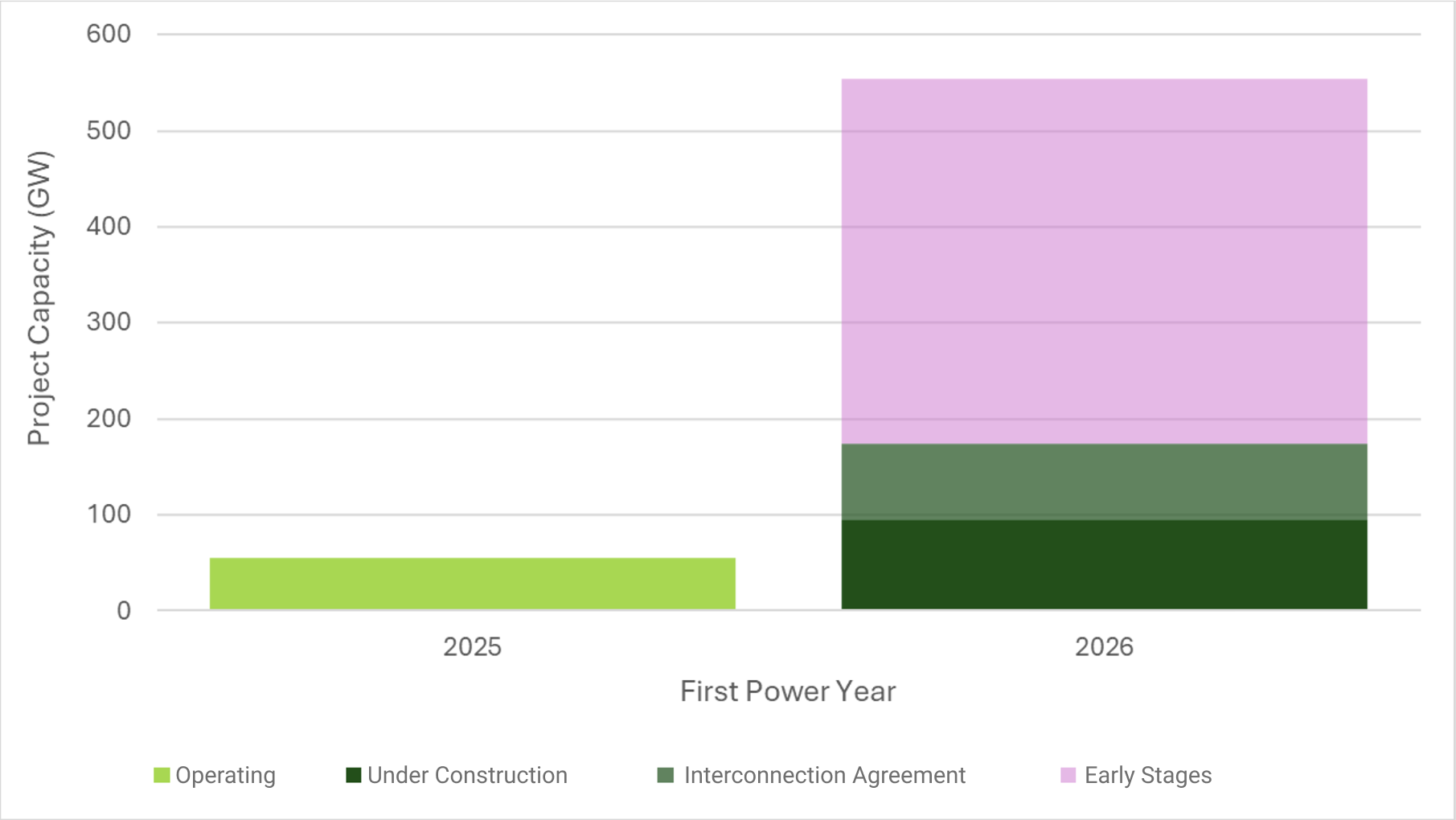
Source | Enverus Power & Renewables, Project Tracking Analytics

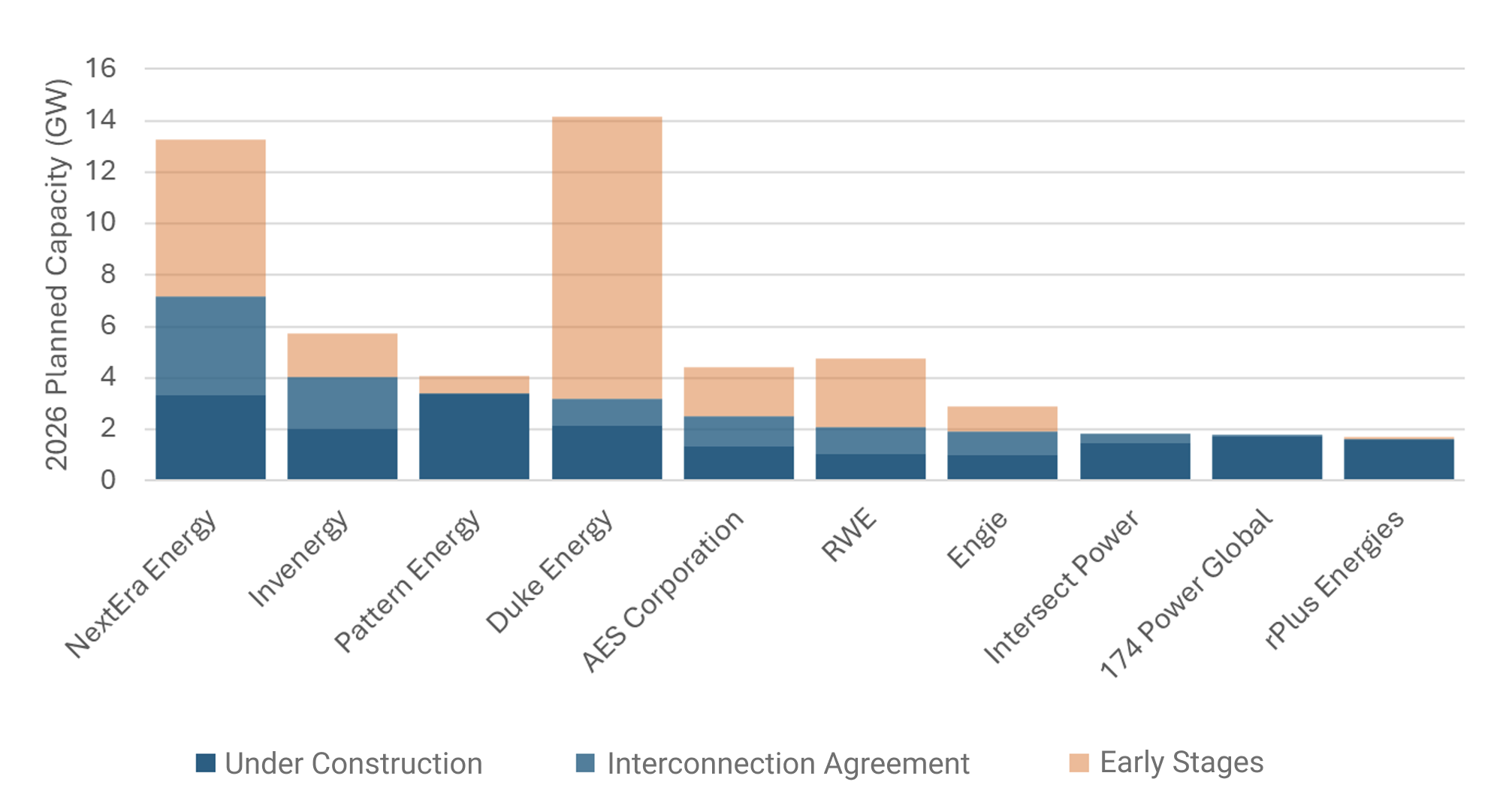
A similar pattern emerges at the developer level. NextEra has the largest volume of queued capacity targeting commercial operation in 2026, totaling around 13 GW (Figure 4). However, based on project maturity, we estimate that only around 3.3 to 7.1 GW of this capacity will come online in 2026. In contrast, Pattern Energy leads in under construction (high-likelihood) capacity at 3.4 GW, followed by NextEra Energy (3.3 GW) and Duke Energy (2.2 GW). 

Figure 5 | Top 2026 Queued Capacity Developers
Source | Enverus Power & Renewables, Project Tracking Analytics

Queue Timelines are Substantial 

ERCOT remains the quickest region to advance projects through the interconnection queue, with an average timeline of 2.9 years for projects that reached construction in 2025. In contrast, CAISO and NYISO experienced lengthened timelines, with an average duration of over 7 years to construction each. Across the contiguous U.S., projects that reach construction or commercial operation in 2025 spent an average of 4.9 years in the queue.  

Queue durations varied substantially by project type, with wind projects exhibiting the longest average timelines of 8 years and gas-fired generation the shortest at 3.4 years.  

For projects with a 2026 first power date, 172 GW are in an early stage of the queue before clearing any studies, 291 GW are in the study stage, and 99 GW are currently under construction. 

Analytics Sources 

This report utilizes PRISM, our advanced analytics platform, to deliver in-depth insights into interconnection queues across various ISOs and utilities. As the leading energy-focused software company globally with more than 25 years of expertise, Enverus is trusted by more than 6,000 businesses to enhance decisionmaking capabilities, improve operational efficiency and secure competitive advantages in the dynamic power and renewables market. 

Below, you will find a detailed list of the charts and graphs included in this e-book. Each entry includes a definition and an explanation of how the data was extracted using PRISM.

About Enverus Intelligence® Research

Enverus Intelligence® | Research, Inc. (EIR) is a subsidiary of Enverus that publishes energy-sector research focused on the oil, natural gas and power and renewable industries. EIR publishes reports including asset and company valuations, resource assessments, technical evaluations and macro-economic forecasts and helps make intelligent connections for energy industry participants, service companies and capital providers worldwide.

About Enverus

Enverus is the leading energy-focused software company globally, serving more than 6,000 businesses, including more than 1,000 players in the electric power markets. Each day, more than 7,500 users rely on our platform to drive decision-making in project development, grid management, power trading and asset management. Our advanced data integration sets us apart, transforming complex and scattered datasets into the most detailed, analytics-ready information on power markets.

With a legacy spanning more than 25 years and backed by strategic acquisitions totaling more than $200 million in the power sector, Enverus delivers unmatched insights through a state-of-the-art software platform. Our commitment to innovation is underscored by a $3 billion investment, ensuring we offer the most modern and effective solutions tailored for the energy industry’s dynamics.

Figure 6 | The Enverus Advantage

In 2025, renewable projects developed by Enverus clients outperformed the market showing:

+33%

Higher Buildability

+20%

Greater Injection Capacity

-41%

Lower Suspension Risk

147 Days

Faster Interconnection

Source | Enverus Power & Renewables, Project Tracking Analytics

Build on the insights from this interconnection queue outlook with project siting strategies that will help you advance higher quality projects with confidence. 

ERCOT

Analyst Insights

ISO Overview:

  • Aggressive Solar & Battery Integration: Solar generation is projected to become the primary driver of new capacity. To balance this, battery storage is expected to scale to over 20 GW.
  • The “Large Load” Reliability Gap: EIR expects a 3.1% year-over-year jump in energy needs in ERCOT, largely from AI data centers and Permian Basin electrification. ERCOT is launching organizational changes in 2026 to bridge the gap where potential demand threatens to outpace available supply.
  • Dispatchable Capacity & Texas Energy Fund (TEF): While renewables dominate new growth, 2026 marks the mobilization of the Texas Energy Fund, with roughly 8.8 GW of new gas-fired dispatchable projects entering the starting capacity mix. This represents a strategic pivot to maintain a healthy ratio of dispatchable-to-total capacity to ensure grid stability. 

Figure 7 | Projects with 2026 Operation Dates
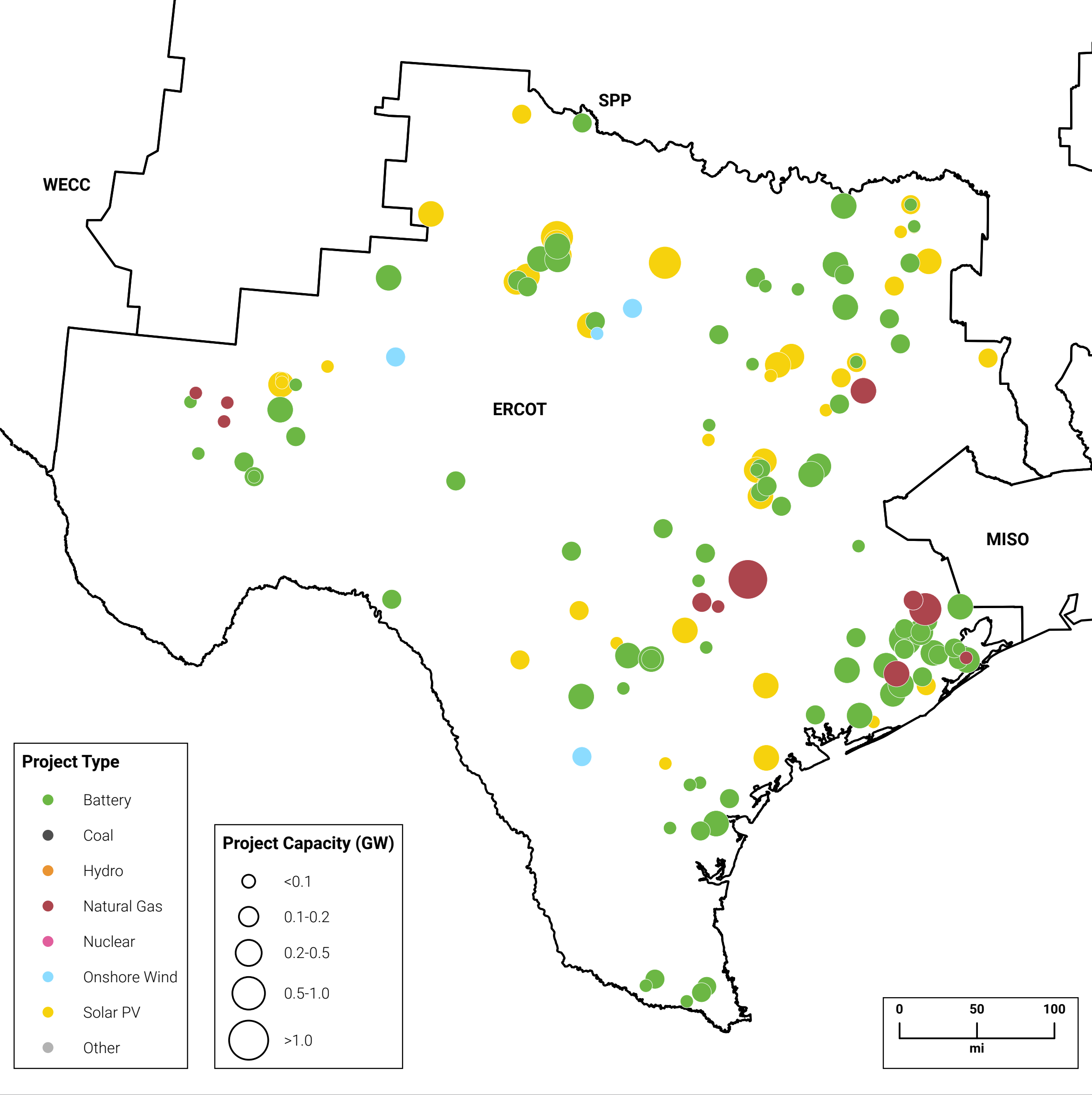
Type
2025 New Capacity (GW)
2026 Queued Capacity (GW)
2026 Under Construction (GW)
2026 Interconnection Agreement (GW)
Solar
8.8
13.0
7.9
0.7
Wind
1.5
3.7
0.2
0.4
Battery Storage
6.2
30.9
8.8
5.8
Natural Gas
<1
6.7
0.9
0.7

Source | Enverus Power & Renewables, Project Tracking Analytics

Policy Updates

  • ERCOT has been trying to attract more natural gas investment through their Texas Energy Fund. Earlier in the year, withdrawals from the fund required the ISO to relax their deadlines for development and funding. However, less than 50% of the targeted natural gas capacity has been reached through the fund, partially due to supply chain shortages for turbines.

Queue Backlogs / Delays

  • ERCOT still remains the fastest interconnection queue of the seven ISOs. This can be attributed to their unique Connect and Manage framework which streamlines the interconnection process by only offering ERIS, removing the need to study broader network upgrades for individual generators.

Time in Queue Analysis

  • Natural gas projects are the quickest to pass through the queue at 2.8 years. Wind and Solar projects are the slowest, sitting around 4.7 and 5.2 years, respectively.
  • In 2025, 65 Battery projects came online with an average timespan of 2.9 years in the queue. Of these projects, 38% are under 10 MW, and would therefore qualify for the streamlined small-load interconnection process.
  • 27% of queued projects planned for 2026 have been in the queue for longer than 5 years.

Transmission Analysis

  • ERCOT’s Strategic Transmission Expansion Plan includes the 765-kV Eastern Backbone Regional Planning Group Project and the 765-kV Link Regional Planning Group Project. Both projects will be the highest voltage transmission lines in the ERCOT region connecting the West to the North and South Load Zones.

Featured Projects

  • RWE’s 174 MW Honey Mesquite Wind Farm is expected to reach commercial operations by the end of 2026. GE Vernova has been announced as the turbine supplier for this project.
  • The 460 MW Gas-fired Pin Peaking Energy Center, developed by Calpine Corporation, is expected to be operational in mid-2026 and energization has already been approved by ERCOT. In October 2025, it was announced that this was the fourth project to receive a Texas Energy Fund loan agreement.
  • Hecate Energy’s 650 MW Pinnington Solar project is expected to reach commercial operation by mid-2026. This follows legal dispute where Repsol sold 40% stake in Hecate Energy Group to Hecate Holdings LLC.

PJM

Analyst Insights

ISO Outlook:

  • Supply Shortfall?: PJM forecasts substantially higher 2030 load than EIR, resulting in a 10% reserve margin, which is marginally better than today. However, EIR expects load growth to fall short of its forecast and the grid to be much better supplied than it is today, with a 20% reserve margin if all RRI projects are fast-tracked.
  • The Retirement Gap Crisis: PJM is losing traditional thermal plants faster than it can replace them. In the last 5 years, over 16 GW of older fossil-fuel plants have retired due to age and policy, while the backlogged interconnection queue has prevented enough new generation from coming online to fill the hole. This has forced PJM/operators to keep old thermal units running to prevent blackouts.
  • System-Wide Price at the Ceiling: For the 2026/2027 delivery year, beginning June 2026, capacity prices cleared at the cap of $329.17/MW-day across the entire PJM footprint. This represents a tenfold increase from 2024 levels ($28.92/MW-day) and signals a shift into “scarcity pricing.” 

Figure 8 | Projects with 2026 Operation Dates
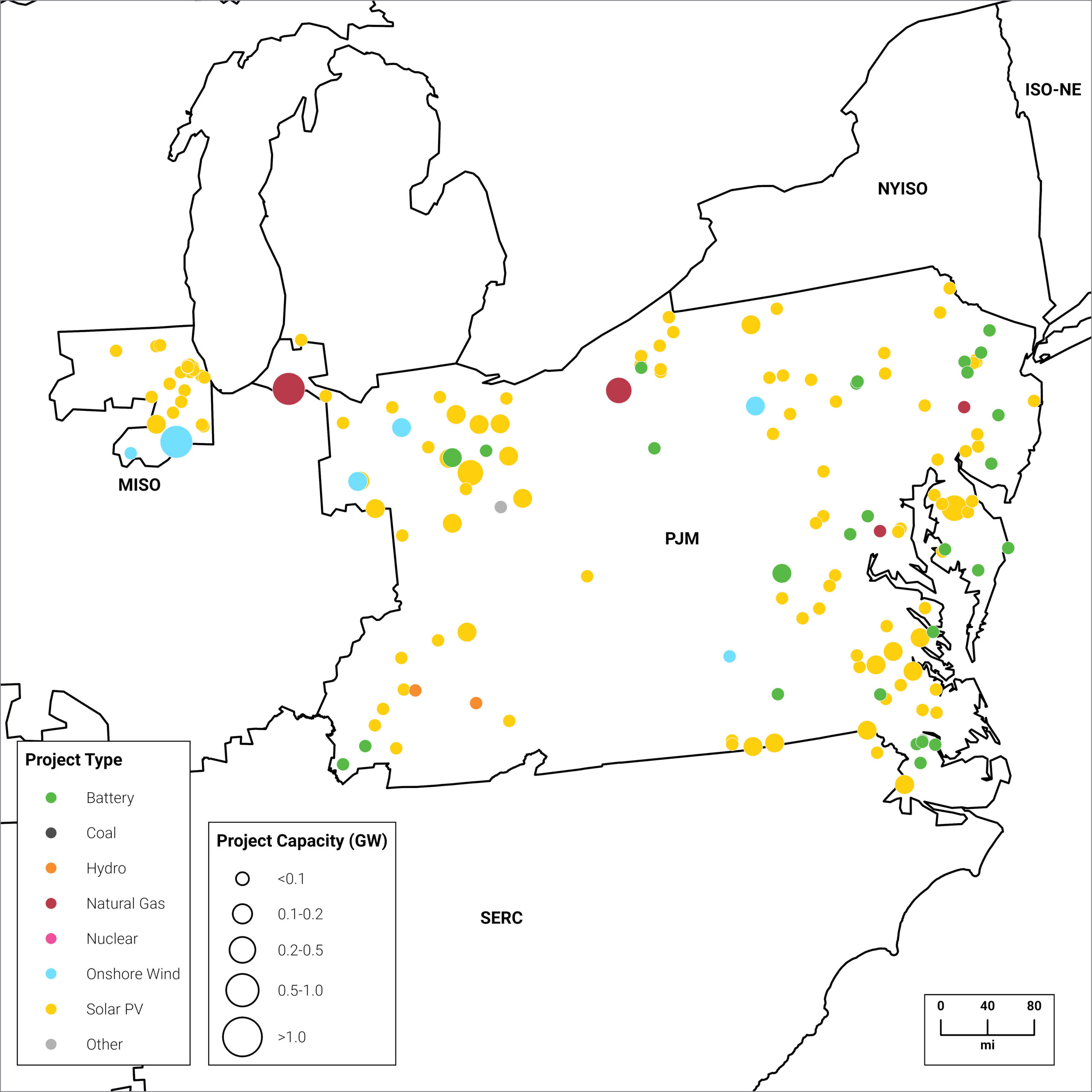
Type
2025 New Capacity (GW)
2026 Queued Capacity (GW)
2026 Under Construction (GW)
2026 Interconnection Agreement (GW)
Solar
3.4
25.3
4.7
1.7
Wind
0.3
6.1
1.4
0
Battery Storage
0.2
66.9
0.4
0.4
Natural Gas
<0.1
38.7
2.9
0

Source | Enverus Power & Renewables, Project Tracking Analytics

Policy Overview

  • PJM implemented their Transition Cycles aiming to transition generators from the old queue process to a new cluster study process. Now projects are studied together in a single process rather than on an individual basis.
  • PJM introduced their Reliability Resource Initiative in October 2024. This process aims to ensure resource adequacy in the region by fast-tracking selected resources, primarily gas and batteries, into their Transition Cycle 2 process.
  • PJM’s application deadline for Cycle 1 of their reformed interconnection process will be April 27, 2026. The processing time to get an interconnection agreement under the new process is stated to be two years.
  • To address load growth, PJM proposed the non-capacity-backed-load program. This program would decrease the need for generation capacity by prioritizing power curtailment to large loads during high demand periods.

Queue Backlogs / Delays

  • PJM continues to manage a substantial backlog of renewable and storage projects, with many still waiting to move beyond initial study stages. The transition to cluster-based studies helped streamline the interconnection process, but overall queue progress remains slow as the new framework is implemented.

Time in Queue Analysis

  • The average time in queue in 2025 was 7.2 years. Onshore wind had the greatest wait times at 13.7 years and solar and batteries the lowest at 6.9 years.
  • 24% of projects planned for 2026 have been in the queue for longer than 5 years.

Transmission Analysis

  • The Mid-Atlantic Resiliency Link is a planned 107.5-mile, 500 kV transmission line developed by NextEra that would add a new high-voltage path across the Mid-Atlantic region. This area often emerges as a source of east-west transfer limitations in PJM’s interconnection studies, affecting renewable and thermal projects trying to move power east.

Featured Projects

  • The 2.5 GW Coastal Virginia Offshore Wind project, developed by Dominion Energy, was expected to come online by the end of the year. However, a recent stop-work order from the Federal Government has made the timeline of this project uncertain and has resulted in a multi-billion-dollar lawsuit against the Department of the Interior. If completed, it would be the country’s largest offshore wind project.
  • The 1 GW Trumbull Energy Center Is expected to come online in early 2026. Developed by Clean Energy Future LLC, this project consists of two Siemens combustion turbines with two heat recovery steam generators and a single steam turbine.
  • The 150 MW/600 MWh Prospect Power Storage project is a four-hour storage facility being developed by Swift Current Energy. The project is part of a 15-year power purchase agreement with Dominion Energy Virginia and would be the largest battery storage project in Virginia.

MISO

Analyst Insights

ISO Outlook:

  • Coal Extensions to Prevent Shortfalls: The Department of Energy has issued emergency orders to keep major coal units operational past their scheduled 2025 retirement dates. These backstop measures are critical to maintaining MISO’s reserve margins as retirements of dispatchable plants continue to outpace the integration of new solar and wind.
  • The “Fast Lane” Interconnection: To meet load growth request this year, MISO implemented an Expedited Resource Addition Study (ERAS). This “fast pass” system is successfully shortening the time to sign Interconnection Agreements from years to days for shovel-ready projects. In 2026, MISO is processing four cycles of these fast-lane projects, which are notably prioritizing natural gas and dispatchable resources to balance the grid.
  • Record High Summer Scarcity Pricing: Following the 2025/2026 auction, which saw summer capacity prices skyrocket to $666.50/MW-day in many zones, 2026 is the first year where scarcity pricing is considered the new baseline. This has triggered a surge in Demand Response participation, with over 9 GW of load-side flexibility now clearing the market to offset the shrinking 2.6 GW physical capacity surplus.
  • Shift to Winter Risk and New Accreditation: 2026 marks a fundamental change in how MISO values power plants. Under the new Direct Loss of Load (DLOL) accreditation, solar and wind are being de-rated for winter reliability. For example, while solar gets a 50% credit in summer, it is only credited at 5% for Winter 2026, forcing utilities to secure more thermal or battery backup to meet the winter reserve margin requirement.

Figure 9 | Projects with 2026 Operation Dates
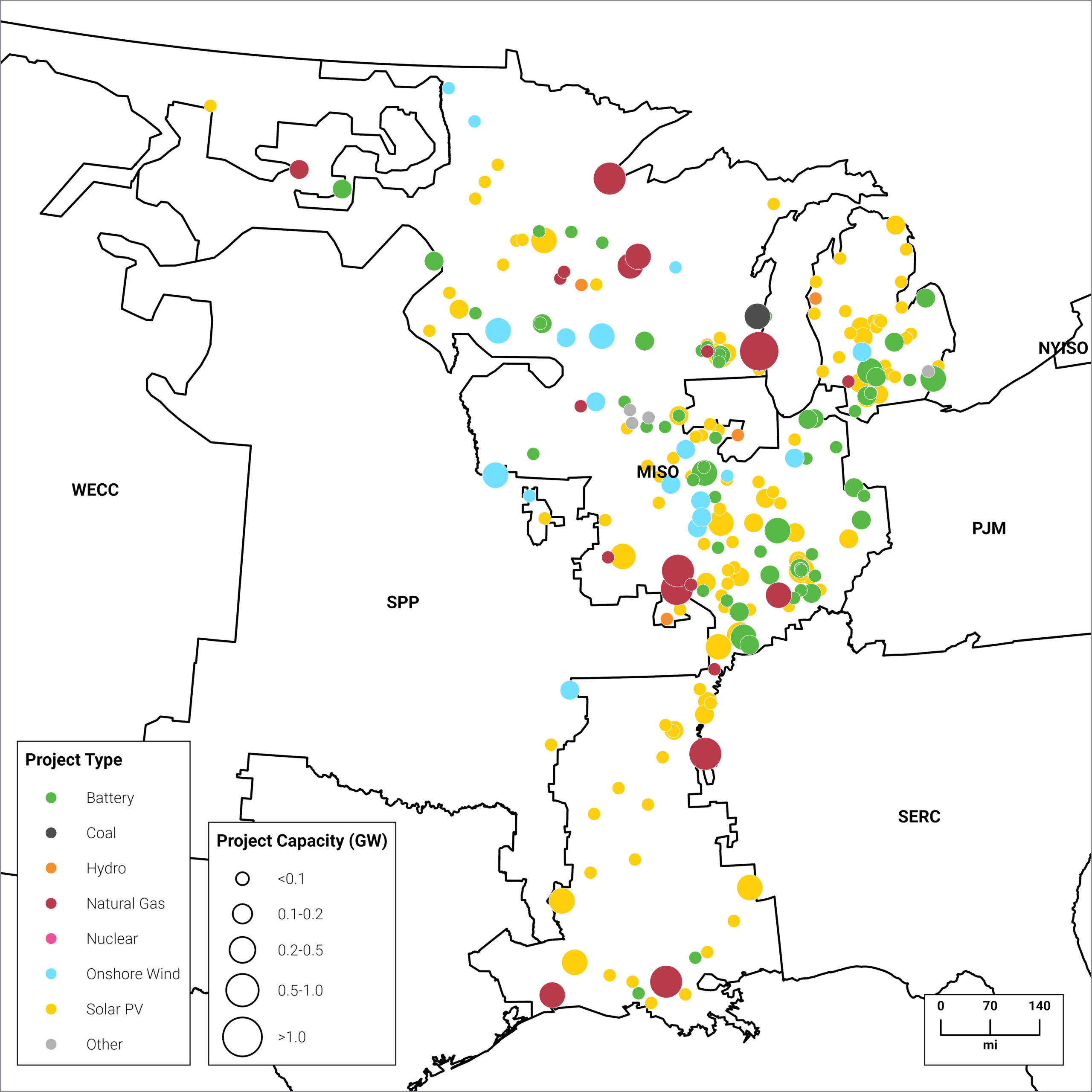
Type
2025 New Capacity (GW)
2026 Queued Capacity (GW)
2026 Under Construction (GW)
2026 Interconnection Agreement (GW)
Solar
5.6
29
7.0
3.5
Wind
0.5
12
1.2
1.4
Battery Storage
0.7
21
0.9
6.1
Natural Gas
0.5
<1
2.3
5.3

Source | Enverus Power & Renewables, Project Tracking Analytics

Policy Overview

  • In early 2025, FERC approved an interconnection queue cap in MISO. This sets a capacity ceiling at 50% of a study region’s non-coincident peak value. Some exemptions apply, such as for projects that are replacing retiring capacity.
  • MISO introduced their Expedited Resource Adequacy Study (ERAS). 2 Cycles of MISO’s ERAS study were completed in 2025, resulting in 25 projects being reviewed for interconnection agreements. MISO will continue to evaluate projects in 2026 until 68 projects, or a deadline of August 31, 2027 is reached.

Queue Backlogs / Delays

  • MISO’s interconnection queue remains heavily backlogged, with many projects still facing multi-year delays due to high application volumes, transmission constraints, and limited study capacity. The average time spent in the interconnection queue is just over six years.
  • Recent reforms, including stricter entry requirements, a new queue cap, proposed expedited study pathways, and increased study automation, are aimed at reducing processing times. MISO’s long-term goal is to bring average queue processing closer to one year by around 2028.
  • Using Pearl Street’s SUGAR automation software, MISO was able to gain significant headway in clearing their historic queue backlog. The software successfully aligned with MISO’s internal analysis over 99% of the time and reduced a two-year study process to just 10 days.

From 2.5 years to less than 90 days: 

MISO implemented study automation technology in 2025 enabling a stalled DPP 2022 cycle cluster to reach its first decision point and provide Phase 1 DPP 2023 results in less than 90 days.  

Time in Queue Analysis

  • The average wait time for projects that came online in 2025 was 6.8 years, which is comparable to 2024 timelines at 6.1 years. Average queue times were the lowest for onshore wind projects at 3.4 years and greatest for natural gas projects at 7.1 years.
  • 13.5% of projects coming online in 2026 have been in the queue for longer than 5 years.

Transmission Analysis

  • Cargas 500 kV and Smalling 500-230 kV stations, project submitted through Expedited Project Review (EPR) process, cost $1.21 billion, and expected in service date of December 2026. Entergy to build two new 500/230 kV stations, two 27-mile 500 kV lines from Smalling to Cargas. The Smalling 230 kV station will be a breaker and a half substation, including four 1,500 MVA 500/230 kV autotransformers and eight 230 kV lines going to six 230 kV stations. The Cargas 500 kV station will be cut into the Perryville to Sterlington 500 kV lines 1 and 2 and Perryville to Baxter Wilson 500 kV line.
  • LEAP Transmission Network – Wabash Valley Power Association will connect into the Whitestown-Hortonville 345kV line and construct a new 345/138kV substation, approximately 10 miles of double circuit 345kV, two 138kV stations and approximately 25 miles of 138kV transmission to accommodate new demand from data centers.

Featured Projects

  • The 349 MW Kelso Solar Project is being developed by Arevon and Tenaska in Scott County, Missouri. It is scheduled to come online at the end of February 2026.
  • The 417 MW Pulaski County Solar project, being developed by Vistra, is expected to come online sometime in 2026. The project is being located near the retired Joppa coal-fired power plant and will connect to the grid at the Joppa site through an 8-mile transmission line.

SPP

Analyst Insights

ISO Outlook:

  • Launch of RTO West: On April 1, 2026, SPP officially expands its RTO footprint into the Western Interconnection. This makes it the first grid operator in the U.S. to manage power across both major interconnections. The integration adds utilities from Arizona, Colorado, and Utah, utilizing three DC interties (510 MW) to balance SPP’s massive wind surplus in the East with Western demand.


  • Wind Saturation Faces a Storage Pivot: With wind providing approximately 40% of SPP’s annual generation, 2026 marks a saturation point where intermittency risk has become the primary operational hurdle. Following a 2023 event where wind output dropped to just 100 MW during a peak hour, SPP has prioritized batteries and hybrid projects in the queue. In 2026, new accreditation rules are in full effect, requiring 4-hour minimum durations for storage to receive full capacity credit.


  • Tightening Reserve Margins and Winter Risk: For the first time, SPP is enforcing a 36% Winter Planning Reserve Margin in 2026 (compared to 16% for Summer). This is a direct response to Winter Storms Uri and Elliott, which proved the region is more vulnerable to extreme cold than heat. To meet this, SPP has significantly increased the deficiency penalty for utilities that fail to secure enough firm capacity, rising 64% to $280/kW-year this cycle. 

Figure 10 | Projects with 2026 Operation Dates
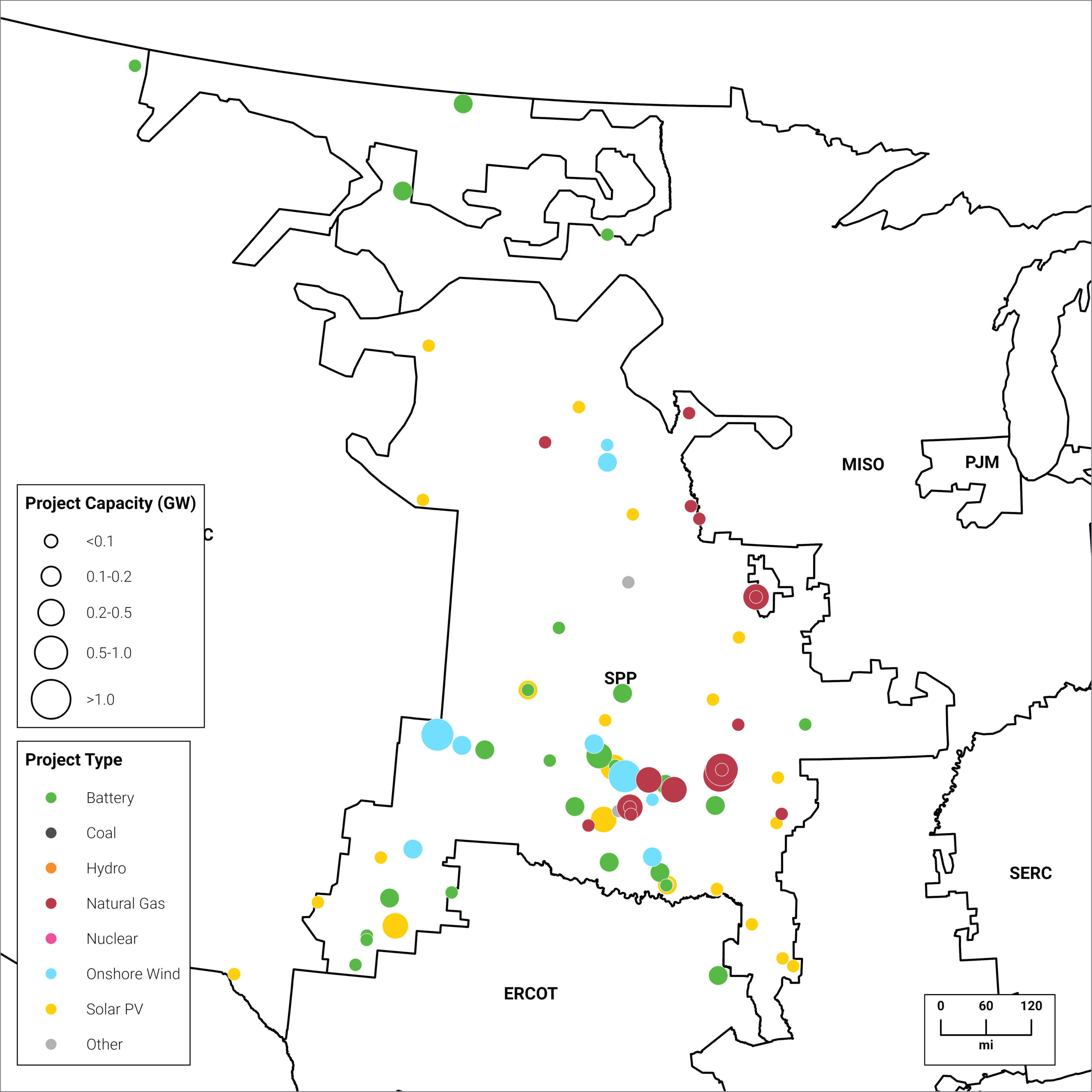
Type
2025 New Capacity (GW)
2026 Queued Capacity (GW)
2026 Under Construction (GW)
2026 Interconnection Agreement (GW)
Solar
0.6
3.5
1.7
0.8
Wind
1.1
3.7
0.9
1.4
Battery Storage
0.2
8.1
0.5
3.1
Natural Gas
1.8
6.5
1.0
3.0

Source | Enverus Power & Renewables, Project Tracking Analytics

Policy Overview

  • SPP’s Expedited Resource Adequacy Study (ERAS) was introduced last year. In SPP’s ERAS, capacity is nominated by load-responsible entities and runs separately to their standard Generation Interconnection queue.
  • SPP introduced their Priority Processing Application late 2025. This will allow generating facilities to expand up to 20% of their capacity under an expedited review process. Any facility can use this process once and must meet certain eligibility requirements.
  • In September 2025, SPP introduced the Consolidated Planning Process (CPP) to accelerate interconnection timelines and reduce costs. The CPP would join the region’s Integrated Transmission Plan and General Interconnection queue into a single process. The CPP effective date will begin in Q1 2026, with full implementation to begin in 2027.

Queue Backlogs / Delays

  • While SPP had already shortened study durations to 18 months, CPP is expected to cut this further to just 7 months, significantly improving efficiency. The new process is projected to deliver $6 million in savings every four years and more than $100 million over time by streamlining high-voltage transmission planning.
  • Since 2022, SPP has reported strong progress in clearing its backlog: 25 cluster studies completed, 190 Generation Interconnection Agreements (GIAs) signed representing over 30 GW, with an additional 20 GW anticipated to sign in the coming year. These milestones underscore SPP’s commitment to faster, more cost-effective integration of new generation resources.

Time in Queue Analysis

  • Average time in the queue from new projects in 2025 was 6.4 years, which is lesser than the 2024 average of 8.4 years. Onshore wind had the greatest wait times (11.7 years) and batteries the lowest (2.1 years).
  • 17.8% of projects coming online in 2026 have been in the queue for longer than 5 years.

Transmission Analysis

  • The Wekiwa–Sooner 345 kV transmission project, a 76-mile line developed by Transource, is designed to relieve congestion and reduce costs for customers, with estimated savings of $16.8 million in the first year and $465.6 million over 40 years. This branch is critical for SPP’s interconnection queue because the Wekiwa and Sooner substations together host over 1 GW of planned generation—primarily onshore wind—either directly connected or along this corridor. By increasing injection capability and improving system flexibility, the project enhances the likelihood that future renewable plants can be built and deliver power efficiently to the grid.

Featured Projects

  • The Grand River Dam Authority will add a new 594 MW simple cycle unit to its Grand River Energy Center in Q2 2026. This unit will replace the final coal-fired unit at the Center and will also include the world’s largest selective catalytic reduction system to ensure minimal nitrogen oxide emissions.
  • Entergy’s 1.3 GW Orange County Advanced Power Station is expected to come online in mid-2026. The project is a combined-cycle power plant and will use a combination of natural gas and hydrogen for fuel. The plant will replace the Sabine plant’s aging gas-fired generating units, which are slated for retirement next year.
  • The 1000 Mile Solar Project developed by Longroad Energy will provide 300 MW to Meta’s data center expansion through a power purchase agreement.

CAISO

Analyst Insights

ISO Outlook:

  • The “Slice-of-Day” Shift: 2026 is the first full year under the CPUC’s new Slice-of-Day Resource Adequacy (RA) framework. This mandates that utilities prove they have enough power for all 24 hours of the day, not just the single afternoon peak. This has forced a massive procurement shift toward Long-Duration Energy Storage (LDES) and firm imports, as solar no longer provides any capacity credit for the critical evening window.


  • Storage as the New Baseload: California’s battery fleet has surpassed 12 GW of installed capacity in 2026. These batteries are now the single most important resource for grid stability, regularly providing over 25% of the system’s total energy during the evening ramp.


  • The Reliability Reserve: Despite aggressive decarbonization goals, 2026 sees the continued operation of the Strategic Reliability Reserve, a fleet of old natural gas peaker plants and the Diablo Canyon nuclear plant, now licensed through 2030. These resources are being held as a multi-gigawatt backstop because, despite the battery boom, CAISO’s load continues to increase due to rising cooling loads and EV charging. 

Figure 11 | Projects with 2026 Operation Dates
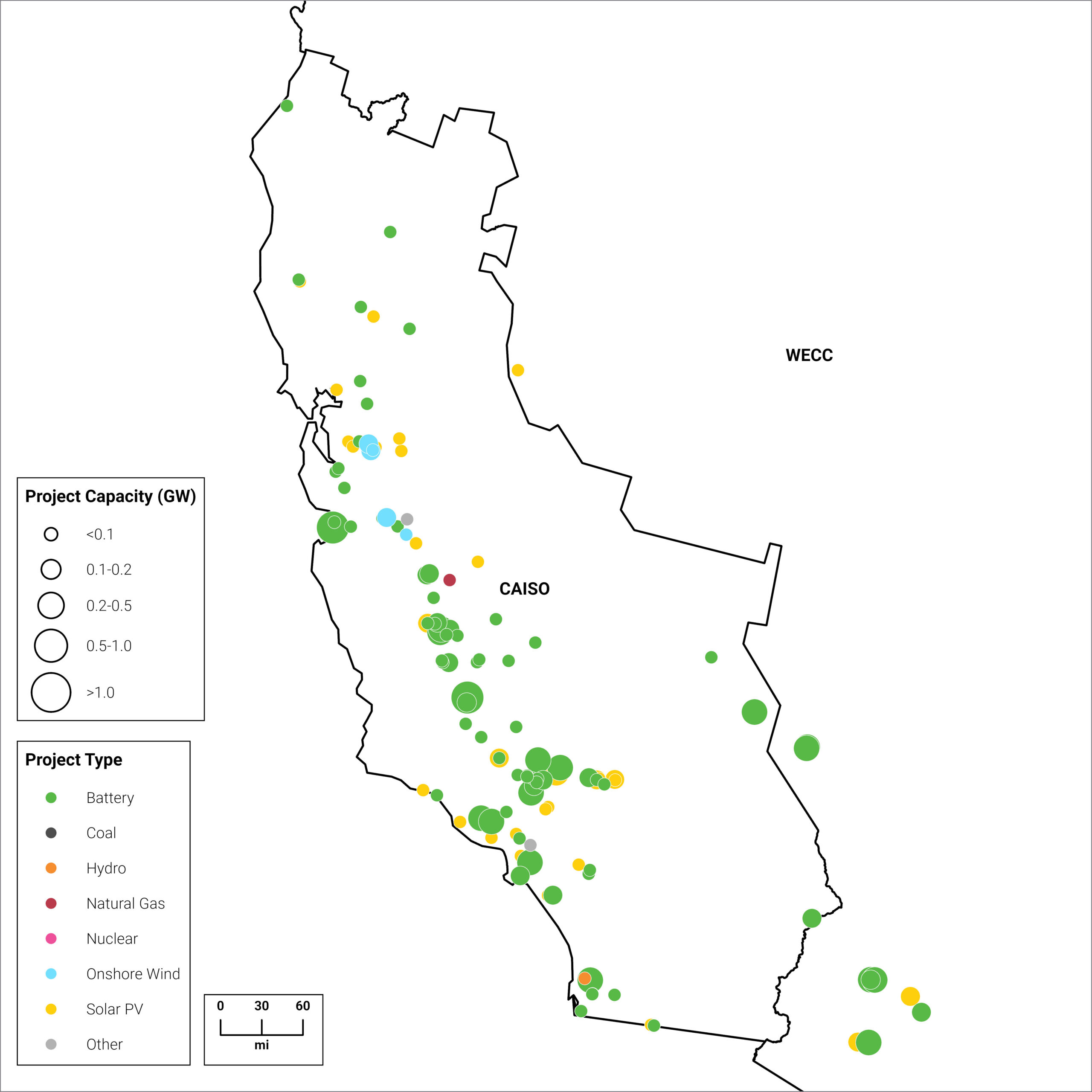
Type
2025 New Capacity (GW)
2026 Queued Capacity (GW)
2026 Under Construction (GW)
2026 Interconnection Agreement (GW)
Solar
2.9
5.6
2.9
0.9
Wind
<0.1
0.6
0.1
0.3
Battery Storage
5.7
20.1
3.6
7.2
Natural Gas
<0.1
1.8
0
<0.1

Source | Enverus Power & Renewables, Project Tracking Analytics

Policy Overview

  • California still aims for 100% carbon-free electricity by 2045 through Senate Bill 100 which was passed in the state’s legislature in 2018.
  • CAISO launched Interconnection Process Enhancements 5.0 in 2025, streamlining interconnection by removing sustainability-goal requirements for non-LSE-backed projects and requiring proof of a PPA for projects requesting commercial operation date extensions beyond seven years.

Queue Backlogs / Delays

  • In 2025, 30 projects in the CAISO queue became operational, totaling 5.7 GW. Those projects had an average time in the queue of 8.7 years, 8.4 years for solar and 8.8 years for battery projects. This is a slight improvement over the previous year, when the average time in queue for newly operating projects was 9.2 years. Looking forward to 2026, there are 68 projects, totaling 9.7 GW, projected to go operational. If all these projects hit their projected operating dates, their average time in the queue before operating will be 9.0 years- 8.8 years for solar, 9.1 years for battery, and 8.7 years for wind. These numbers indicate that there is still work to be done to clear out the CAISO queue backlog- projects do not appear to be moving faster through the queue today than they have the last few years.

Time in Queue Analysis

  • Average time in the queue in 2025 was 8.5 years, which is lower than the average of 9.3 years for 2024 projects.
  • 21.7% of projects coming online in 2026 have been in the queue for longer than 5 years.

Transmission Analysis

  • The Round Mountain 500 kV Area Dynamic Reactive Support Project is a 90-mile, 500 kV above ground reliability rebuild in the PG&E transmission area. It began construction in February 2024, and is expected to be completed in Q1 2026. This project includes construction of a new Fern Road substation, and upgrades to the Round Mountain and Table Mountain substations. This project is needed to ensure reliability of the CAISO grid, by mitigating excessive high voltage and dynamic stability issues near the Round Mountain substation.

Featured Projects

  • Scout Clean Energy’s 133 MW Gonzaga Ridge Wind Farm will be paired with a 52 MW battery storage project and is expected to come online in Q1 2026. The project will replace a 30-year-old wind farm located in Merced County.
  • Centennial Flats is a battery and solar farm located in CAISO’s Arizona footprint being developed by Eolus. The project consists of a 500 MW solar farm alongside 267 MW of battery storage and is part of a 15-year power purchase agreement with Southern California Edison. The project is expected to come online in Q1 2026.
  • Avantus’ Aratina Solar Center is a 470 MW solar farm with a 313 MW of co-located battery storage located in Kern County. It is being developed in multiple phases, with 320 MW of solar and 200 MW of batteries currently under construction and expected online in late Q2 2026. The remainder has not yet begun construction, but is expected online in late 2027.

ISO-NE

Analyst Insights

ISO Outlook:

  • The Shift to Seasonal Market Design: In January 2026, ISO-NE officially filed a landmark proposal with FERC to overhaul its capacity market. The region is moving away from the three-year Forward Capacity Auction (FCA) model toward a Prompt auction and a seasonal construct, procuring capacity just months ahead. This is specifically designed to send more accurate price signals for winter reliability, reflecting the unique pipeline constraints that make gas-fired generation less certain during New England cold snaps.

  • Winter Scarcity and the “REST” Framework: This year, ISO-NE has fully operationalized the Regional Energy Shortfall Threshold (REST) and the Probabilistic Energy Adequacy Tool (PEAT). These new metrics allow operators to quantify energy shortfall risk rather than just capacity risk. 

  • Offshore Wind Stalled by Federal & Economic Headwinds: Despite ISO-NE’s advocacy for offshore wind as a pillar of future reliability, the industry has hit a wall in 2026. Developers are currently battling federal stop-work orders, issued in late 2025. Combined with undesirable project economics, driven by a 30% rise in capex and high interest rates, these headwinds threaten to scuttle projects that were already under construction. 

Figure 12 | Projects with 2026 Operation Dates
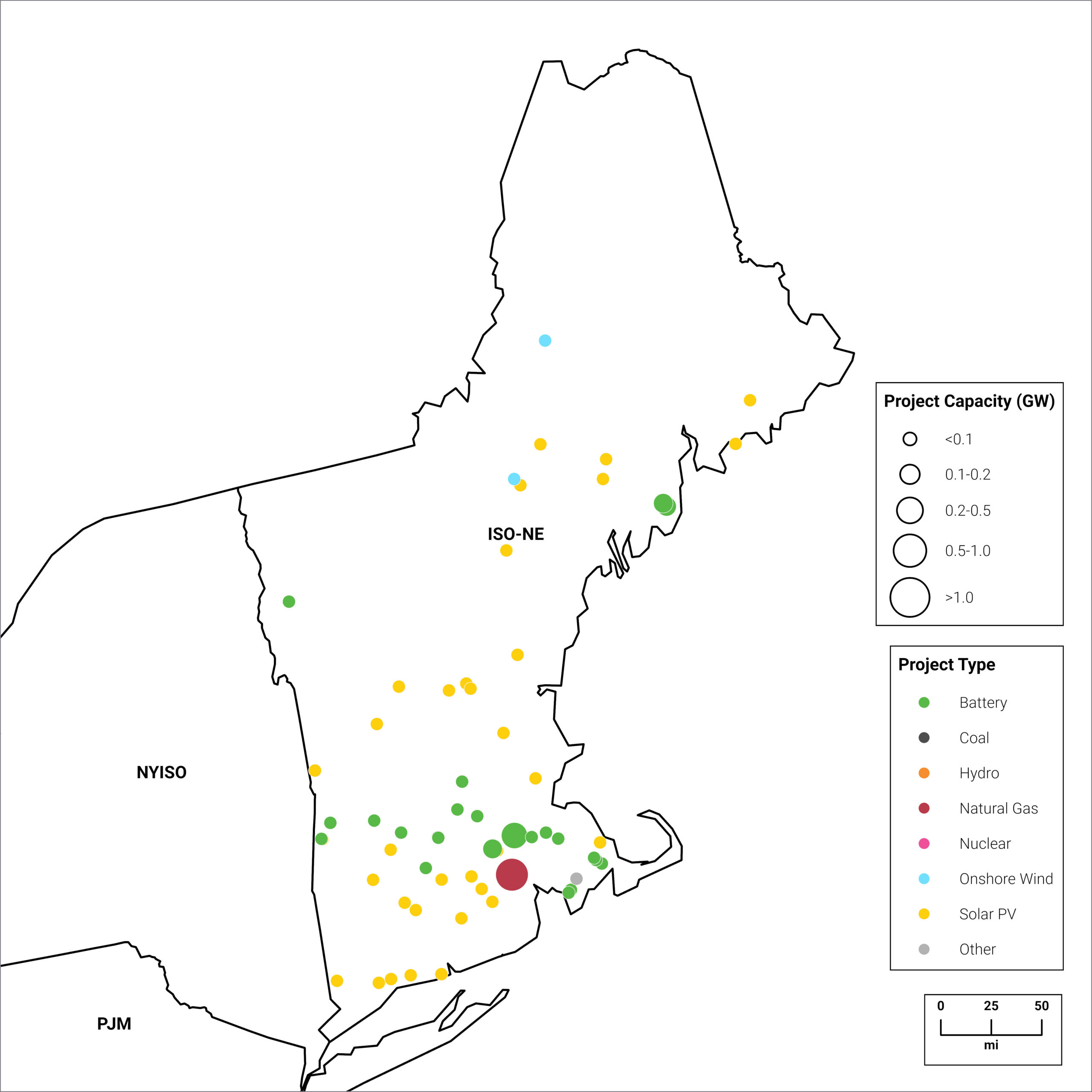
Type
2025 New Capacity (GW)
2026 Queued Capacity (GW)
2026 Under Construction (GW)
2026 Interconnection Agreement (GW)
Solar
0.5
2.8
0.2
0.1
Wind
0.2
0.3
<0.1
<0.1
Battery Storage
0.5
2.9
<0.1
0.8
Natural Gas
0
0.7
0
0.6

Source | Enverus Power & Renewables, Project Tracking Analytics

Policy Overview

  • ISO-NE launched their new “first-ready first-served" transitional cluster study in Q4 2025, the first under a new queue framework. 26 interconnection requests are under review, 21 of which are storage projects. These requests are expected to be completed by August 2026. The request window for the first full cluster study will open in October 2026.
  • The Clean Energy Act, signed into Massachusetts law in November 2024, directs Massachusetts utilities to enter long-term contract for 5 GW of energy storage systems by 2030. A Request for Proposals for 1.5 GW of 4- to 10-hour storage was released in July 2025, funded through the Clean Peak Standard. About 1 GW of mid-duration storage is scheduled to be procured by July 2026.

Queue Backlogs / Delays

  • ISO-NE is shifting to a cluster-based interconnection study process, as required by FERC Order 2023, which should eventually reduce delays by evaluating projects together rather than one-by-one. The transitional cluster study is scheduled to be completed by Aug. 6, 2026.

Time in Queue Analysis

  • Average time in the queue for 2025 projects was 6.5 years, which is longer than the average time in 2024 at 4.3 years. Onshore wind took the longest time in 2025 between queue date and first power date at 12.5 years, while solar projects were the quickest to connect at 5.3 years.
  • 7.0% of potential projects coming online in 2026 have been in the queue for longer than 5 years.

Transmission Analysis

  • Avangrid’s New England Clean Energy Connect has received its final permit needed to begin operations in January 2026.
  • The 145-mile transmission line has been in the works for eight years and will reshape project economics along the corridor by adding 1,200 MW of controllable import capability, ultimately feeding hydropower from Canada into the Maine 345-kV backbone and down toward New Hampshire and Massachusetts.
  • Import/export nuances under Trump’s 2025 trade and permitting regime add a policy risk overlay for both ISO-NE and Canadian counterparts. Flows will remain shaped by Hydro-Québec’s water conditions as well as respective load growth in both regions.

Featured Projects

  • Revolution Wind is a 704 MW offshore wind farm which is being developed by Ørsted and Deepwater Wind, with ownership belonging to Skyborn Renewables and Ørsted. Revolution was the subject of a stop-work order by the federal government which was overturned in September 2025 following a ruling by U.S. District Court Judge Royce Lamberth that there was a lack of justification for the order. The Bureau of Ocean Energy Management has passed the deadline to appeal the judge’s decision, meaning the project will continue its construction and is expected to come online in 2026. A second stop-work order was filed by the Department of the Interior in December 2025 which will be challenged again by the developers.
  • Hecate Energy's Eastern Ave Energy Center is a 250 MW/1,000 MWh energy storage project under development in Chelsea, MA. Strategically located in the Greater Boston area, the project is planned to interconnect to the 488 Chelsea 115 kV substation owned by Eversource Energy. It entered the ISO-NE interconnection queue in April 2021 and is targeting commercial operation in November 2026.
  • Taft BESS is a 200 MW / 800 MWh energy storage project being developed by Flatiron Energy in Uxbridge, MA. As of September 2025, Flatiron has closed on $540 million USD of financing commitments towards this project which is now expected to be operational by the end of 2026. The financing commitments span construction and bridge loan facilities, term loan facilities, letter of credit facilities, a preferred equity commitment, and a tax credit transfer commitment.

NYISO

Analyst Insights

ISO Outlook:

  • Narrow Reliability Margins in NYC: As of early 2026, the reliability margin for New York City has dropped to a precarious 100 MW to 150 MW. This is driven by the Peaker Rule retirements of aging gas plants, like Gowanus and Narrows Barge. To prevent blackouts this summer, NYISO has been forced to keep several fossil fuel units online past their legal retirement dates, as new supply is not keeping pace with demand growth. 

  • Offshore Wind Stalled by Federal and Economics Headwinds: While ISO-NE and NYISO have been major advocates for offshore wind, 2026 is a year of significant retreat. New York has officially terminated its Public Policy Transmission Need (PPTN) process for offshore wind as of late 2025. This was a response to federal stop-work orders and undesirable project economics, including a 30% rise in capital costs, making the state’s goal of 9 GW by 2035 appear increasingly impossible to meet on schedule. 

  • The Interconnection Cluster and Storage Focus: NYISO is operating its first full year of the reformed Cluster Study process in 2026. There are currently over 19 GW of battery storage projects in this new queue. However, due to the failure of many projects to secure state-level Index Storage Credits, actual commercial operations for 2026 are expected to be far below the needed capacity to reach the 6 GW goal for 2030. 

  • Marginal Capacity Accreditation: Starting with the 2025/2026 capability year, NYISO has fully moved to Marginal Capacity Accreditation (MRI). This new math significantly derates the value of renewables and short-duration storage. For example, in 2026, solar is only credited for roughly 9.4% of its nameplate capacity toward reliability. This shift has triggered a price spike in the capacity market, signaling to developers that firm power is now the most valuable commodity in the state. 

Figure 13 | Projects with 2026 Operation Dates
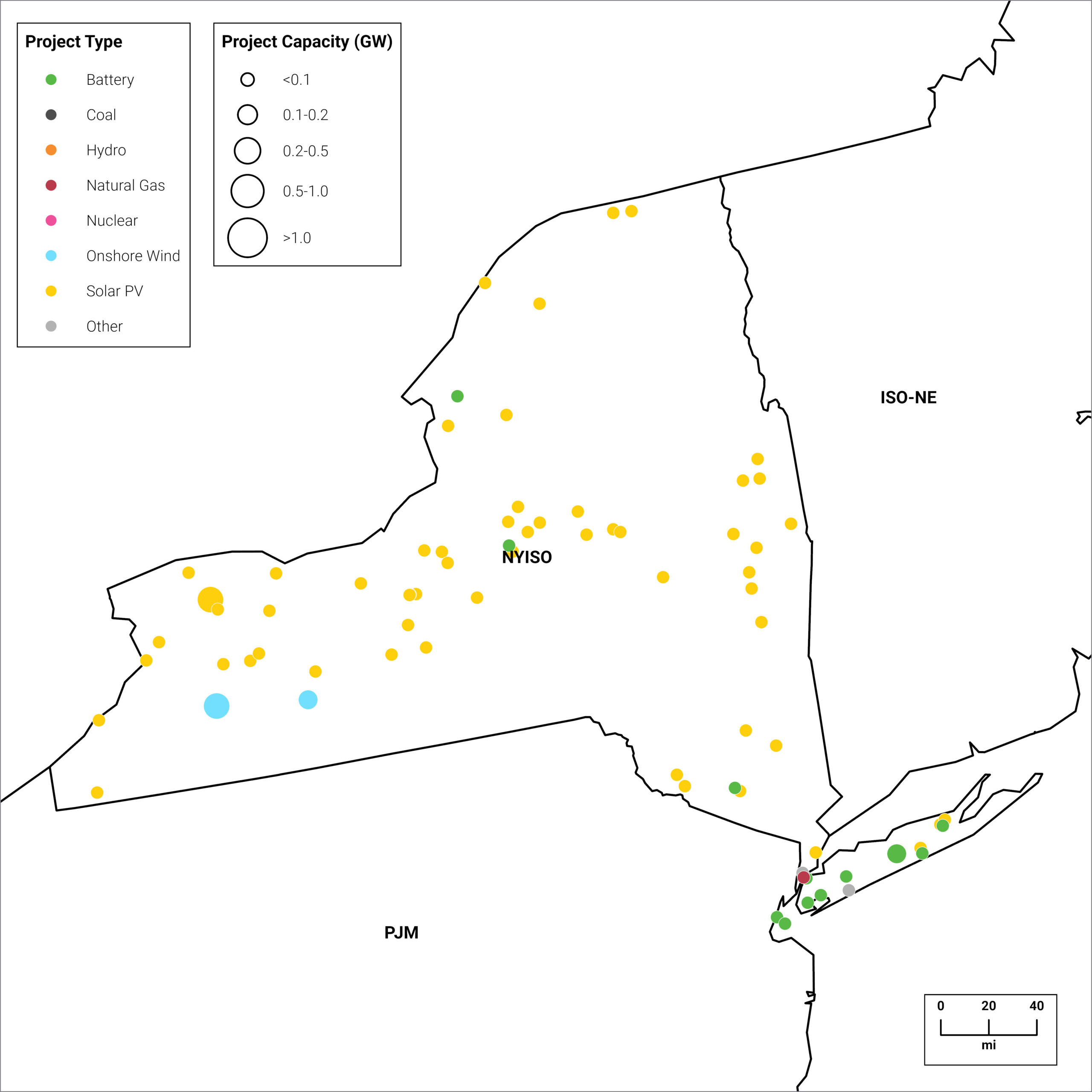
Type
2025 New Capacity (GW)
2026 Queued Capacity (GW)
2026 Under Construction (GW)
2026 Interconnection Agreement (GW)
Solar
0.4
3.3
0.7
0.4
Wind
0
0.5
0.5
0
Battery Storage
<0.1
2.6
0.2
0.3
Natural Gas
<0.1
1.1
<0.1
0

Source | Enverus Power & Renewables, Project Tracking Analytics

Policy Overview

  • In 2020, NYISO passed the Climate Leadership and Community Protection Act (CLCPA) which aims to make 70% of the state’s electricity from renewable energy sources by 2030, with zero emissions from electricity by 2040. Under their Energy Storage Goal, NYISO plans to add 6 GW of storage capacity by 2030.
  • In July 2025, FERC approved NYISO’s proposal to implement additional operating reserve requirements to better deal with forecast uncertainty in both day-ahead and real-time markets.
  • The New York Public Service Commission authorized New York State Energy Research and Development Authority (NYSERDA) to meet CLCPA targets through centralized procurement of RECs from developers to sell to utilities. This process only applies to projects which have reached Phase 2 of NYISO’s Cluster Study.

Queue Backlogs / Delays

  • NYISO is experiencing a significant interconnection backlog, with more than 500 projects in its queue and average wait times stretching to over six years, largely due to transmission constraints and a surge in applications. High attrition rates with nearly half to three-quarters of queued projects ultimately suspended or canceled further slow progress and clog the system. While NYISO’s recent shift toward cluster studies and ongoing transmission upgrades aim to streamline processing, interconnection delays remain one of the region’s biggest obstacles to bringing new clean-energy projects online.

Time in Queue Analysis

  • The average time in the queue for NYISO sits around 7 years since 2022, with the greatest lead times given to wind projects (7 to 17 years) and the shortest for battery projects (4 to 6 years).
  • 8.4% of projects coming online in 2026 have been in the queue for longer than 5 years.

Transmission Analysis

  • Propel NY Energy is a ~90-mile transmission buildout (underground and submarine lines + substations) slated to expand and modernize the transmission backbone across Long Island, New York City and Westchester County. By expanding high-capacity transmission capacity downstate, Propel NY reduces a major bottleneck that has constrained the delivery of large amounts of clean power (especially offshore wind or other renewables) into load centers. This helps unlock projects that are otherwise “stuck” behind transmission limits.

Featured Projects

  • Greenbacker Renewable Energy Company’s 500 MW Cider Solar project will be the ISO’s, and the developer’s, largest solar facility to date. The project is located in Genesee County and spans approximately 2,500 acres. The site is expected to also integrate agricultural activities, with sheep grazing on over 300 acres of the land, and expectations to expand agricultural activities on the site over its lifetime.
  • East River Energy storage set to come online by the end of 2026 is a 100MW battery storage system that would put it among the largest battery storage projects operating in the NYISO region. The site of the project sits at the former Charles Poletti Power Plant, showcasing NYISO's ability to turn a former brownfield site into a clean energy hub.
  • Empire Wind 1, an 810 MW offshore wind farm located south of Long Island faces uncertainty after an April 2025 stop work order forced construction of the project to stop temporarily, another hurdle came in Oct. 2025 when a 475 million installation vessel contract was terminated that was being specially built for Empire Wind 1 by Maersk Offshore wind. Both issues have shed light on the instability of federal policy and financing on large-scale projects across the NYISO region.

Arizona Public Service (AZPS)

Analyst Insights

  • The Growth Pays for Growth Model: To accommodate large energy users like the TSMC semiconductor plants and new AI data centers, AZPS is breaking ground in 2026 on the Desert Sun Power Plant, a 2,000 MW natural gas facility. Notably, Phase 2 of this project utilizes a first-of-its-kind subscription model, where large-load customers fund the capital costs directly to ensure residential ratepayers aren’t burdened by the infrastructure needed for industrial expansion.


  • Massive Battery Storage Deployment: 2026 is the year AZPS’s battery fleet becomes a core pillar of evening reliability. The utility is bringing online its largest-ever addition of storage, including the Desert Bloom (600 MWh) and Papago (1,200 MWh) projects. These systems are specifically designed to soak up Arizona’s massive midday solar surplus and discharge it during the critical 5:00 p.m. to 9:00 p.m. summer peak when air conditioning load is highest.


  • Palo Verde’s Role as a Regional Anchor: The Palo Verde Generating Station remains the bedrock of the AZPS portfolio in 2026, providing over 25% of the region’s carbon-free power. As other Western states retire firm capacity, AZPS is increasingly leveraging Palo Verde’s 3.2 GW of steady output to navigate the net peak challenges and to provide high-value exports to CAISO during California’s evening energy shortages.


  • Delay of Coal Retirements: Amidst a regional reliability crunch, AZPS has officially extended the life of the Four Corners Power Plant. Previously slated for a 2031 closure, AZPS confirmed in late 2025 that the 1,500 MW plant will now operate until no later than 2038. This 7-year extension is a direct response to soaring demand and the need for a firm, dispatchable bridge as the utility integrates more intermittent renewables. 

Figure 14 | Projects with 2026 Operation Dates
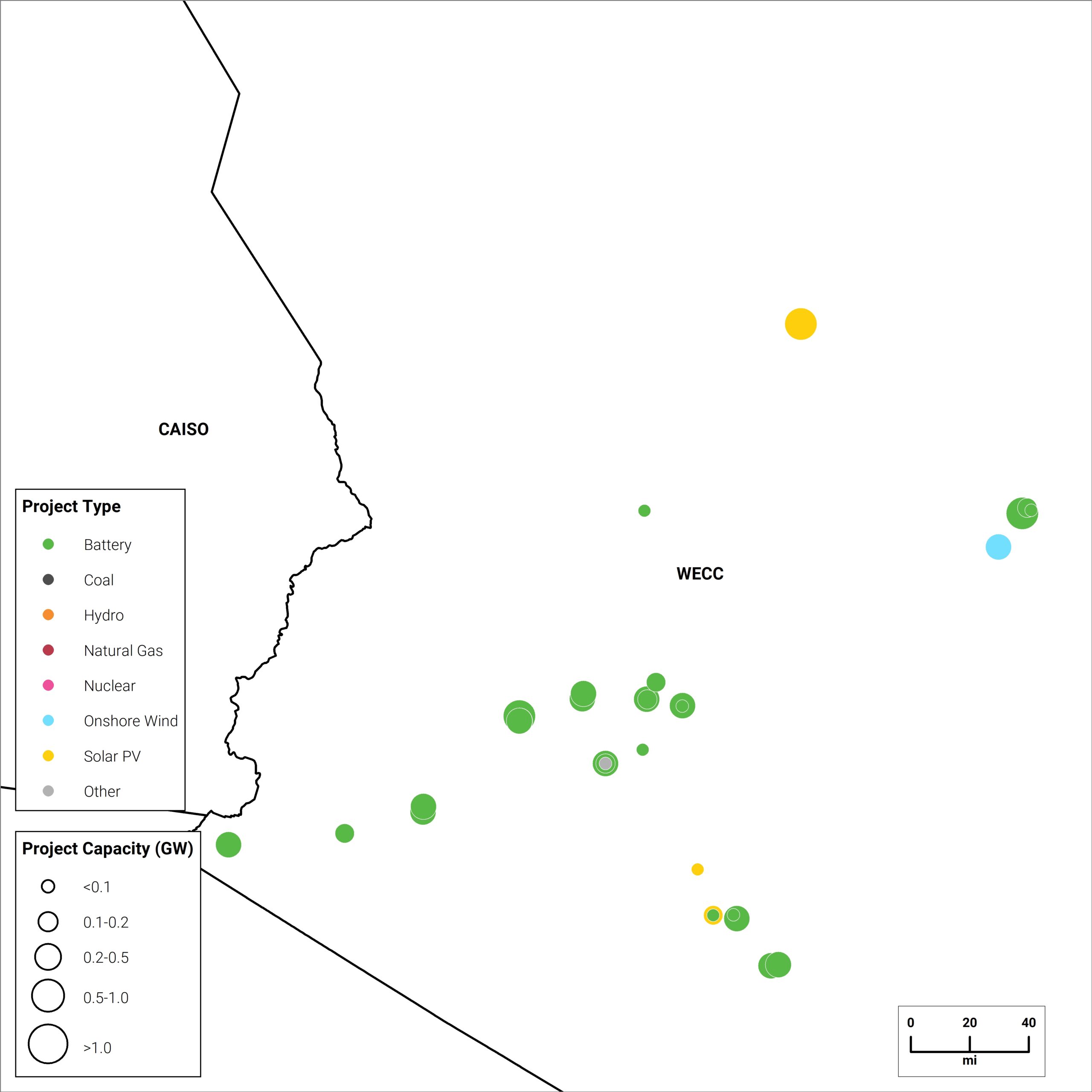
Type
2025 New Capacity (GW)
2026 Queued Capacity (GW)
2026 Under Construction (GW)
2026 Interconnection Agreement (GW)
Solar
<0.1
6.2
5.9
<0.1
Wind
0
0.7
0.5
0
Battery Storage
0.6
22.2
7.0
0.8
Natural Gas
0
1.7
0
0

Source | Enverus Power & Renewables, Project Tracking Analytics

Bonneville Power Administration (BPAT)

Analyst Insights

  • Cluster Study Interconnection Push: To handle a staggering interconnection queue, BPA is executing its first major Cluster Study cycle in 2026. This year alone, BPA is slated to connect two wind projects (392 MW) and nine solar projects (1,709 MW). Notably, this 2026 wave includes the first major integration of co-located battery storage to help the hydro system manage the extreme ramps caused by increasing wind penetration. 

  • Market Seams & Legal Clouds: As of January 2026, BPA’s plan to join SPP’s Markets+ is being challenged in the 9th Circuit Court of Appeals by five advocacy groups. The lawsuit, which filed its opening brief in late 2025, alleges that BPA’s May 2025 decision to bypass the CAISO-led EDAM violates the Northwest Power Act by ignoring studies, including one by Oregon and Washington state agencies, showing a unified market could have saved the region $4.4 billion. While BPA is targeting a 2028 market launch, the litigation has created a regulatory cloud in 2026, as critics argue the split will lead to market seams that increase electricity costs and reduce grid efficiency just as California’s EDAM officially goes live this year. 

Figure 15 | Projects with 2026 Operation Dates
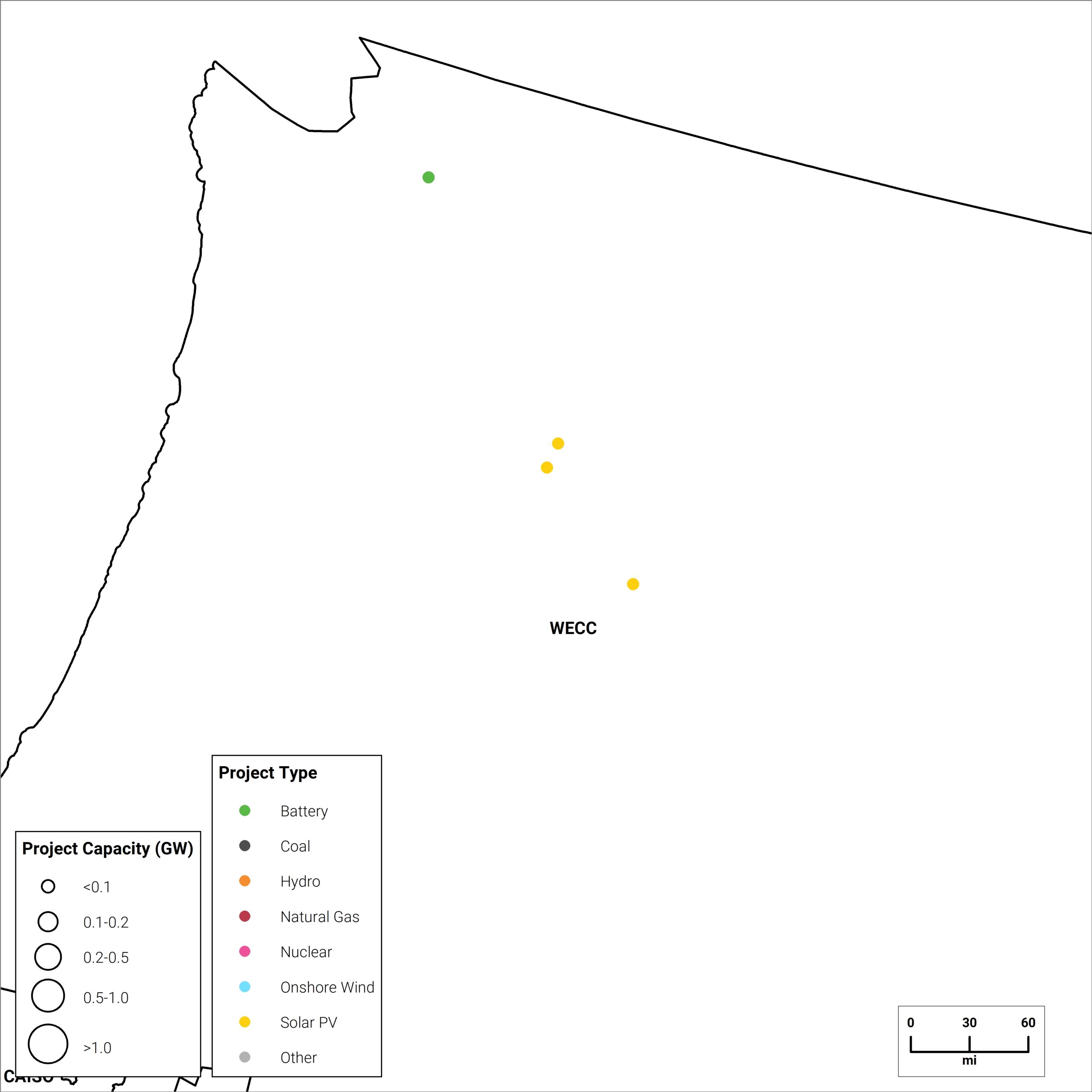
Type
2025 New Capacity (GW)
2026 Queued Capacity (GW)
2026 Under Construction (GW)
2026 Interconnection Agreement (GW)
Solar
0
0.3
0
0
Wind
0
0.2
0
0
Battery Storage
0
4.0
<0.1
0
Natural Gas
0
<0.1
0
0

Source | Enverus Power & Renewables, Project Tracking Analytics

PacifiCorp

Analyst Insights

  • Coal-to-Gas and Life Extensions: 2026 is a major execution year for PacifiCorp’s coal-to-gas conversion strategy. The utility is currently converting the 687 MW Naughton Power Plant in Wyoming to natural gas to bridge the gap until advanced nuclear arrives. Simultaneously, PacifiCorp has pumped the brakes on other retirements; units at Jim Bridger and Dave Johnston that were once slated for closure by 2027 have had those dates pushed back or canceled in favor of potential carbon capture retrofits to meet surging industrial demand.
  • Nuclear Island Groundbreaking at Natrium: While early non-nuclear construction began in 2024, 2026 marks the official start of nuclear island construction for the 345 MW Natrium advanced reactor in Kemmerer, Wyoming. This Bill Gates-backed TerraPower project is the centerpiece of PacifiCorp’s long-term firm capacity plan. Despite an expedited NRC review process announced in mid-2025, the project remains on a high-stakes timeline for a 2030 commercial launch, leaving the utility reliant on its fossil fleet for the remainder of the decade.
  • Aggressive Battery and Iron-Air Storage Deployment: To manage its 10,000+ MW wind and solar portfolio, 2026 is a deadline year for several massive storage projects. This includes the completion of the 100 MW Bakeoven Solar battery in Oregon by April 2026. Furthermore, PacifiCorp has officially integrated multi-day iron-air batteries (100-hour duration) into its 2026 procurement cycle, aiming to deploy over 600 MW of this long-duration technology by the early 2030s to solve the winter wind lull problem.
  • West’s First Day-Ahead Market: On May 1, 2026, PacifiCorp will make history as the inaugural member of the CAISO Extended Day-Ahead Market (EDAM). This transition, finalized after a landmark FERC ruling in late 2025, allows the utility to build on the $1 billion in savings already realized through real-time trading. By integrating into the EDAM this year, PacifiCorp aims to enhance grid reliability and lower costs for its 2 million customers across the West, effectively outpacing the development of the rival SPP Markets+ footprint. 

Figure 16 | Projects with 2026 Operation Dates
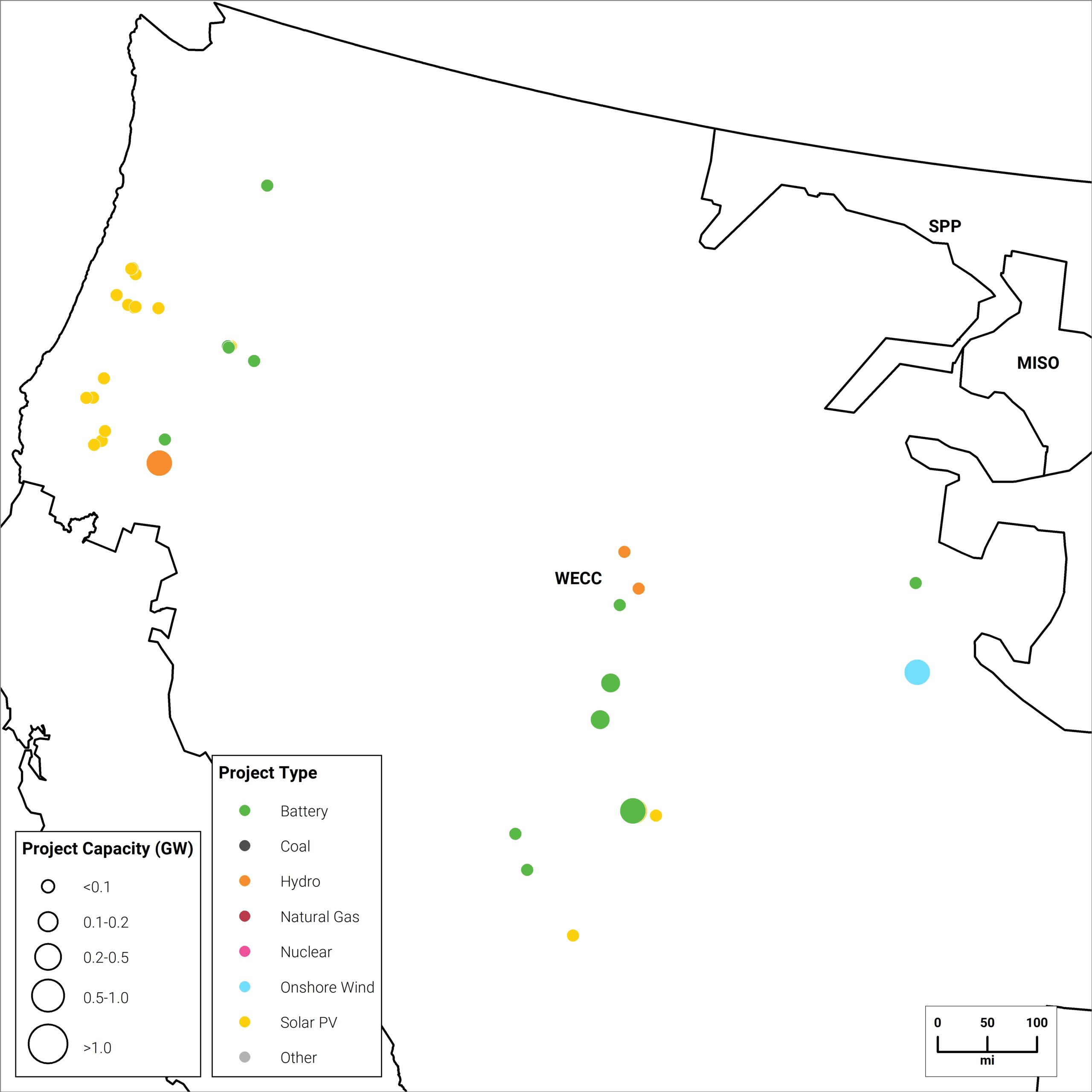
Type
2025 New Capacity (GW)
2026 Queued Capacity (GW)
2026 Under Construction (GW)
2026 Interconnection Agreement (GW)
Solar
0.8
1.4
0.6
0.6
Wind
0
1.4
0.4
0
Battery Storage
0.5
10.1
0.8
0.7
Natural Gas
0
0.7
0
0

Source | Enverus Power & Renewables, Project Tracking Analytics

Southern Company (SoCo)

Analyst Insights

  • Strategic Coal Reprieve and Gas Bridge: To prevent a reliability gap caused by the Data center surge, Southern Company has officially delayed the retirement of over 8,200 MW of coal capacity. Major units at Plant Bowen and Plant Scherer (Georgia) and Plant Daniel (Mississippi) that were originally slated for 2028 closures have had their lives extended to 2035 or 2039. In 2026, the utility is aggressively moving forward with co-firing natural gas at these sites to lower emissions while maintaining the firm dispatchable power required by data center operators. 

  • Capitalizing on the “Vogtle Advantage”: With Units 3 and 4 at Plant Vogtle now in steady-state commercial operation, Southern Company is leveraging its position as the leader in new U.S. nuclear. In 2025/2026, Southern Nuclear achieved a global milestone by installing Advanced Lead Test Assemblies (uranium enriched above historical 5% limits) in Unit 2. This innovation is a key part of SoCo’s 2026 strategy to extend fuel cycles and reduce operational costs across its nuclear fleet to offset rising interest rates and capex. 

  • Acceleration of the “Order 2023” Cluster Study: In response to the federal FERC Order 2023, Southern Company has launched its most rigid interconnection process to date for the 2026 cycle. The new Annual Cluster Study, opening February 2026, imposes strict readiness requirements, such as 6 acres/MW for solar and expensive withdrawal penalties, to clear placeholder projects out of the queue. This reform is designed to fast-track the 20,000 MW of renewables and storage Southern expects to have in its portfolio by the early 2030s. 

Figure 17 | Projects with 2026 Operation Dates
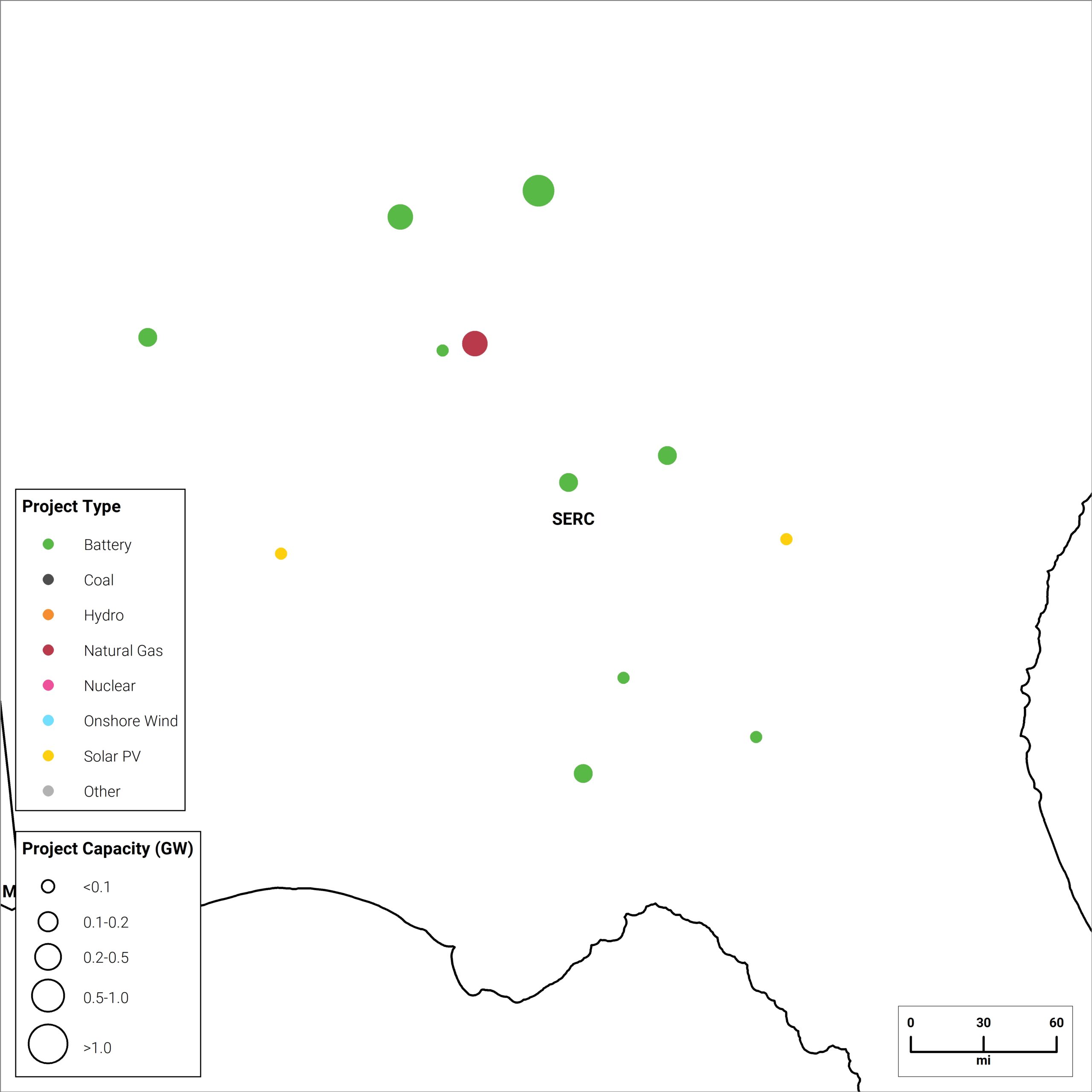
Type
2025 New Capacity (GW)
2026 Queued Capacity (GW)
2026 Under Construction (GW)
2026 Interconnection Agreement (GW)
Solar
0
0.6
<0.1
<0.1
Wind
0
0
0
0
Battery Storage
0
1.9
1.0
0.6
Natural Gas
<0.1
0.5
0
0.5

Source | Enverus Power & Renewables, Project Tracking Analytics

Duke

Analyst Insights

  • Delay of Coal Retirements: To ensure reliability during current demand surge, Duke has officially filed to delay the retirement of major coal units by two to four years. Under the 2025/2026 resource plan updates, the Belews Creek Steam Station is now slated to burn coal as late as 2040, with units at the Marshall and Rogers (Cliffside) plants also extended to the mid-2030s. This pragmatic pause is intended to provide a bridge until new nuclear and expanded battery storage are fully operational.


  • Natural Gas as a Permanent Pillar: In a significant shift from its 2023 plan, Duke’s 2026 strategy now treats natural gas as a foundation rather than a placeholder. The utility is moving forward with 9.7 GW of new gas capacity by 2033, including five massive combined-cycle units and seven combustion turbines. In early 2026, construction is ramping up at the Buck and Marshall Energy Complexes, where new hydrogen-capable gas units are being co-located with existing assets to maximize infrastructure efficiency.


  • The Nuclear Up-rate and SMR Push: With new nuclear being the only carbon-free firm power available in the are, Duke is currently executing a plan to add 300 MW of capacity simply by uprating its existing nuclear fleet through 2031. Furthermore, in early 2026, Duke is progressing through the Early Site Permit process for its first dedicated SMR project in North Carolina, targeting a late-2030s go-live to eventually replace the coal capacity extended this year. 

Figure 18 | Projects with 2026 Operation Dates
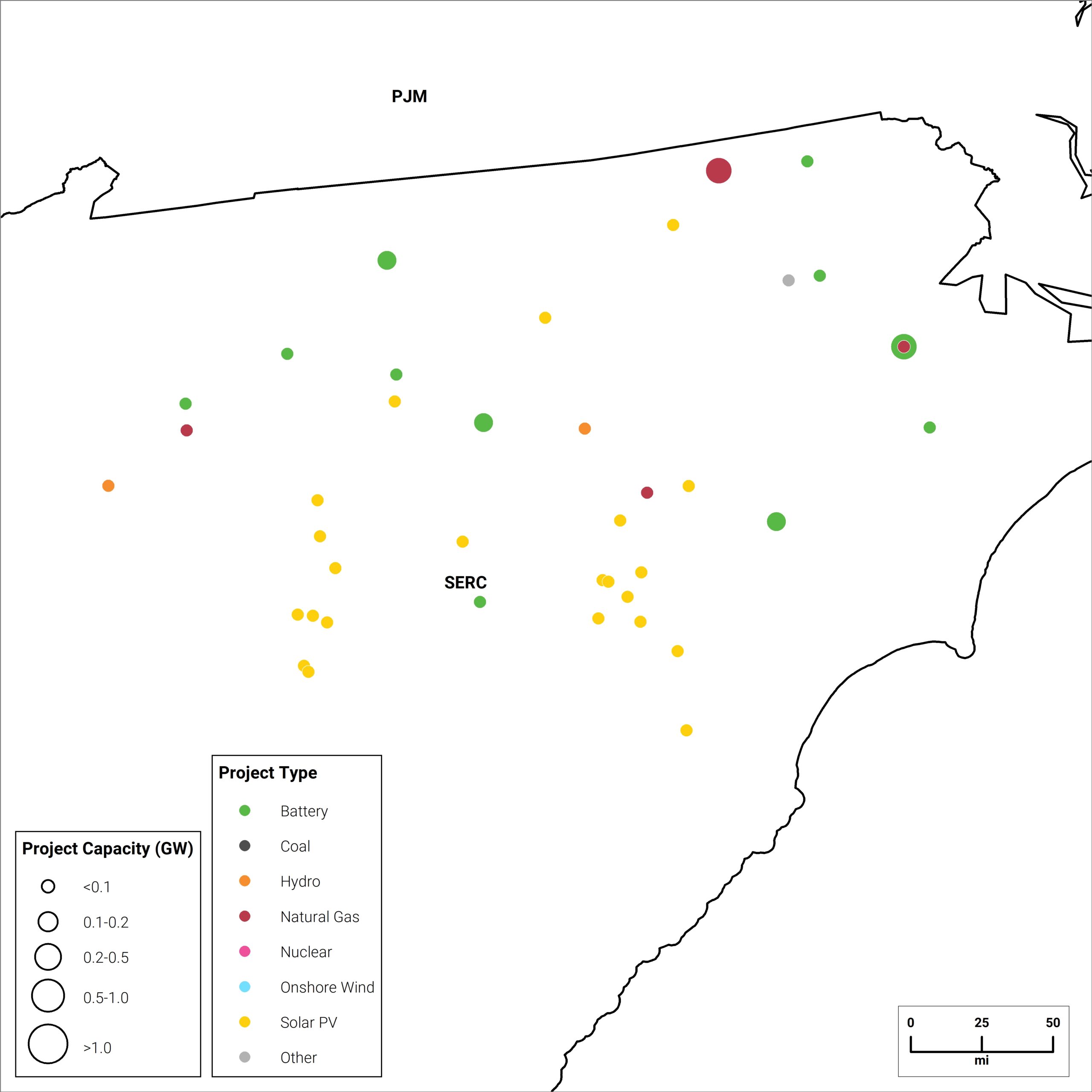
Type
2025 New Capacity (GW)
2026 Queued Capacity (GW)
2026 Under Construction (GW)
2026 Interconnection Agreement (GW)
Solar
0.2
7.4
2.3
0.4
Wind
0
0
0
0
Battery Storage
<0.1
4.0
1.0
0.3
Natural Gas
<0.1
14.4
1.3
2.0

Source | Enverus Power & Renewables, Project Tracking Analytics

Tennessee Valley Authority (TVA)

Analyst Insights

  • The Historic Gas Build: 2026 marks the operational peak of TVA’s massive gas expansion. The 1.4 GW Cumberland Fossil Plant gas conversion is scheduled to come online this year to replace the first of two retiring coal units. This is part of a broader $16 billion capital plan through 2027 that aims to add over 3.7 GW of new gas capacity to the system—the largest such build-out in the federal utility’s history. 


  • Coal Political Reprieve: Following a mid-2025 shift in federal energy policy, TVA is currently evaluating life extensions for its remaining coal fleet, including units at Shawnee and Gallatin that were previously considered for 2030s retirement. While the Cumberland (2026) and Kingston (2027) retirements remain largely on track due to advanced gas construction, TVA is leveraging new federal exemptions to maintain its existing coal assets as a reliability backstop against record-setting winter peaks. 


  • SMR Leadership: 2026 is a make-or-break year for TVA’s advanced nuclear ambitions. The Nuclear Regulatory Commission (NRC) is expected to finalize its review of the Clinch River SMR construction permit by late 2026. This project, which utilizes the GE Vernova BWRX-300 design, is positioned as the primary solution for carbon-free 24/7 power required by the region’s growing cluster of hyperscale data centers. 


  • Winter Reliability: Following an all-time peak of >35 GW in early 2025, TVA’s 2026 Winter Outlook identifies a persistent import dependency. During extreme cold events, TVA is now forecasting a 30% chance of needing to purchase more than 6 GW from neighbors, a precarious position as neighboring PJM and MISO also face thinning margins. To mitigate this, TVA is fast-tracking 1.5 GW of battery storage targeted for 2029 and activating a new $330 million system operations center in early 2026. 

Figure 19 | Projects with 2026 Operation Dates
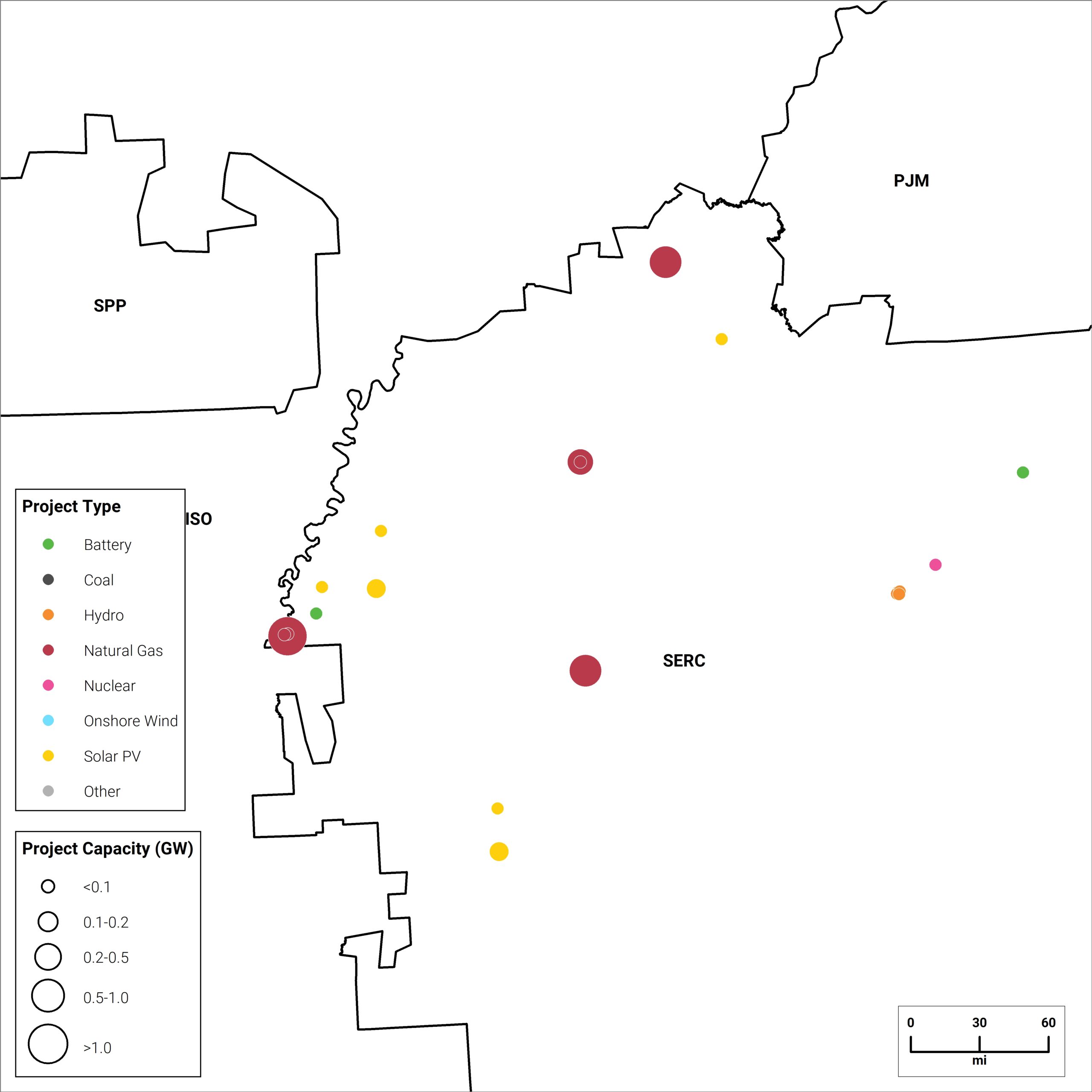
Type
2025 New Capacity (GW)
2026 Queued Capacity (GW)
2026 Under Construction (GW)
2026 Interconnection Agreement (GW)
Solar
0.4
0.7
0.4
0.2
Wind
0
0
0
0
Battery Storage
<0.1
0.5
0
0.1
Natural Gas
0
6.9
0
3.1

Source | Enverus Power & Renewables, Project Tracking Analytics

Related Power & Renewables Solutions

Advanced grid insights with accurate load forecasts and extensive monitoring enhance trade execution and profitability.

Read More

Quickly identify grid opportunities and risks with high-quality mid-term forecasts, expert analysis and streamlined grid analysis.

Read More

Confidently shape your investment strategy, identify optimal power asset locations and optimize utility scale PV project profitability—all in minutes.

Read More

With Enverus Instant Analyst™, you receive answers you can trust, delivered in seconds. Sourcing from 25+ years of vetted data and research on the most trusted SaaS platform designed exclusively for energy.

Read more

Site your next data center 4x faster with Enverus. Enverus helps you cut costs, reduce risk and site with confidence.

Read More

Scenario-based forecasts that look 20 years into the future. Confidently plan around evolving grid dynamics, identify profitable opportunities and support strategic decisions with the most trusted long-term view in power.

Read More

Arm yourself with the knowledge to inform strategic decisions and grow your business with one source for insights across oil and gas, renewables, carbon capture and ESG.

Read More

Design PV Plants & Battery Storage Systems 90% Faster with Our Advanced Solar & Battery Software.

Read more

SUGAR™ helps grid operators and utilities manage increasing interconnection queue volumes by accelerating modeling and simulation studies, with up to 2x reduction in time-consuming study processes.

Learn More

Unlock returns of electron and molecule-based energy transition technologies with deal insights, from power generation assets to CCUS and hydrogen.

Read More

Tune out the noise, get unbiased evaluations and uncover hidden opportunities with advice you can trust from experienced energy and power intelligence advisors.

Read More

Comprehensive coverage of power markets and insights into emerging energy technologies and project economics.

Read More

Interconnect offers developers certainty throughout the interconnection lifecycle, providing scenario analysis and risk assessment capabilities to improve the chances of deploying new projects.

Learn More

Let’s get started!

We’ll follow up right away to show you a quick product tour.

Let’s get started!

We’ll follow up right away to show you a quick product tour.

Ready to Get Started?

Ready to Subscribe?

Sign Up

Power Your Insights