
Click the image to explore the interactive guide to Source-To-Pay Best Practices.
Market conditions and increased pressure from Wall Street make strategic sourcing and increased efficiency more vital than ever before. The announcement made at last year’s SPARK Conference that Enverus plans to build a complete end-to-end source-to-pay solution that will revolutionize the way buyers and suppliers collaborate and transact couldn’t come at a better time. A strong source-to-pay strategy contributes to overall company success in several different ways including time and cost savings.
Watch the video from Marathon Oil below to learn more about this plan.
Enverus is excited about how this will change everyday processes and experiences across our buyer and supplier network. But when it comes to oil and gas supply chain, procurement, and sourcing, buzz words and terms that sound suspiciously similar abound, so we’ve put together this guide to clarify the differences between these terms, what they mean and why they should matter to you.
What is source-to-pay?
Source-to-pay (S2P) starts when a company chooses preferred vendors to buy from, orders from the select vendors, receives goods or services, processes the invoice, and pays the vendor after the service or product is delivered. The result is more controlled procurement that leads to significant savings. The reason this term may not be familiar is that very few companies offer this integrated solution. It has grown over time driven by the need for connected systems, data and processes.
What are the S2P process steps?
The steps in the S2P process are:
- Source
- Contract
- Order
- Receive
- Invoice
- Pay
What is the difference between S2P and procure-to-pay (P2P)?
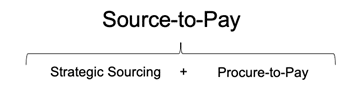
Remember the terms we mentioned that sounded suspiciously similar? While S2P and procure-to-pay (P2P) don’t sound very different, there is a distinct difference. P2P starts with the requisition of goods or services and ends when payment is made to the supplier. S2P adds another layer by creating a shortlist of vendors with whom to do business. This is commonly called “Strategic Sourcing.” Think of it as a planning exercise before you order. For the oil and gas industry, procurement is when a dispatch ticket is sent out to the vendor network. Sourcing is when an operator and specific vendor negotiate a price for a good or service that will be requested later.
What is strategic sourcing?
Strategic sourcing is a collaborative process that allows an organization to align purchasing power with its overall value proposition. For example, rather than sourcing friction reducers from seven different suppliers, an operator might choose to source from only two to three suppliers. The result is more controlled procurement that leads to significant savings.
It improves efficiency and quality by building a robust, diverse supply base. Strategic sourcing is a smart move for organizational success because it:
- Reduces costs, freeing up cash to expand your business.
- Mitigates supply chain risk by vetting a supplier before signing a contract.
- Builds strong vendor relationships, which can lead to faster lead times, higher quality, reliable fulfillment and better negotiations.
Why does strategic sourcing matter for oil and gas?
- To execute an effective growth strategy, companies must focus on supply chain optimization and efficiency. Energy investors demand that operators generate more free cash flow internally to finance their growth strategies. When implemented correctly, best practices can improve cost control and operating efficiency, freeing up funds to invest bank into a company.
- Digitalization of back-office processes and access to spend analytics are key to implementing these new best practices. Together, digitalization and analytics increase process efficiency and enable data-driven decision-making to maximize cost savings and realize economies of scale within your supply chain.
What are source-to-pay best practices?
For a sustainable fiscal strategy, energy companies should focus on supply chain optimization and efficiency. Best practices are proven strategies that, when implemented, streamline and optimize your process. At a high level, these include standardized workflows, improved collaboration, visibility and controls, automation and analytics that measure progress and drive better decisions. The result is improved cost control and operating efficiency, which free up cash flow to invest back into a company.
Read the Enverus guide on S2P best practices to digitalize your entire S2P process and reap the benefits of improved operating efficiency and cost savings in your supply chain.
To learn more, contact businessdevelopment@enverus.com, or request a tour by filling out the form below.