
Pumping the Brakes on Oil Production

byEnverus

What does less than $60/bbl mean for U.S. Production?

After previous reports of reduction in oil rig counts, the trend continues amid global market uncertainty induced by tariffs and trade wars despite expected increases in energy demand. Leaders from some of the largest producers, including Diamondback, Coterra, Chevron, EOG, and Matador, are reducing rig and workforce counts to wait out the storm and ensure long term sustainability. 

This broad market sentiment is important to take into account when updating our TGS U.S. production model (Figure 1). Using the consensus expectation of decreasing U.S. onshore rig count by 10-20% by the end of 2025, we’ve updated our rig count forecast. The result is a 9% drop in total U.S. production by the end of the year, from 13 MMBOPD to 11.97 MMBOPD. This reflects both the immediate impact of decreasing investment and the heavy reliance on drilling new unconventional wells to maintain gross production. As we’ve talked about in previous articles, there is an increasing trend of unconventional wells producing with higher initial rates and higher decline rates. This results in a much faster return on investments, but also a reduced capacity for long-term sustained production.

While the current U.S. administration is favoring keeping oil prices low, this would make it more difficult to bring new wells online with increasing breakeven prices, caused by inflating material costs and large markets such as China making strides with electric and other alternative energy sources. 

Reductions in U.S. oil production combined with OPEC increasing supply to a nearly saturated market, calming volatility with new trade agreements may be required to ease the fears echoing across the industry. Though operators have been debunking analyst predictions of a peak in U.S. shale production for years, comments from Diamondback CEO Travis Stice indicates that the time may have finally arrived. “Today, geologic headwinds outweigh the tailwinds provided by improvements in technology and operational efficiency. On an inflation-adjusted basis, there have only been two quarters since 2004 where front month oil prices have been as cheap as they are today (excluding 2020 which was impacted by the global pandemic). Therefore, we believe we are at a tipping point for U.S. oil production at current commodity prices.”
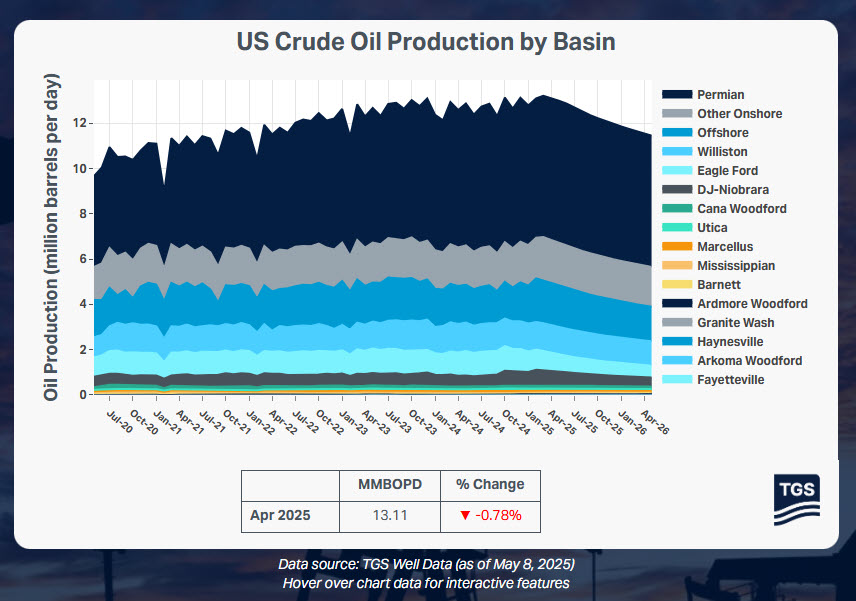
Fig 1 1
Figure 1.  TGS U.S. Production Forecast Model with Market Consensus Rig Count Assumptions.

Despite turmoil in oil production, there is an emerging demand for natural gas production. While operators and analysts are being cautious about the remainder of the year, there will still be a need for operations to continue, and players have noted that they are ready to ramp up activity quickly when conditions improve.

For more information about TGS Well Data Analytics or to schedule a demo, contact us at WDPSales@tgs.com. 

Picture of Enverus

Enverus

Energy’s most trusted SaaS platform — creating intelligent connections that uncover insights and opportunities to deliver extraordinary outcomes.

Subscribe to the Enverus Blog

A weekly update on the latest “no-fluff” insight and analysis of the energy industry.

Related Content
Enverus Intelligence® Research Press Release - Recap: How the Trump Administration is reshaping energy markets
Post
Power & Renewables
ByEnverus

Learn how utilities, hyperscalers, and developers can score assets, align stakeholders, and structure power agreements that close faster and withstand scrutiny.

800 VDC rewrites AI data center power economics
Post
Trading & Risk
ByJuan Arteaga, Principal Analyst, Enverus Intelligence® Research

IREN data center buildout advances as Sweetwater Hub hits ERCOT Batch Zero, signaling tangible progress for GPU deployments.

Enverus Intelligence® Research Press Release - Haynesville operators calculate remaining growth
Post
Power & Renewables
ByEnverus

Learn how utilities, hyperscalers, and developers can score assets, align stakeholders, and structure power agreements that close faster and withstand scrutiny.

Enverus Intelligence® Research Press Release - OPEC+ cuts and Trump tariffs force price downgrade
Post
ByIan Elchitz

In upstream oil and gas, loosely managed materials leak margin through duplicate buys, stranded inventory, and untracked transfers. Learn how Enverus OpenMaterials gives supply chain and finance teams one accurate view of inventory.

GettyImages-1178545406-oil&Gas
Post
Oilfield Services
ByBrandon Chandler

Private operators now run more U.S. rigs than public ones for the first time. See what the crossover means for oilfield services demand by segment.

Enverus Press Release - E&Ps with natural gas + CCS pave way for model data center development
Post
Power & Renewables
ByEnverus

MISO hit its $10,000/MWh cap on Sept. 2 as evening load surged, solar output collapsed, and imports weakened, triggering an EEA2 alert.

Enverus Intelligence® Research Press Release - Enhanced geothermal systems: The future of reliable, green power for AI data centers?
Post
Power & Renewables
ByEnverus

A $1 million-per-MW gap separates buying gas capacity from building it. See why utilities rarely run that comparison, and what it takes to defend the answer.

Enverus Press Release - Enverus Acquires BidOut, energy’s leading AI-powered procurement platform provider
Post
Power & Renewables
ByEnverus

Most FTR losses come from sound analysis with incomplete visibility. Learn the five pitfalls that separate winning desks from ones that explain away the losses.

Enverus releases Top 50 Public E&P Operators of 2024
Post
Trading & Risk
ByJuan Arteaga, Principal Analyst, Enverus Intelligence® Research

Enverus insight on solar and battery storage growth, Duke Energy plans, and whether policy incentives can close the merchant revenue gap.

Let’s get started!

We’ll follow up right away to show you a quick product tour.

Let’s get started!

We’ll follow up right away to show you a quick product tour.

Sign up for our Blog

Ready to Subscribe?

Ready to Get Started?