
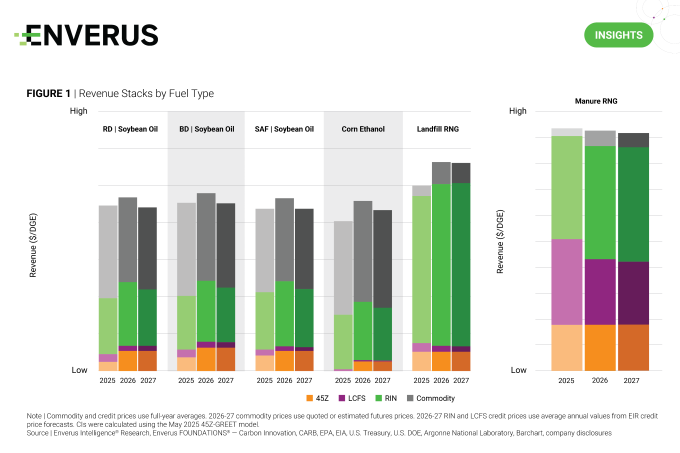
The clean fuels story has turned a corner. Enverus Intelligence® Research (EIR)’s 2026 Clean Fuels Fundamentals finds an industry in recalibration: credit exposure, policy clarity and margin durability have replaced breakneck expansion as the sector’s defining priorities. Policy is clearer than in recent years, but Renewable Volume Obligation (RVO) decisions for 2026-27 remain unresolved, which is no small matter when Renewable Identification Numbers (RINs) drive the majority of fuel revenue, and tighter feedstock restrictions are squeezing margins (Figure 1). With capacity expected to expand at a far more modest pace through 2030, developers and investors alike are scrutinizing low-carbon projects for margin resilience and policy compatibility.
The shift is visible on balance sheets and in project pipelines. ExxonMobil trimmed low-carbon spending in late 2025, a clear signal that undifferentiated clean fuels exposure no longer pencils out. But capital hasn’t disappeared – it’s concentrating around platforms with durable offtake who know how to capitalize on credits. Recently, LanzaJet advanced a $650 million equity raise to scale its alcohol-to-jet platform and Syzygy Plasmonics locked in a six-year Sustainable Aviation Fuel (SAF) deal with Trafigura earlier in the year. The bottom line: this is a margin management phase for clean fuels, where execution, policy fluency and disciplined capital deployment will separate leaders from the rest.
This blog offers just a glimpse of the powerful analysis Energy Transition Research delivers on the trending themes. Don’t miss the full picture.
DID YOU KNOW?
Used cooking oil has gone from a waste disposal problem, with restaurants paying to have it removed, to one of the most sought-after feedstocks in the clean fuels supply chain.
Key Takeaways
Is the clean fuels industry moving from growth to discipline?
The sector is no longer focused on rapid expansion. Instead, companies are prioritizing margin management, credit exposure, and policy risk. Slower capacity growth through 2030 reflects a more cautious approach as feedstock constraints and unresolved RVO decisions pressure profitability.
Why does policy uncertainty still matter so much?
While policy is clearer than in recent years, key decisions for 2026–27 remain unresolved. Because RINs drive most clean fuel revenue, this uncertainty directly affects project economics and investor confidence.
Where is capital still flowing in clean fuels?
Investment has not disappeared, but it has become more selective. Capital is concentrating on projects with durable margins, strong offtake agreements, and teams that understand how to maximize credits. This phase rewards strong execution and disciplined capital deployment over undifferentiated growth.
About Enverus Intelligence® | Research
Enverus Intelligence® | Research, Inc. (EIR) is a subsidiary of Enverus that publishes energy-sector research focused on the oil, natural gas, power and renewable industries. EIR publishes reports including asset and company valuations, resource assessments, technical evaluations, and macro-economic forecasts and helps make intelligent connections for energy industry participants, service companies, and capital providers worldwide. See additional disclosures here.