
Across the EVOLVE 2026 panels, a consistent admission surfaced: most teams are still quantifying what they have left by hand. Analysts draw DSUs one play at a time. Type curves come from area averages instead of location-level predictions. Between that and everything else on their plate, most deal teams get through three or four valuations in a week. The operators who’ve moved past that work can actually see their inventory runway. The rest are estimating.
Here’s what the panels surfaced and what it means for how you work now.
The inventory gap that consolidation couldn’t close
Consolidation reshaped the Permian, the DJ, the Montney, and every basin that’s seen major M&A over the last three years. The companies that acquired aggressively got better capital efficiency and real runway, but the count of high-quality drilling locations across those basins stayed flat. Panelists were clear on that distinction: consolidation redistributed inventory rather than adding to it. The operators still on the sidelines now face a thinner market, with fewer clean targets at a price that works, and “wait and buy later” gets more expensive every quarter.
Private operators are feeling this most directly. One conversation that came up repeatedly: companies that historically relied on acquiring or swapping bolt-on acreage are now creating inventory through geological extension rather than transaction. The formations getting traction are the Cherokee across the Anadarko, the Dawson-Dean, and parts of the northwestern Delaware. These plays have been mapped for years but treated as upside, not core planning. That’s shifted. Operators who used to reach for these formations when their Tier 1 looked long are now modeling them as part of their baseline.
Extensional plays are moving from interesting to essential
Five years ago, adding extensional formations to an inventory model was a way to show upside to a potential buyer. Now operators are doing it because their base case requires it.
The plays getting the most attention on stage: emerging deep zones in the Delaware and Midland, where formations like the Barnett-Woodford are converting from geologically viable to economically viable at pace. Panelists pointed to the northern Delaware specifically, where the resolution of permitting friction in the Known Potash Leasing Area has re-opened development across acreage that was previously stranded. Extended reach laterals exceeding four miles changed the unit economics enough to bring material inventory back into the picture.
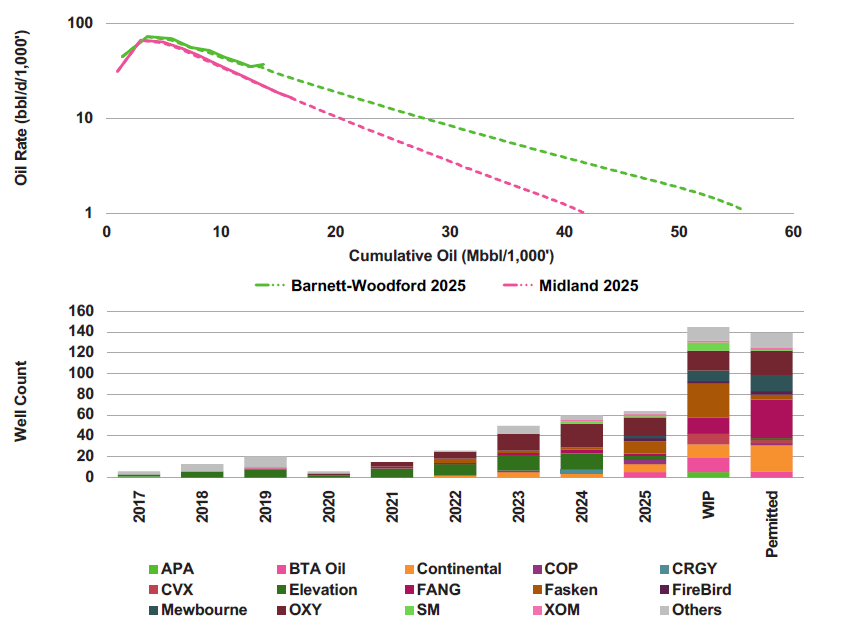
The operators winning in extensional plays share one trait: they’ve moved past basin-level type curves. Location-by-location production predictions, built from geological inputs and updated well data, separate the formations that look economical in aggregate from the ones that are worth drilling. Our Enverus Intelligence® Research (EIR) basin teams have been running this methodology for years, basin by basin, Tier 1 through Tier 2, hand-drawing DSUs for every play. The operators on stage who are doing this themselves have materially better visibility on where their real runway sits.
More assets to evaluate, less margin for a bad decision
The volume of assets being marketed hasn’t slowed. Panelists described running economics on 30 to 40 competing assets at any given time, across multiple basins, all while managing current production demands. Running a large deal queue is nothing new for operators in this market. The difference now is the cost of a misjudgment deeper in that queue.
When Tier 1 was abundant, a mediocre acquisition could still be a fine one. A well in a slightly lower-quality part of the basin still worked at the right price. That margin for error is compressing. Sellers are marketing assets with credible-looking inventory profiles that don’t hold up at the location level. The difference between a seller’s type curve and what the offset well data actually shows can swing deal value by tens of millions of dollars on a mid-size package.
The practical constraint panelists named is throughput, not capital. A team pulling offset data by hand and rebuilding economics in spreadsheets moves through a handful of deals a week. The bottleneck isn’t the judgment call, it’s everything that has to happen before the judgment call. When the assets worth winning are scarcer and the buyer pool is deeper, the team that can run a credible valuation faster gets more shots at the deals that matter.
What the best operators ran last month
Several panelists already run AI-assisted deal evaluation and walked through their exact workflow. Strategic fit screening comes first before committing analytical hours. Define the target profile by basin, production mix, inventory-to-PDP ratio, and minimum quality threshold. Filter at the portfolio level before anyone opens a model. Once an asset clears that screen, move from deal teaser to offset-based valuation with the operator’s own economic assumptions applied: commodity price deck, discount rate, OPEX benchmarks.
Enverus ONE™’s Inventory Evaluation Flow and Deal Screener Flow handle this sequence. You go from an API list or a deal teaser to a decision-ready valuation grounded in analyst-curated data, with your own economic inputs applied, in under a minute for inventory and under five minutes for a full screened deal. Analyst time goes to interpreting the output and making the call, rather than assembling the inputs.
Every evaluation makes the next one sharper
Panelists kept circling the same question: which teams have built the muscle to spot the Tier 1 inventory that’s left and move on it before anyone else does.
Every deal you run, every inventory stack you verify, every location you score against your own criteria tightens your read on the rock. The operators who’ve run thousands of evaluations the same way understand their acreage, and the market around it, in a way a team starting cold this year can’t match for a while.
EIR tracks where inventory sits, who controls it, and where the next stretch of rock is crossing from geologically viable to economically viable. Load your team’s proprietary data into Enverus ONE and the gap closes between that market picture and the asset-level calls only you can make. The operators who sort this out first will have their pick of what’s left.
Ready to evaluate your next deal with engineering-grade economics before the bid deadline? See the Inventory Evaluation Flow or talk to our team.
About Enverus Intelligence® | Research, Inc. (EIR)
Enverus Intelligence® | Research, Inc. (EIR) is a subsidiary of Enverus that publishes energy-sector research focused on the oil, natural gas, power and renewable industries. EIR publishes reports including asset and company valuations, resource assessments, technical evaluations, and macroeconomic forecasts and helps make intelligent connections for energy industry participants, service companies, and capital providers worldwide. See additional disclosures here.