Based on the Enverus Winter Power Market Outlook webinar for ERCOT and SPP, presented by Adam Jordan, Director of Power Analytics.
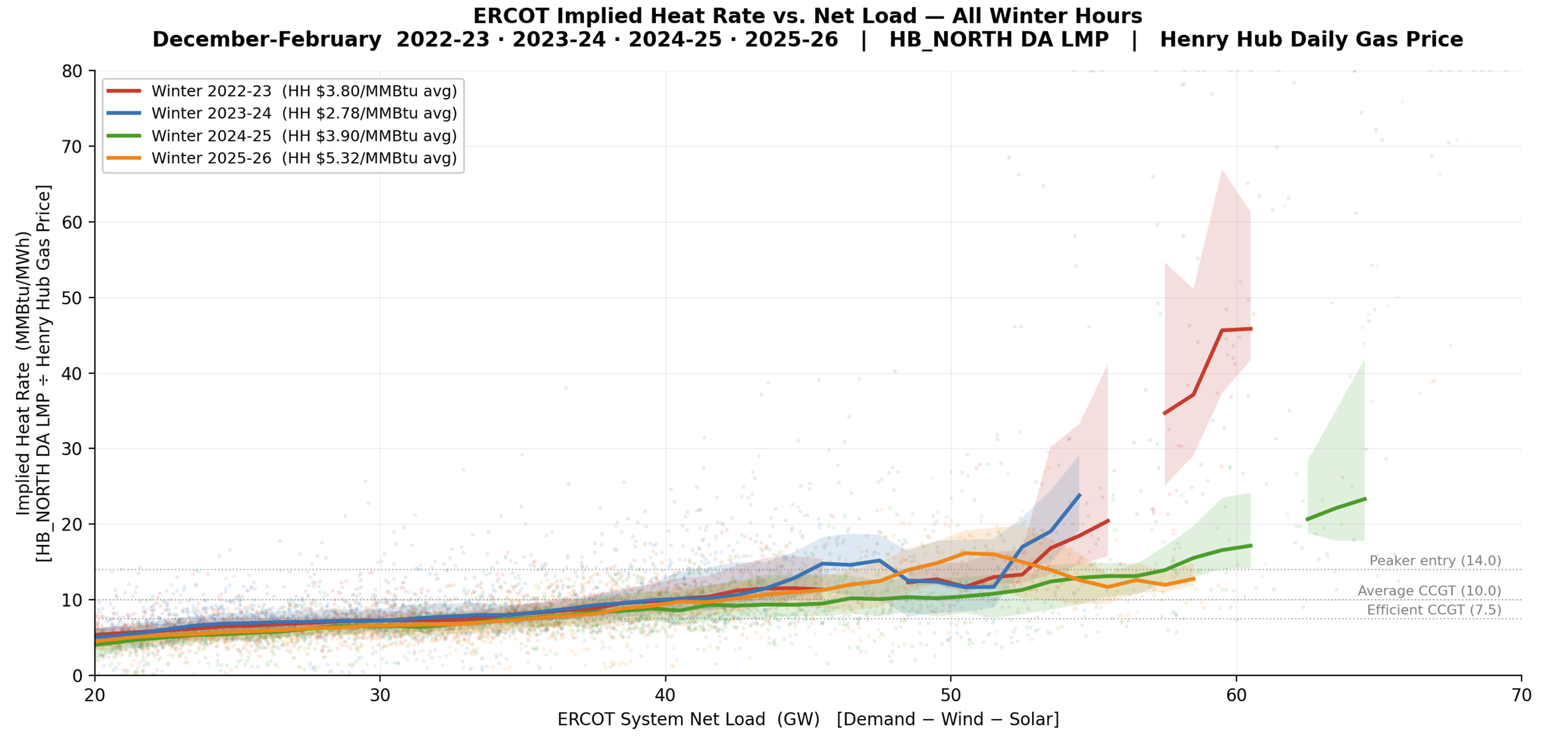
ERCOT has produced only 15 to 30 hours above 60 GW of net load in each of the last few winters. Winter in Texas is event-driven, and Enverus Intelligence® Research (EIR) expects the difference between a $100 day and a $1,000 day to come down to wind. This winter adds a record El Niño, which brings mild temperatures but also storms that cut into solar output. In SPP, load growth is outpacing capacity additions.
An El Niño for the ages
EIR’s analog years are 2015/16 and 2023/24, which average +1.6 on the Relative Oceanic Niño Index (RONI). The global climate model statistical average for December through February is +3.1, and the models show record-high El Niño conditions. The pattern points to a warm north and cooler anomalies in the south, and a supercharged jet stream should keep wind above average.
In ERCOT, EIR expects a stormy December with limited heating load. January should bring long stretches of mild or seasonal weather punctuated by one or two violent arctic outbursts, and their number, timing and location are the greatest risk to the forecast. The February analog years were mild and lacked significant cold events, another signal that cold risk concentrates in January. Gas prices stand out in the analog years: both mild winters ended with high storage, and average spot Henry Hub slid below $2.00. That isn’t a gas forecast. It’s a risk to power prices through lower marginal fuel costs.
ERCOT congestion has eased
The constraints behind LZ_WEST price strength have seen major mitigation, especially along the Midland-Odessa corridor, where Vealmoor-Koch and Morgan Creek-Navigation formerly dominated. Congestion into LZ_WEST has fallen sharply in 2026. Elsewhere, new 345 kV double circuits through Cruce effectively eliminate LaPalma and Weslaco-Heidelberg congestion.
Load growth holds near 5%
Annualized ERCOT load growth has measured just shy of 5% year to date. Large loads are showing up primarily in the NCEN and SCEN zones, and the large coastal load is new LNG capacity. We expect 2027 growth to continue at roughly 5%, and Batch Zero approvals in April 2027 set up higher growth in 2028.
Solar and battery projects continue to trend larger, which has changed long-established congestion patterns. WESTEX, for example, will bind more on-peak than off-peak because of solar. EIR expects 5 to 6 GW of new solar in 2027, a drop from the last couple of years, and about 2.4 GW of battery storage is under construction with 2027 first power.
ERCOT price view: January carries the risk
| ERCOT implied heat rate | Bearish | Expected | Bullish | Forward |
|---|---|---|---|---|
| December | 9.0 | 9.4 | 9.6 | 10.4 |
| January | 10.1 | 10.8 | 15.0 | 12.5 |
| February | 9.5 | 10.2 | 11.2 | 13.2 |
December presents a tame entry to winter. We favor downside risks because December is historically low volatility. January holds the most risk for price strength of any winter month. Temperatures may be mild, but storms will diminish solar, and higher net load from weak solar is one of the primary paths to price strength. Add an isolated arctic outbreak and the bullish case comes into focus. In February, bullish risks relax as the chance of a high-impact storm diminishes quickly.
SPP weather: cold risk peaks in January
We expect warm anomalies in December to concentrate in the northern half of SPP, with below-average demand and the risk of a cold snap in the third or fourth week. January is the heart of winter, and the risk of an arctic intrusion is highest then. February looks wetter for Oklahoma and dry from Nebraska north, as a strong Pacific jet stays draped over Texas with occasional breakouts north.
SPP congestion: North Hub volatility continues
EIR expects North Hub volatility to continue throughout the winter. Strong heating demand will amplify outage impacts:
- Weeping Water corridor, Nebraska (Oct. 23 to Dec. 18): Increased flow on NEBRCTY-SUB3456 is bullish for North Hub and bearish for South Hub.
- Near Great Bend, Kansas (Jan. 4 to April 30, 2027): Increased flow on KNOLL1-NHAYS is bullish for South Hub and bearish for North Hub.
SPP load growth outpaces new capacity
SPP has about 2.5 GW of generation under construction, based on the Enverus PRISM® classification. SPP’s reserve margin is shrinking and will keep declining until 2028, according to SPP’s own outlook, which means more volatility in shoulder seasons.
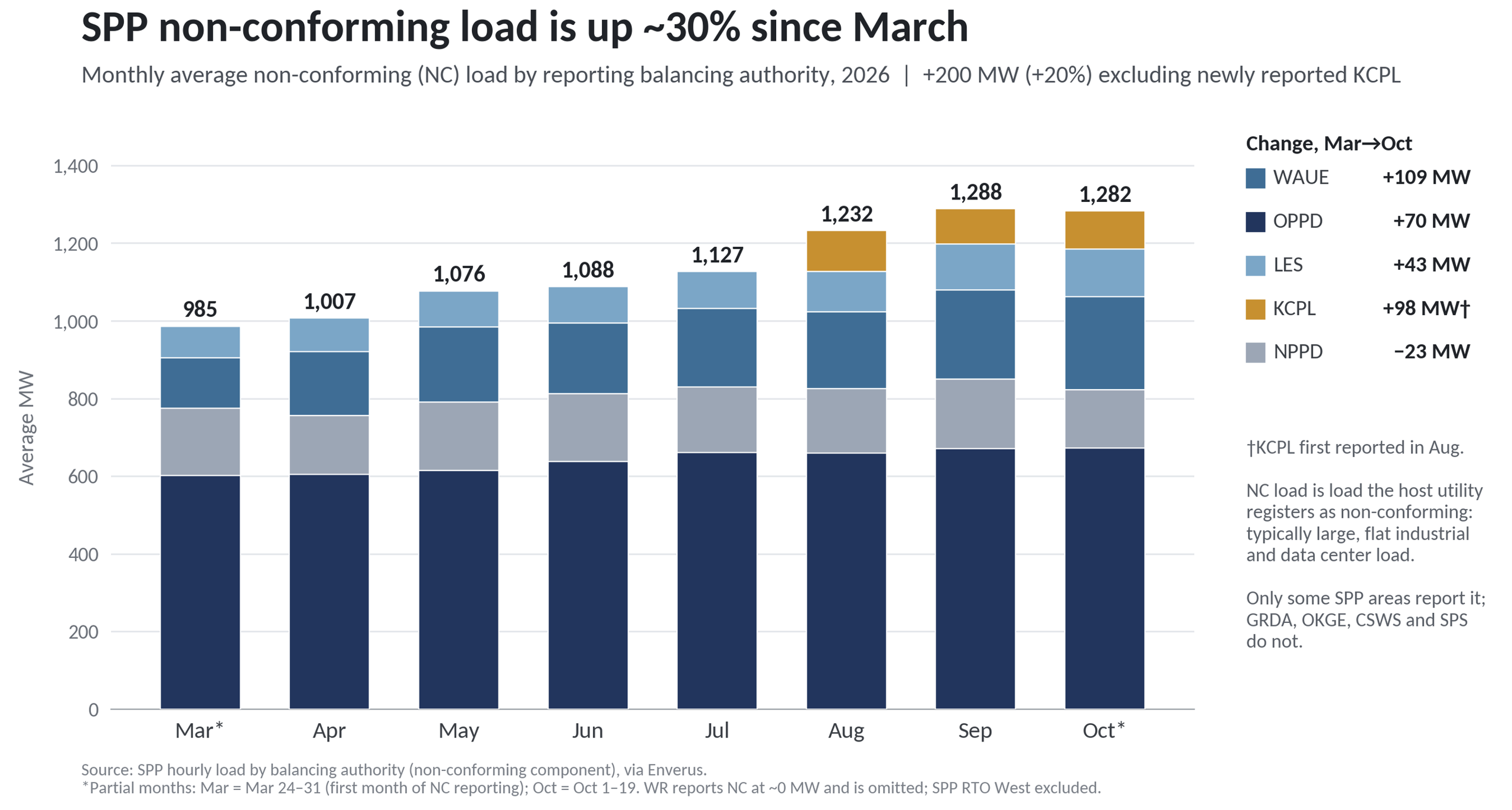
SPP began publishing non-conforming (NC) load data in March. NC load is typically large, flat industrial and data center load. Monthly average NC load is up about 30% since March, or about 200 MW (20%) excluding newly reported KCPL. SPP winter implied heat rates have compressed over the last four winters, driven by fuel switching and gas costs, while the supply stack is essentially unchanged.
SPP price view: risks lean bearish
| SPP South Hub implied heat rate | Bearish | Expected | Bullish | Forward |
|---|---|---|---|---|
| December | 7.6 | 11.7 | 12.3 | 12.3 |
| January | 6.5 | 12.7 | 14.2 | 15.8 |
| February | 6.5 | 11.8 | 12.4 | 14.5 |
Risks lean bearish in December, and our bullish scenarios only reach parity with current forwards, leaving little upside for South Hub to wrap up 2026. January holds risk for strong load from stormy skies in the south and arctic intrusions in the north, but we don’t expect strong or prolonged outbreaks, and our most bullish scenarios are still a few dollars short of the market. In February, market sentiment leans bearish relative to our base case.
What to take into the winter
- An El Niño for the ages.
- ERCOT’s reliance on solar introduces price risk in a stormy winter.
- ERCOT congestion patterns remain at reduced intensity.
- SPP’s load growth outpaces capacity additions.
Want to stay ahead of how ERCOT and SPP trade this winter? Learn more about our power trading solutions.
About Enverus Intelligence® | Research, Inc. (EIR)
Enverus Intelligence® | Research, Inc. (EIR) is a subsidiary of Enverus that publishes energy-sector research focused on the oil, natural gas, power and renewable industries. EIR publishes reports including asset and company valuations, resource assessments, technical evaluations, and macroeconomic forecasts and helps make intelligent connections for energy industry participants, service companies, and capital providers worldwide. See additional disclosures here.