
Get insights into 2026 interconnection queue, ISO dynamics, utility strategies, and energy policies shaping project development and grid access.
Research written by:
Enverus Intelligence Team
Investment advisory products and services provided by Enverus Intelligence® Research, Inc. Visit www.Enverus.com/disclosures for additional information.
Reviewed by:
Ryan Luther, Research Director, Enverus Intelligence® Research

To take advantage of federal tax credits, developers are accelerating solar deployments across all ISOs, while reliability driven market signals simultaneously drive gas and battery development.
Figure 1 | Queued Capacity and Status
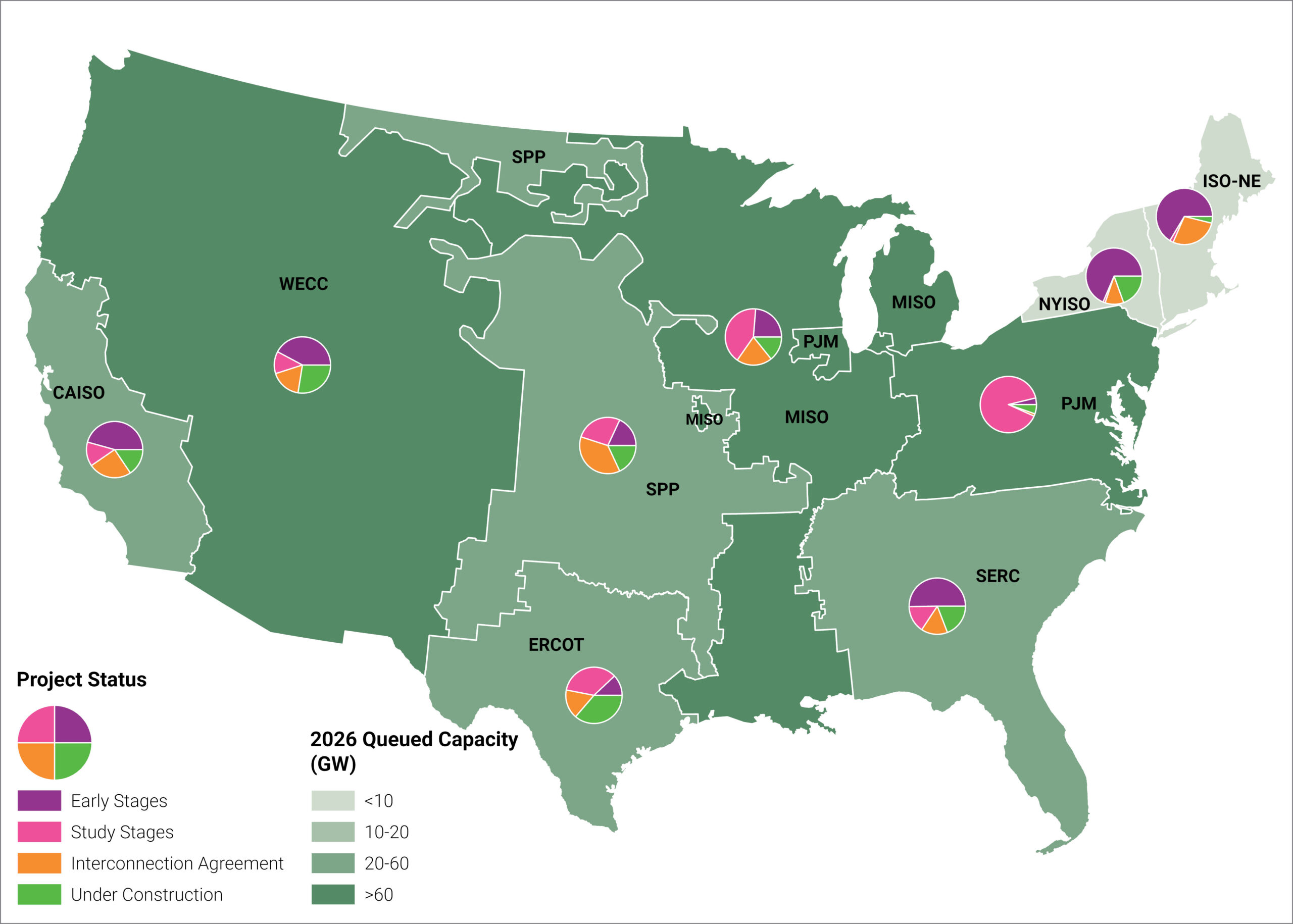
Source | Enverus Power & Renewables, Project Tracking Analytics
Expiring federal tax incentives, queue backlogs, and new reliability-focused policies accelerate solar and storage development in the short run while constraining longer-term renewable growth. Across ISOs, only a fraction of the hundreds of gigawatts targeting 2026 are likely to reach operation, with faster-moving regions like ERCOT contrasted by slower, transmission‑constrained markets. We will see gas and batteries gaining strategic importance as grid reliability and large-load growth take center stage; however, supply chains and interconnection timelines will constrain how much front-of-the-meter gas generation can be added.
The passage of the One Big Beautiful Bill Act (OBBBA) in July of 2025 triggered the phase-out of Inflation Reduction Act (IRA) tax credits. While the IRA originally provided a long runway for renewables, the OBBBA requires wind and solar projects to be placed in service by December 31, 2027, to remain eligible for the PTC and ITC tax credits. Projects failing to demonstrate they have begun construction, using the physical work test or the 5% safe harbor, by July 4, 2026, or the 2027 service deadline will lose access to these federal incentives. ITC remains available for grid-scale batteries through 2036.
OBBBA is expected to have a two-phase impact on renewable development. In the near term, solar development is likely to accelerate as projects rush to meet safe harbor requirements; solar is projected to lead 2026 capacity additions and project counts across most U.S. regions (Figure 1). Over the longer term, however, renewable development is expected to decline more significantly as federal incentives diminish. In markets with Renewable Portfolio Standards, or in energy-constrained areas, these dynamics are likely to result in higher Power Purchase Agreement (PPA) prices and an increase in renewable projects paired with energy storage.
To see how OBBBA shifts are impacting project valuations and queue survival rates, you can explore detailed economic modeling and regional viability analysis in the reports linked below:
You must be an Enverus Intelligence® subscriber to access these reports.
Advanced grid insights with accurate load forecasts and extensive monitoring enhance trade execution and profitability.
Quickly identify grid opportunities and risks with high-quality mid-term forecasts, expert analysis and streamlined grid analysis.
Confidently shape your investment strategy, identify optimal power asset locations and optimize utility scale PV project profitability—all in minutes.
With Enverus Instant Analyst™, you receive answers you can trust, delivered in seconds. Sourcing from 25+ years of vetted data and research on the most trusted SaaS platform designed exclusively for energy.
Site your next data center 4x faster with Enverus. Enverus helps you cut costs, reduce risk and site with confidence.
Scenario-based forecasts that look 20 years into the future. Confidently plan around evolving grid dynamics, identify profitable opportunities and support strategic decisions with the most trusted long-term view in power.
Arm yourself with the knowledge to inform strategic decisions and grow your business with one source for insights across oil and gas, renewables, carbon capture and ESG.
Design PV Plants & Battery Storage Systems 90% Faster with Our Advanced Solar & Battery Software.
SUGAR™ helps grid operators and utilities manage increasing interconnection queue volumes by accelerating modeling and simulation studies, with up to 2x reduction in time-consuming study processes.
Evaluate AFEs with confidence — backed by decades of proprietary energy data and built-in risk assessment. The AFE Evaluation Agent gives non-op teams a conversational AI agent that benchmarks costs, derives EURs, surfaces risks, and delivers defensible consent recommendations within a single, iterative workflow on Enverus ONE.
Unlock returns of electron and molecule-based energy transition technologies with deal insights, from power generation assets to CCUS and hydrogen.
Tune out the noise, get unbiased evaluations and uncover hidden opportunities with advice you can trust from experienced energy and power intelligence advisors.
Comprehensive coverage of power markets and insights into emerging energy technologies and project economics.
Interconnect offers developers certainty throughout the interconnection lifecycle, providing scenario analysis and risk assessment capabilities to improve the chances of deploying new projects.
Let’s get started!
Let’s get started!
We’ll follow up right away to show you a quick product tour.
Ready to Subscribe?
Ready to Get Started?