2025 Winter: Power Market Outlooks by ISO

See what’s coming in ERCOT, SPP, PJM, MISO, CAISO, Mid-C, ISO-NE and NYISO

Case Study Hero Stock Image

Your 2025 Winter Outlooks

Welcome to the Winter Power Market Outlook for 2025—your essential guide to navigating the complexities of the upcoming winter power markets across key U.S. regions. As the energy landscape continues to evolve, understanding the interplay of load growth, generation shifts, planned outages, new infrastructure, policy changes and market dynamics is critical for stakeholders aiming to optimize operations, manage risks and seize opportunities.

This e-book provides a detailed, region-by-region analysis, unpacking the factors that will shape winter operations—from shifting demand driven by weather extremes and electrification to the integration of renewable energy and storage, which are reshaping grid dynamics. We explore planned outages and their congestion implications, highlight new builds and retirements that will influence supply, and examine policy developments that could redefine market rules.

Additionally, our forward-looking heat rate and price forecasts offer actionable insights to help you anticipate market trends, prepare for volatility, and make informed decisions in an increasingly dynamic energy environment.

By reading this e-book, you will gain the following key takeaways:

  • Comprehensive regional insights: Understand the unique drivers of load, generation, and market dynamics in ERCOT, SPP, MISO, CAISO, Mid-C, PJM, NYISO and ISO-NE for winter 2025.
  • Congestion and outage impacts: Identify critical outage-driven congestion patterns and their implications for trading and operational strategies.
  • Emerging infrastructure trends: Learn about new builds, retirements and their effects on supply reliability and market pricing.
  • Policy and regulatory shifts: Stay informed on policy changes, such as real-time co-optimization and capacity market reforms that will shape market operations.
  • Actionable market forecasts: Leverage detailed heat rate and price forecasts to anticipate volatility, manage risks and develop effective hedging strategies during cold snaps and scarcity events.

This Winter Outlook equips you with the insights needed to anticipate challenges, capitalize on emerging trends, and drive strategic decision-making in a rapidly changing power market landscape.
ERCOT

Load and Generation

December 2025

  • The difference in analog years, shown in the table below, is striking. 2017 reflects the risk for growing La Nina conditions while 2013 remains closer to neutral on the Oceanic Nino Index. What stands out is 2013 being cooler on average and not really showing a cold snap like 2017. The highest temps are not really a concern as heat is short-lived.
  • Weighing risks, the month ends up looking average. Late month cold snaps would be the high impact events that have a significant impact on price formation.
Average 2010-2024
December 2013
December 2017
December 2024
Average
Average
52
48
52
58
52
Minimum
42
38
42
47
42
Maximum
62
58
62
68
63

January 2026

  • Analog years do not show a history of sustained cold. 2014 had two days with a high in the 35-degree range in Dallas and Houston (neither had a day with a high temp below freezing). The first couple days of 2018 had high temps below freezing in Dallas although the around-the-clock freezing temps didn’t make it to Houston.
  • While 2018 had the coldest temps, they were even more short lived than 2014. For that reason, 2014 is expected to better resemble the conditions for January 2026. There will be lower-than-average temps with limited risk for a prolonged, extreme cold snap.
Average 2010-2024
January 2014
January 2018
January 2025
Average
Average
50
47
47
46
47
Minimum
40
35
36
37
36
Maximum
61
61
59
57
59

February 2026

  • Analog years look generally near average to slightly above average. However, 2025 had a pretty good cold snap from Feb. 19-22 with Houston, Austin and San Antonio all recording below freezing temperatures on these days. Dallas was below freezing for the first three days of this cold snap.
  • In 2014, there was a short-lived cold snap in Dallas on Feb. 6 and 7, with a low of 18 degrees in Dallas and a low of 33 in Houston on Feb. 6.
Average 2010-2024
February 2014
February 2018
February 2025
Average
Average
54
52
56
54
54
Minimum
44
41
47
44
44
Maximum
65
62
66
66
65

Outages

December 2025 Transmission Outages/Congestion

NCEN

  • BELCNTY-SALSW (138KV) shows higher post-contingency flows with an outage at GEORSO-MIDNT (138KV) between 11/21-12/31.

  • MRVLY-ESTLD (69KV) shows higher post-contingency flows with an outage at LENSW-FLTCK (138KV) between 11/24-12/10.

WEST/FWEST

  • KENDAL-KERRST (138KV) shows higher post-contingency flows with an outage at MENGCR-K0 (138KV) between 12/15/25-01/30/26.

  • W_BATESV-UVALDE (138KV) shows higher post-contingency flows with an outage at LYTLE2-DEVINE (69KV) between 10/01-12/16.

  • YELWJCKT-HEXT (69KV) shows higher post-contingency flows with an outage at BIGHIL-TWINBU (345KV) between 12/01/25-05/15/26.

COAST

  • LOLITA-BLESSING (138KV) shows higher post-contingency flows with an outage at KENEDSW-ROSATA (138KV) between 09/17-12/10. SCEN/SOUTH

  • LYTTON_S-PILOT (138KV) shows higher post-contingency flows with an outage at SWIFTE-BASTCI (345KV) between 09/16-12/31.

  • WINCHES-GIDEON (138KV) shows higher post-contingency flows with an outage at FPPYD2-LYTTON_S (345KV) between 11/11/25-05/15/26.

  • LOYOLA (138/69KV) shows higher post-contingency flows with an outage at DRSCOLS-RICRDOS (69KV) between 11/17/25-03/20/26.

January 2026 Transmission Outages/Congestion

NCEN

  • BELCNTY-SALSW (138KV) shows higher post-contingency flows with an outage at JOHNDU-HORNSB (345KV) between 01/06/26-01/23/26.

WEST/FWEST

  • KENDAL-KERRST (138KV) shows higher post-contingency flows with an outage at MENGCR-K0 (138KV) between 12/15/25-01/30/26.

  • BALLINGE-HUMBLTAP (138KV) shows higher post-contingency flows with an outage at BRNWD-BANGS (69KV) between 01/06/26-02/15/26.

  • YELWJCKT-HEXT (69KV) shows higher post-contingency flows with an outage at BIGHIL-TWINBU (345KV) between 12/01/25-05/15/26.

COAST

  • FRANKC-SARGNTS (69KV) shows higher post-contingency flows with an outage at CARNCS-OVILASW (69KV) between 12/11/26-02/12/26.

SCEN/SOUTH

  • BANDER-MASOCR (138KV) shows higher post-contingency flows with an outage at MENGCR-K0 (345/138KV) between 12/15/25-01/30/26.

  • LYTTON_S-PILOT (138KV) shows higher post-contingency flows with an outage at GARFIELD (345/138KV) between 01/20/26-02/06/26.

  • WINCHES-GIDEON (138KV) shows higher post-contingency flows with an outage at FPPYD2-LYTTON_S (345KV) between 11/11/25-05/15/26.

  • LOYOLA (138/69KV) shows higher post-contingency flows with an outage at DRSCOLS-RICRDOS (69KV) between 11/17/25-03/20/26.

February 2026 Transmission Outages/Congestion

NORTH/NCEN

  • LPLMK-LPLNE (115KV) shows higher post-contingency flows with an outage at LPLNW-LPLMD (115KV) between 02/16/26-03/06/26.

  • SEA (138K/69V) shows higher post-contingency flows with an outage at TMPSW-FRYSW (115KV) between 02/24/26-03/31/26.

WEST/FWEST

  • BALLINGE-HUMBLTAP (138KV) shows higher post-contingency flows with an outage at BRNWD-BANGS (69KV) between 01/06/26-02/15/26.

  • YELWJCKT-HEXT (69KV) shows higher post-contingency flows with an outage at BIGHIL-TWINBU (345KV) between 12/01/25-05/15/26.

COAST

  • LOLITA-BLESSING (138KV) shows higher post-contingency flows with an outage at BLESSING (345/138KV) between 02/16/26-03/17/26. SCEN/SOUTH

  • LA_PALMA-HAINE_DR (138KV) shows higher post-contingency flows with an outage at MV_BURNS-MV_HBRG4 (138KV) between 12/14/25-02/15/26.

  • LYTTON_S-PILOT (138KV) shows higher post-contingency flows with an outage at GARFIELD (345/138KV) between 01/20/26-02/06/26.

  • WINCHES-GIDEON (138KV) shows higher post-contingency flows with an outage at FPPYD2-LYTTON_S (345KV) between 11/11/25-05/15/26.

  • LOYOLA (138/69KV) shows higher post-contingency flows with an outage at DRSCOLS-RICRDOS (69KV) between 11/17/25-03/20/26.

Power Unit New Build and Retirement

ERCOT continues to experience rapid infrastructure growth, particularly in solar and battery storage, while wind capacity remains steady. These developments are reshaping the supply stack and influencing market dynamics heading into winter 2025/26.
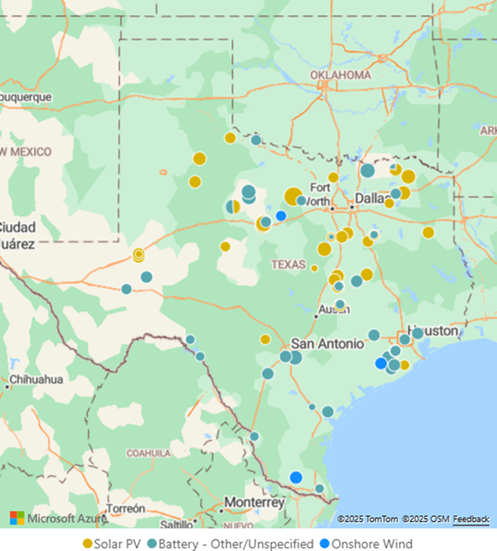
  • Solar & Battery Expansion: Enverus data shows up to 7.6 GW of solar capacity expected to reach commercial operation before June 2026, with the largest projects concentrated in ERCOT North. Battery additions are also accelerating, with 4.7 GW of battery energy storage systems (BESS) under construction. Notably, 29 BESS projects are slated for completion by mid-2026, including 12 projects of 200 MW or larger. The Houston area is seeing the highest concentration of battery development.
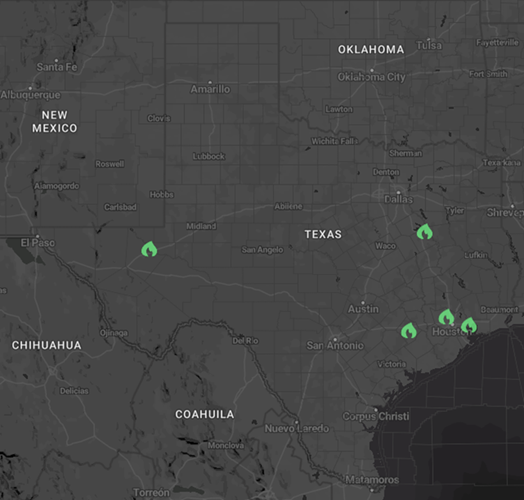
  • Texas Energy Fund (TEF) Projects: Under the TEF program, five projects have been approved for funding, totaling $2.28 billion in loans. These include a mix of brownfield and greenfield developments, such as:
Project Name
Capacity (MW)
Company
Loan Amount
Rock Island
122
KPUB
$105
TH Wharton
456
NRG
$216
Cedar Bayou
721
NRG
$562
Pin Oak Creek
460
Calpine
$278
Basin Ranch
1,350
CPV
$1,120

Most of these projects were already in early development prior to TEF legislation and are expected to cover up to 60% of their costs  through the fund.

  • Retirements & Capacity Tracking: While no major retirements are slated for this winter, ERCOT’s capacity tracking shows:
  • Wind: Increased from 39.8 GW (June) to 40.2 GW (October)
  • Solar: Increased from 31.7 GW to 32.7 GW
  • Storage: Jumped from 12.4 GW to 15.2 GW, reflecting a nearly 3 GW increase over the summer

Policy

A major market evolution is underway in ERCOT with the launch of RTC+B, scheduled to go live in December 2025. This initiative marks a significant shift in how ancillary services and energy are priced and dispatched in real time, with direct implications for battery economics, price formation and market behavior.

What RTC+B Changes

  • ASDCs replace ORDC adders: Reserve scarcity pricing is built directly into energy price (not an adder).
  • RT optionality: Resources can switch between energy and AS based on economics. ERCOT’s improved visibility to BESS SOC is an important enhancement.
  • AS becomes a financial exposure only: No structural penalties for non-performance; you just buy back in RT.
  • Greater DA/RT efficiency: Fewer extreme price spikes, tighter spreads, on average.
  • Indirect DA impacts: Lower fear-premium, more fundamental-driven price formation.

Impacts by Stakeholder Type

Stakeholder
Impact of RTC+B
Battery Operators
Battery Operators Biggest winner. Can monetize entire capacity across multiple AS + energy in same hour; reduced risk causes more aggressive DA participation; drives downward pressure on reg prices
Conventional Generators
Value of optionality increases; DA offers start embedding explicit opportunity cost of choosing AS vs energy
Traders
AS becomes a tradable financial product, new arbitrage opportunities and tighter spreads; improved efficiency reduces volatility, not opportunity
Renewable Assets
Minimal DAM behavior change; better RT efficiency can reduce curtailment noise but does not change offer strategy
Retail
Stay DAM-heavy due to volatility risk; DSM / VPP participation increases strategic reserve bidding and adds competition and downward pressure on AS prices

RTC+B Webinar

Join us for a data-driven webinar forecasting RTC+B’s rollout and its ripple effects across ERCOT—equipping traders, developers and operators with day-one insights to navigate shifting market dynamics, dispatch patterns, pricing signals and potential volatility. You’ll gain a week-one snapshot from our proprietary models, a months-ahead outlook based on back-tests, macro trends and scenario triggers, plus actionable strategies for optimization and risk management, capped by a live Q&A with industry experts before go-live. Reserve your spot now.

Price Forecasts

December 2025

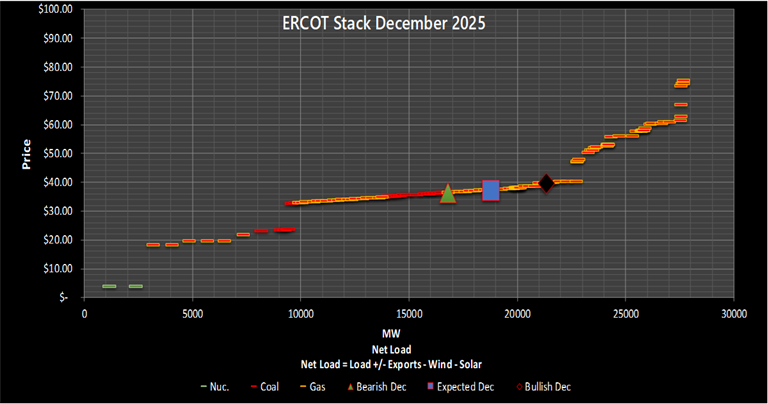
  • December is setting up on the flat part of the curve. Gen outages will be dropping and are typically 10-11GW to start December.
  • December is also the launch of RTC+B. The anticipated impacts on the DA are modest. Any delay in the implementation of RTC+B would have minimal impact on the DAM forecast.
Price
Bearish
Expected
Bullish
Enverus Price Forecast
$36.47
$37.46
$39.90
Enverus Heat-Rate Forecast
9.4
9.7
10.3
Forward Heat-Rates
10.3
10.3
10.3

January 2026

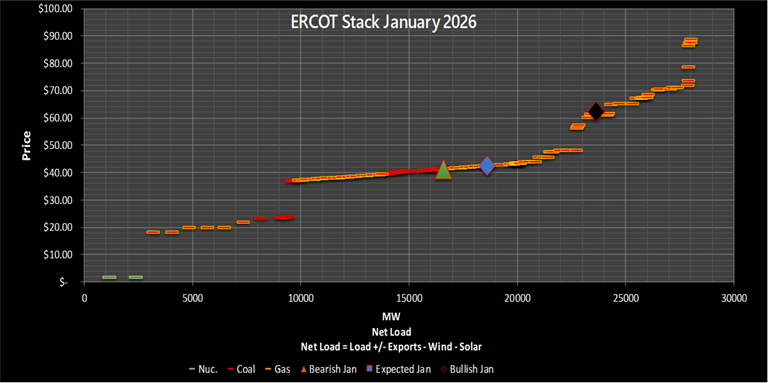
  • January scenarios include a winter storm/cold snap risk. That puts us in line with the market’s current heat rate.
  • A scenario where prices exceed the bullish case would likely require a major storm and prolonged cold. That combination is not supported by analog year analysis nor current climatology.
Price
Bearish
Expected
Bullish
Enverus Price Forecast
$44.41
$45.60
$65.39
Enverus Heat-Rate Forecast
10.7
11.0
15.8
Forward Heat-Rates
15.0
15.0
15.0

February 2026

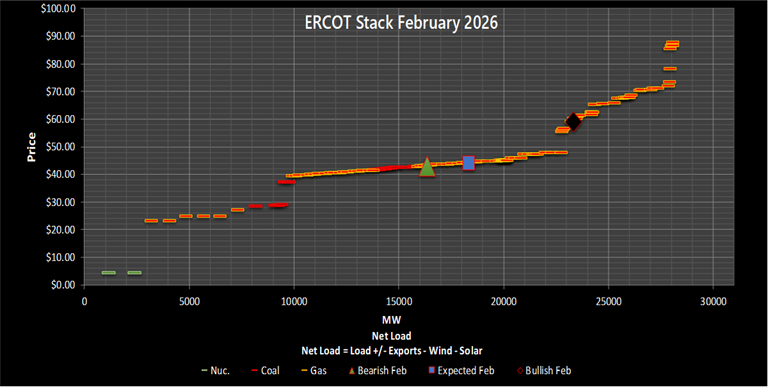
  • February risks center around winter storms and severe cold. The analog years and expected conditions are not suggesting a particularly active month/period. It is unlikely we make it through January and February without at least one cold snap; it’s a matter of timing and magnitude. We expect it will take a significant event to move the monthly average to the current market level.
Price
Bearish
Expected
Bullish
Enverus Price Forecast
$41.22
$42.30
$57.12
Enverus Heat-Rate Forecast
10.5
10.8
14.6
Forward Heat-Rates
16.1
16.1
16.1

SPP

Load and Generation

December 2025

  • If weather for 2025 had a theme, it might be “average with risks for extreme hot/cold snaps” and December would be the poster child. The analog years demonstrate the risk for a deep freeze while producing otherwise average (normal) temps.
  • The risk for an impactful cold snap looks substantial. Timing would most likely come late in the month. Of course, no reliable forecast would be able to predict a cold front with that precision and accuracy more than a couple of weeks out. Hedge appropriately.
Average 2010-2024
December 2013
December 2017
December 2024
Average
Average
36
32
33
37
34
Minimum
26
26
26
30
27
Maximum
46
43
41
45
43

January 2026

  • January is bitter cold in SPP. The average highs obscure the chance for a prolonged cold period, particularly in the northern areas of the region.
  • Each analog year shows some extremely cold lows and pleasant highs. We are leaning toward colder risks.
  • With average to below average temps expected, it is reasonable to expect above average demand throughout the month.
  • In 2014, the maximum temperature was 11 degrees below average, with the minimum 8 to 10 degrees below average.
Average 2010-2024
January 2014
January 2018
January 2025
Average
Average
33
25
30
28
28
Minimum
26
16
21
21
19
Maximum
46
34
39
35
36

February 2026

  • The analog years are close to average; however, like in ERCOT, 2014 is on the cold side, so the risk for the month to be colder than average is elevated.
  • In 2014, Feb. 5-7 had single-digit lows over much of the southern ISO.
Average 2010-2024
February 2014
February 2018
February 2025
Average
Average
37
28
39
34
34
Minimum
26
20
48
27
32
Maximum
48
37
39
42
39

Outages

December 2025 Transmission Outages/Congestion

NCEN

  • BELCNTY-SALSW (138KV) shows higher post-contingency flows with an outage at GEORSO-MIDNT (138KV) between 11/21-12/31.

  • MRVLY-ESTLD (69KV) shows higher post-contingency flows with an outage at LENSW-FLTCK (138KV) between 11/24-12/10.

WEST/FWEST

  • KENDAL-KERRST (138KV) shows higher post-contingency flows with an outage at MENGCR-K0 (138KV) between 12/15/25-01/30/26.

  • W_BATESV-UVALDE (138KV) shows higher post-contingency flows with an outage at LYTLE2-DEVINE (69KV) between 10/01-12/16.

  • YELWJCKT-HEXT(69KV) shows higher post-contingency flows with an outage at BIGHIL-TWINBU (345KV) between 12/01/25-05/15/26.

COAST

  • LOLITA-BLESSING (138KV) shows higher post-contingency flows with an outage at KENEDSW-ROSATA (138KV) between 09/17-12/10. SCEN/SOUTH

  • LYTTON_S-PILOT (138KV) shows higher post-contingency flows with an outage at SWIFTE-BASTCI (345KV) between 09/16-12/31.

  • WINCHES-GIDEON (138KV) shows higher post-contingency flows with an outage at FPPYD2-LYTTON_S (345KV) between 11/11/25-05/15/26.

  • LOYOLA (138/69KV) shows higher post-contingency flows with an outage at DRSCOLS-RICRDOS (69KV) between 11/17/25-03/20/26.

January 2026 Transmission Outages/Congestion

NCEN

  • BELCNTY-SALSW (138KV) shows higher post-contingency flows with an outage at JOHNDU-HORNSB (345KV) between 01/06/26-01/23/26.

WEST/FWEST

  • KENDAL-KERRST (138KV) shows higher post-contingency flows with an outage at MENGCR-K0 (138KV) between 12/15/25-01/30/26.

  • BALLINGE-HUMBLTAP (138KV) shows higher post-contingency flows with an outage at BRNWD-BANGS (69KV) between 01/06/26-02/15/26.

  • YELWJCKT-HEXT (69KV) shows higher post-contingency flows with an outage at BIGHIL-TWINBU (345KV) between 12/01/25-05/15/26.

COAST

  • FRANKC-SARGNTS (69KV) shows higher post-contingency flows with an outage at CARNCS-OVILASW (69KV) between 12/11/26-02/12/26.

SCEN/SOUTH

  • BANDER-MASOCR (138KV) shows higher post-contingency flows with an outage at MENGCR-K0 (345/138KV) between 12/15/25-01/30/26.

  • LYTTON_S-PILOT (138KV) shows higher post-contingency flows with an outage at GARFIELD (345/138KV) between 01/20/26-02/06/26.

  • WINCHES-GIDEON (138KV) shows higher post-contingency flows with an outage at FPPYD2-LYTTON_S (345KV) between 11/11/25-05/15/26.

  • LOYOLA (138/69KV) shows higher post-contingency flows with an outage at DRSCOLS-RICRDOS (69KV) between 11/17/25-03/20/26.

February 2026 Transmission Outages/Congestion

NCEN

  • BELCNTY-SALSW (138KV) shows higher post-contingency flows with an outage at GEORSO-MIDNT (138KV) between 11/21-12/31.

  • MRVLY-ESTLD (69KV) shows higher post-contingency flows with an outage at LENSW-FLTCK (138KV) between 11/24-12/10.

WEST/FWEST

  • KENDAL-KERRST (138KV) shows higher post-contingency flows with an outage at MENGCR-K0 (138KV) between 12/15/25-01/30/26.

  • W_BATESV-UVALDE (138KV) shows higher post-contingency flows with an outage at LYTLE2-DEVINE (69KV) between 10/1-12/16.

  • YELWJCKT-HEXT (69KV) shows higher post-contingency flows with an outage at BIGHIL-TWINBU (345KV) between 12/01/25-05/15/26.

COAST

  • LOLITA-BLESSING (138KV) shows higher post-contingency flows with an outage at KENEDSW-ROSATA (138KV) between 09/17-12/10. SCEN/SOUTH

  • LYTTON_S-PILOT (138KV) shows higher post-contingency flows with an outage at SWIFTE-BASTCI (345KV) between 09/16-12/31.

  • WINCHES-GIDEON (138KV) shows higher post-contingency flows with an outage at FPPYD2-LYTTON_S (345KV) between 11/11/25-05/15/26.

  • LOYOLA (138/69KV) shows higher post-contingency flows with an outage at DRSCOLS-RICRDOS (69KV) between 11/17/25-03/20/26.

Power Unit New Build and Retirement

New Builds:

  • Solar development remains limited, with fewer projects in the queue compared to other ISOs.
  • Battery storage projects are small and sparse, offering minimal impact on real-time flexibility or ancillary services.
  • Grand River Energy Center (GREC) Unit 4 in Choteau, OK, is replacing a coal-fired unit with a simple-cycle Mitsubishi gas turbine (design heat rate: 8 MMBtu/MWh).
  • This swap is largely capacity-neutral but may help alleviate persistent west-to-east congestion across Oklahoma.

Retirements:

  • No major retirements are scheduled for winter 2025/26.
  • Several coal units remain under review for future retirement, but reliability concerns have delayed timelines.

Transmission-Linked Development:

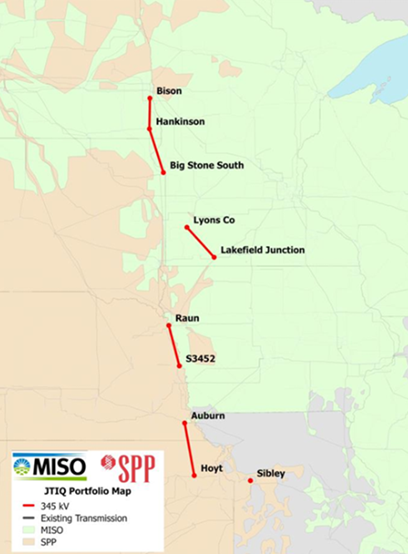
  • The Joint Targeted Interconnection Queue (JTIQ) initiative has approved multiple 345 kV transmission projects that are expected to come online around 2029–2031.
  • Additional plans include a 765 kV system from western Oklahoma to southern New Mexico and a 345 kV buildout along the western seam connecting Nebraska to North Dakota.

Price Forecasts

December 2025

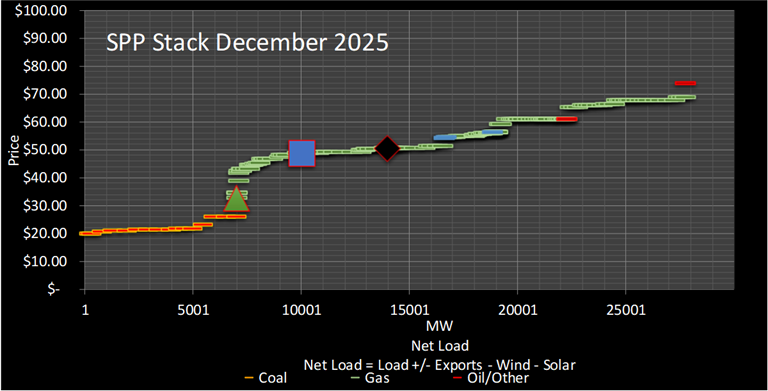
  • We have accounted for the risk of an impactful cold snap in our bullish scenario. What stands out is the flat curve on the range of expected/probable loads. 5GW of incremental net load is worth a little less than $2 in price increase.
Price
Bearish
Expected
Bullish
Enverus Price Forecast
$26.00
$48.64
$50.72
Enverus Heat-Rate Forecast
7.2
13.5
14.1
Forward Heat-Rates
12.9
12.9
12.9

January 2026

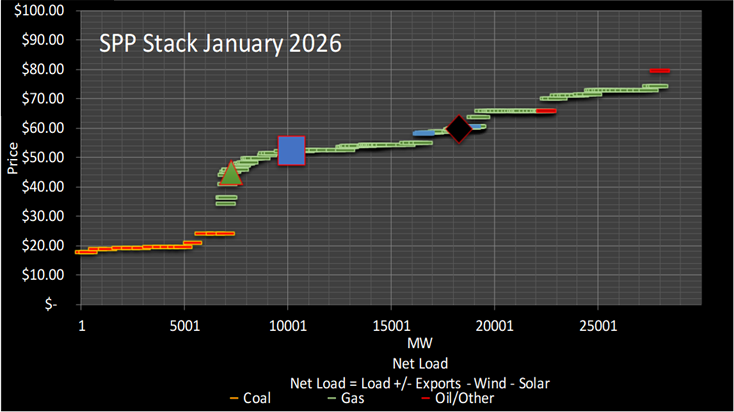
  • A major cold event brings our forecast closer to the market heat rate. Most scenarios indicate that the bullish case is a reasonable high point.
  • The risk that we exceed the bullish scenario is small. Analog years and expected climate do not support prolonged or super stormy conditions. A cold snap is likely, just a question of magnitude.
Price
Bearish
Expected
Bullish
Enverus Price Forecast
$74.01
$52.18
$59.74
Enverus Heat-Rate Forecast
11.8
13.1
15.0
Forward Heat-Rates
16.4
16.4
16.4

February 2026

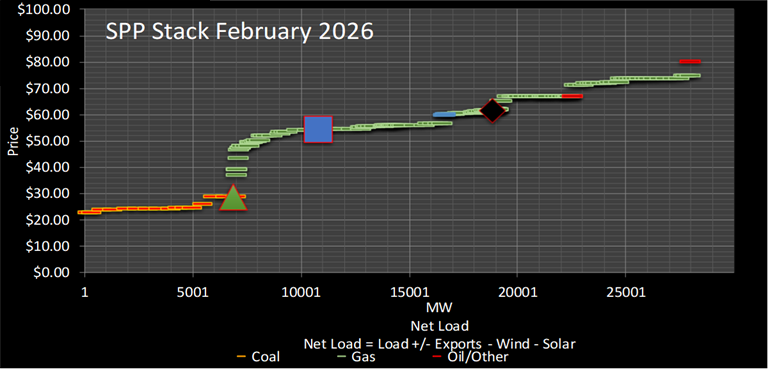
  • The bullish risks continue to hinge on winter weather. The bearish scenario stands out, though. Should we hit a warm spell, prices stand to fall through the floor. The analog years show both impactful cold and warmth, which is well reflected in the range of outcomes. We are leaning bearish in risk profile barring any major winter event.
Price
Bearish
Expected
Bullish
Enverus Price Forecast
$26.00
$54.42
$61.77
Enverus Heat-Rate Forecast
6.9
14.4
16.4
Forward Heat-Rates
15.1
15.1
15.1

PJM

Load and Generation

December 2025

  • At the start of winter 2025/2026, our analog years are 2013/14, 2017/18 and, (last year) 2024/2025, all pointing to a mostly cold winter.
  • Of the three, 2013 stands out for its stronger cold risk, with Chicago experiencing 19 days below 10°F, Philadelphia 7 days, and Washington, D.C. 2 days during that stretch. Last year Chicago did have a couple of days that measured lows of 4 degrees.
Average 2010-2024
December 2013
December 2017
December 2024
Average
Average
38
32
33
37
34
Minimum
31
26
26
30
27
Maximum
45
43
41
45
43

January 2026

  • In January, our analog years transition to 2014, 2018 and 2025, but our view holds to high demand during the month.
  • January 2014 stands out as an exceptionally cold month. For example, from Jan. 21-29, the average minimum temperatures in Chicago were -2°F with Philadelphia measuring 4 days lower than 10 degrees for lows and DC measuring an average low of 23 degrees. January 2018 had approximately 30% of January days in Chicago recording temperatures below 10°F. In 2025, Jan 13-21 had an average low temperature of 0 degrees in Chicago.
Average 2010-2024
January 2014
January 2018
January 2025
Average
Average
33
25
30
28
28
Minimum
23
16
21
21
19
Maximum
46
34
39
35
36

February 2026

  • Our view in February reflects a typical La Nina year with mostly above average temperatures in the Eastern Interconnect & below average load.
  • Analog year 2025 holds the colder anomalies with temperatures in Chicago dropping to a frigid -5 degrees on Feb. 18th with Philadelphia & D.C., in the low 20s.
Average 2010-2024
February 2014
February 2018
February 2025
Average
Average
29
28
39
34
34
Minimum
22
20
29
27
32
Maximum
36
37
48
42
39

Outages

December 2025 Transmission Outages/Congestion

  • For the duration of the winter Conaston-Ottercreek line will be undergoing an outage (11/3-7/31) increasing constrained flows for MANOR-GRACE. A supply imbalance favoring Wildcat & Brunner Island over Brandon Shores sends a rush of megawatts into the PA/ MD border resulting in binding on this element.  It gives a slight tick up to WHUB but has more of a bearish impact on NJ HUB.

  • Our flow analysis suggests rising congestion at the AEP–Dominion Transfer Interface in December, driven by the 765 kV Belmont– Mount line outage (Dec. 1–19) and strong winter demand in Dominion, which encourages coal imports from West Virginia into southern Virginia—placing additional strain on the interface. When binding, it discounts WHUB.

  • The northern Richmond area will be a bottleneck for east-west flows specifically for SANN-LOUIS as the Ladysmith-Possumpoint line is undergoing work (12/8-12/12). It is bearish DOM HUB during periods when Louisa is offline and when demand in the Dominion footprint is underperforming.

January 2026 Transmission Outages/Congestion

  • The Braid-EFRN line will be taken out of service (1/23-1/30) which increases congestion risk for ELWO-GOOD and ideal conditions for strong shadow prices, Elwood & Jackson CTs online and elevated demand in Comed. When binding, it is bearish NIHUB.

  • West-to-east flows across central Pennsylvania are expected to be prominent during the Aspen–Roxbury line outage (Jan. 5–9, Jan. 12–16), heightening sensitivity on the SHAD-ROX path. A favorable setup would include Cardinal coal unit online, paired with weak Pittsburgh demand and stronger loads around Harrisburg.

  • Early in the month the Pleas-Ashburn line will be undergoing an outage (1/4-1/8) increasing constrained flows for BRAM-POLA. Strong coal imports from West Virginia and weak thermal generation in Baltimore/D.C. area create additional strain.

February 2026 Transmission Outages/Congestion

  • Conditions are ideal for PLEAS–ASHB congestion, with strong Dominion demand in the 17–18 GW range and elevated coal-fired imports from West Virginia.

  • At the PA/MD border, CONA-NRTH remains a key congestion driver due to the ongoing Conaston–Northwest line outage (Jan. 4–May 9). This is a dual-circuit line with one segment out of service, increasing flow on the remaining in-service circuit. The constraint tends to bind when strong thermal generation is present in eastern Pennsylvania, paired with weaker sink-side output from Brandon Shores and Keys. This supply imbalance amplifies north-to-south flows across the PA/MD border, and when the constraint binds, it provides upward support to WHUB.

  • The upcoming Olive–Olive University Park line outage (Feb. 5 – May 22) increases congestion risk around the STILL–DUMO interface—particularly on windy days in ComEd. The risk is elevated when thermal generation on the eastern shore of Lake Michigan is outpaced by stronger output from the western shore.

Power Unit New Build and Retirement

New Builds

  • No notable gas or thermal generation is expected to come online before winter.
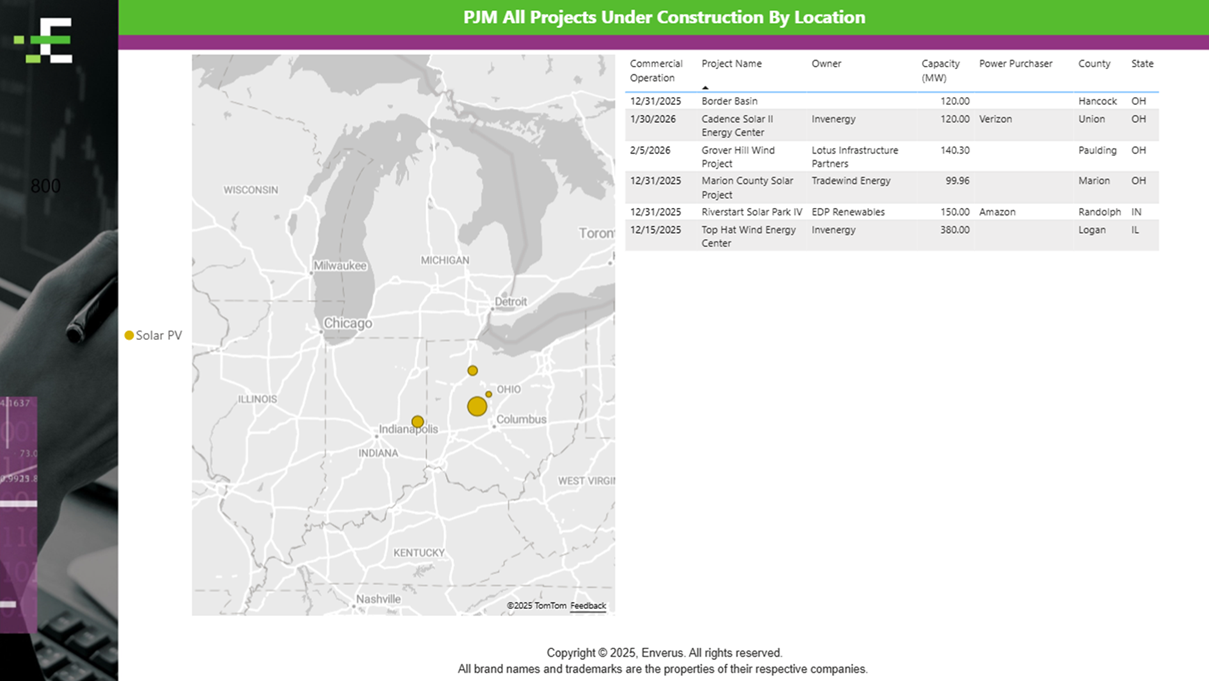
  • Most new capacity is solar-focused, concentrated in Ohio and surrounding areas.
  • Larger thermal projects are in development for 2026–2027, including:
  • CPV Shay Energy Center in northern West Virginia
  • Homer City Energy Campus in Pennsylvania
  • FirstEnergy Gas Plant Replacements across multiple sites
These projects are strategically located in Appalachia, and while not impacting this winter, they serve as indicators of future grid evolution and load growth.

Retirements

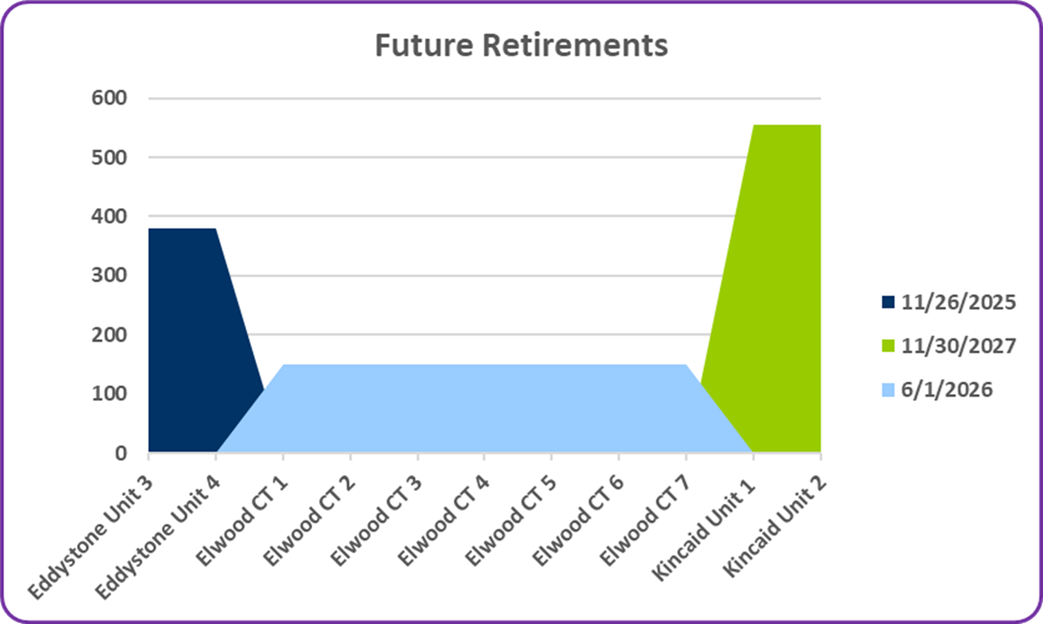
  • Eddystone units are scheduled to retire at the end of November 2025, though they’ve already received two postponements via DOE orders.
  • Further delays are possible, and market sentiment suggests they may remain online through winter.

Looking ahead:

  • Elwood CTs are slated for retirement in spring 2026.
  • Kincaid units are expected to retire in 2027.
Transmission Developments
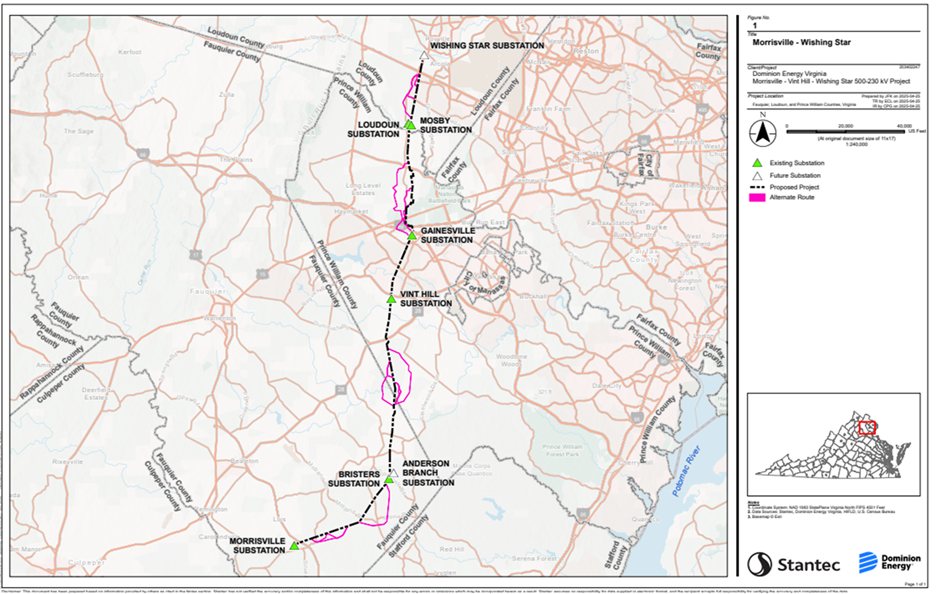
  • A quick update on critical transmission projects in “Data Center Alley,” specifically the Morrisville to Wishing Star transmission line project. According to Dominion, the application to the Virginia State Corporation Commission (SCC)  is expected to be submitted late this year or early in 2026.  As of now, it remains under the “planning phase.“
  • Why it’s important: It will add backbone transmission at the 500 kV level in the heart of Loudoun, Prince William and Fauquier counties.  Once completed, it opens the door for more data centers and even more load growth in the Dominion zone. The project has an estimated cost near $852.9 million.
  • Price impacts: If and when the Morrisville to Wishing Star line is completed, it’s bullish for DOM HUB, as the transmission line should provide for more data centers and load growth in the area.

Price Forecasts

December 2025

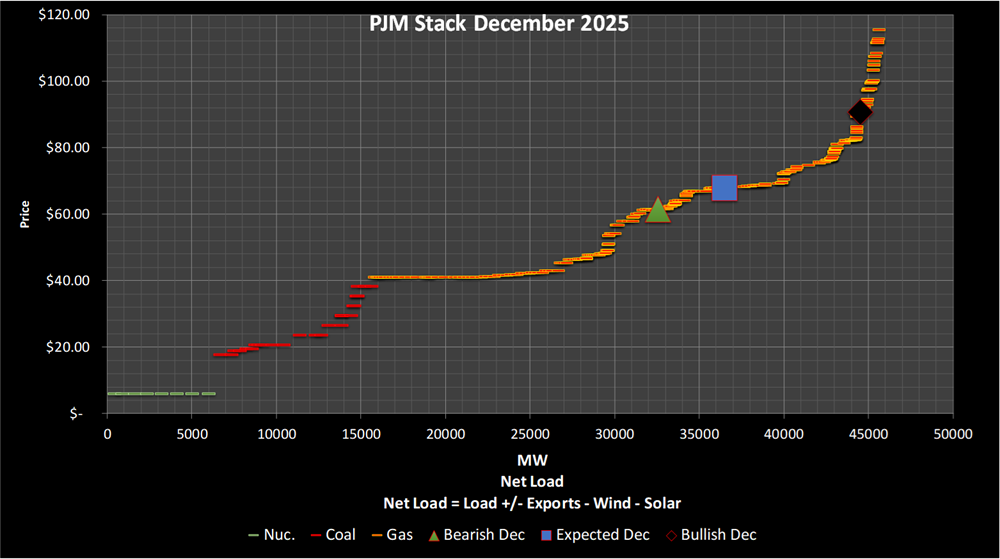
  • Looking ahead to winter, our base case for December anticipates MANO-GRAC congestion, reinforcing a bullish view on WHUB heat rates relative to the broader market. The primary risk to this outlook is sustained congestion along the AEP–Dominion Transfer Interface. When binding, this constraint typically weighs on WHUB pricing and can drive heat rates closer to our bearish case.
Price
Bearish
Expected
Bullish
Enverus Price Forecast
$61.25
$67.87
$90.58
Enverus Heat-Rate Forecast
12.7
14.1
18.8
Forward Heat-Rates
12.5
12.5
12.5

January 2026

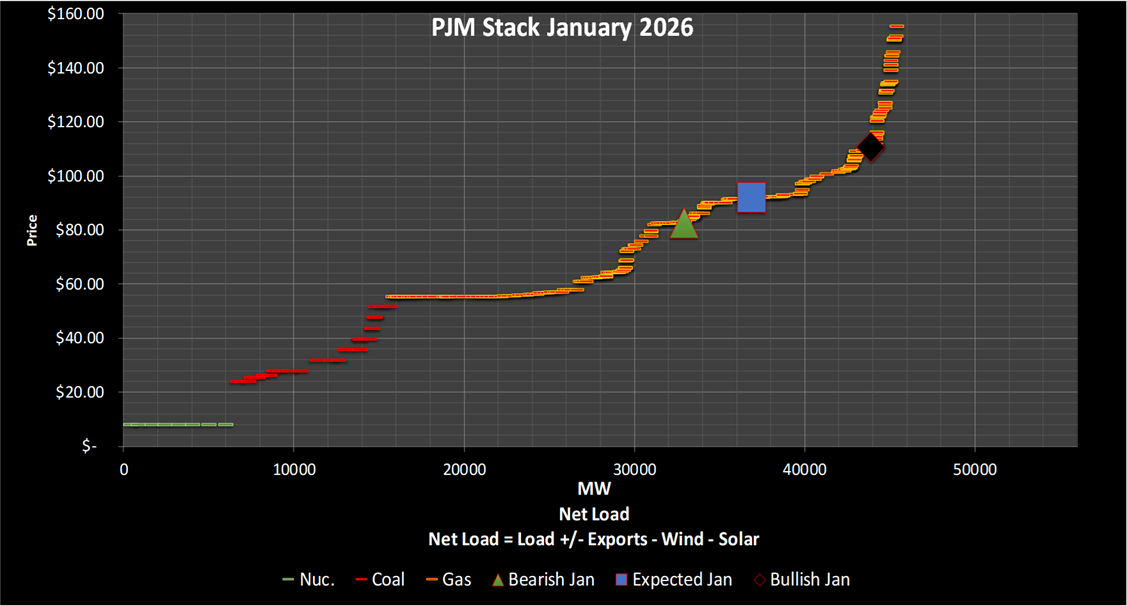
  • The combination of our projections for above-average demand and congestion risk from BCPEP interface, which has a 31% shift factor for WHUB, is fueling our expected heat rate near 11.8.
Price
Bearish
Expected
Bullish
Enverus Price Forecast
$82.87
$91.55
$110.68
Enverus Heat-Rate Forecast
10.6
11.7
14.1
Forward Heat-Rates
10.3
10.3
10.3

February 2026

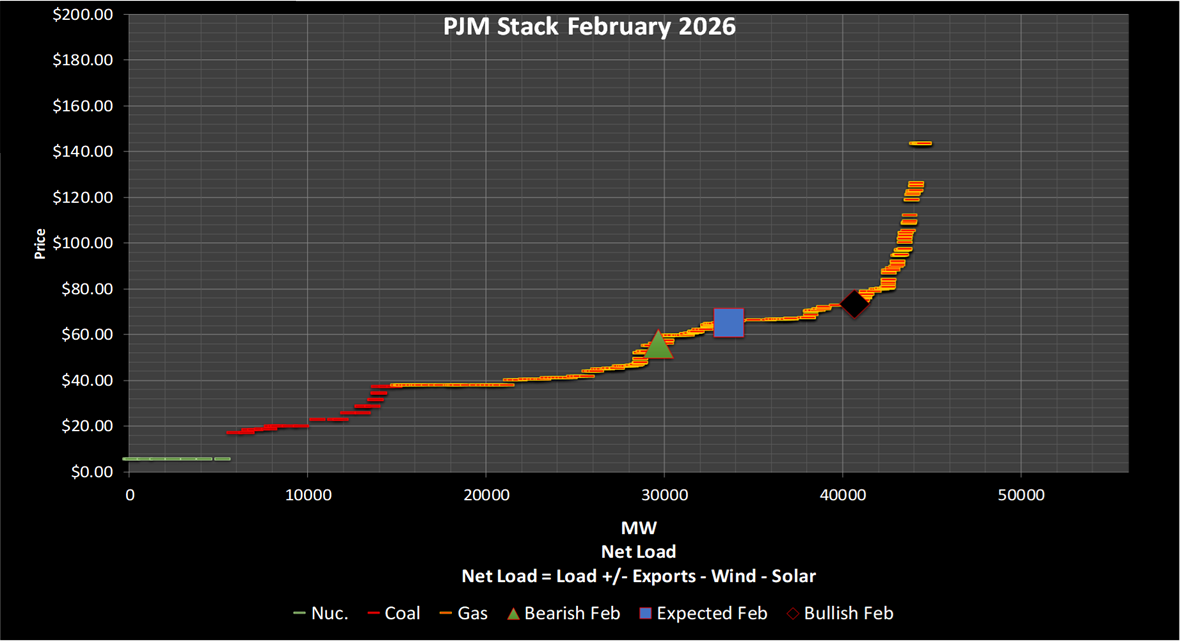
  • For February, we are just below the market stance on WHUB, primarily driven by below-average demand.
  • There is PLEAS–ASHB congestion risk, but on its own not likely to outpace MANOR-GRACE or CONA-NRTH.
Price
Bearish
Expected
Bullish
Enverus Price Forecast
$56.34
$65.42
$73.70
Enverus Heat-Rate Forecast
8.4
9.8
11.0
Forward Heat-Rates
10.4
10.4
10.4

MISO

Load and Generation

December 2025

  • In December we retain our analog years 2013, 2017 and 2024. 2013 and 2017 are cold, but 2024 was closer to average so there is a risk that December won’t be as cold.
  • 2013 holds the “colder,” risk with nearly 50% of the days in December measuring temperatures below 10 degrees in Indianapolis and Detroit.
Average 2010-2024
December 2013
December 2017
December 2024
Average
Average
33
28
30
36
31
Minimum
26
21
23
30
24
Maximum
40
36
38
42
39

January 2026

  • In January, our analog years shift to 2014, 2018 and 2025 and we expect strong demand throughout the month.
  • Both analog years 2014 and 2018 feature notable cold outliers, with 7 to 9 days in Indianapolis and Detroit falling below 10°F. This represents nearly 25% of the month.
  • In 2025 from Jan. 19-24, minimums averaged 5 degrees in Indy and 2 degrees in Detroit.
Average 2010-2024
January 2014
January 2018
January 2025
Average
Average
29
21
27
26
25
Minimum
21
11
18
18
16
Maximum
36
32
36
35
34

February 2026

  • Our view in February reflects a typical La Nina year with mostly above average temperatures in the Eastern Interconnect and below average load.
  • Analog year 2025 holds the colder anomalies with temperatures in Chicago dropping to a frigid -5 degrees on Feb. 18 with Philadelphia and D.C., in the low 20’s.
Average 2010-2024
February 2014
February 2018
February 2025
Average
Average
32
24
34
31
30
Minimum
24
15
25
23
21
Maximum
41
33
43
40
39

Outages

December 2025 Transmission Outages/Congestion

  • A 345 KV line outage near Eau Claire Corridor in WI from 11/01–12/30 with strong wind production in ALTW, MEC during high NSP demand increasing the flow on element REDROCK-WOODBRY (115KV) in NSP. It will be bullish for MN HUB prices.

  • A 161 KV line outage near Yellville Corridor in AR from 10/7/25-02/06/26 with strong natural gas generation in EES, EAI during low demand in EES is increasing the flow on element HILLTOP_ST_JOE_E (161KV) in EAI. It will be bearish for AR hub prices.

  • A 161 KV line outage near Auburn Corridor in NE from 12/10-12/19 with strong wind generation in WR, OKGE during strong demand in OPPD, MEC is increasing the flow on element NEBRCTY-SUB3456 (345KV) in OPPD. It will be bullish for MN hub prices.

January 2026 Transmission Outages/Congestion

  • A 345 KV line outage near Cold Spring Corridor in MN from 01/22/26–03/06/26 with strong North Dakota wind generation relative to MISO North during strong demand in NSP, OTP is increasing the flow on element FARGO-SHEYNNE (230KV) in WAUE. It will be bullish for MN hub prices.

  • A 161 KV line outage near Berryville Corridor in AR from 12/06/25-01/21/26 with strong natural gas generation in EES, EAI during low demand in EES is increasing the flow on element HILLTOP_ST_JOE_E (161KV) in EAI. It will be bearish for AR hub prices.

  • A 345KV line outage near Chicago Heights Corridor in IL from 11/20/2025–05/22/2026 with strong wind generation in ALTW, MEC during strong demand period in AEP, ONT, NIPS increasing the flow on element CHICAGO-PRAX (138KV) in NIPS. It will be bullish for IN, MI hubs and bearish for MN hub prices.

February 2026 Transmission Outages/Congestion

  • A 345 KV line outage near Cold Spring Corridor in MN from 01/22/26–03/06/26 with strong North Dakota wind generation relative to MISO North during strong demand in NSP, OTP is increasing the flow on element FARGO-SHEYNNE (230KV) in WAUE. It will be bullish for MN hub prices.

  • A 345KV line outage near Chicago Heights Corridor in IL from 11/20/2025–05/22/2026 with strong wind generation in ALTW, MEC during strong demand period in AEP, ONT, NIPS increasing the flow on element CHICAGO-PRAX (138KV) in NIPS. It will be bullish for IN, MI hubs and bearish for MN hub prices.

Power Unit New Build and Retirement

New Builds

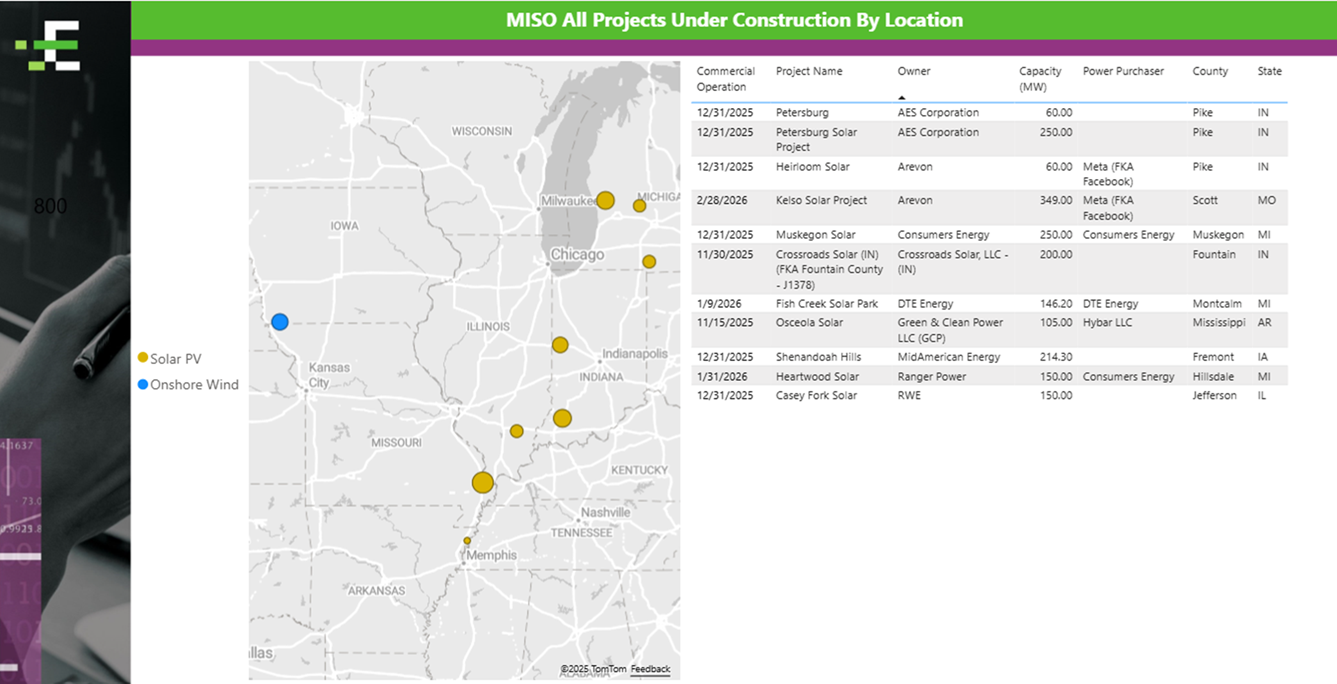
Petersburg Solar Project:

  • A new 250 MW solar facility is under development near the former Petersburg coal generation station along the White River and will be paired with 180 MW of battery storage. Based on recent satellite imagery, construction has made steady progress over the past year, making a commercial operation date (COD) by the end of December a realistic target. This project is part of AES’s broader $1 billion transition initiative, which includes the conversion of Units 3 and 4 to natural gas. As part of the solar buildout, a 6-mile, 345-kV transmission line is also being constructed to connect the facility directly to the Petersburg Station, utilizing infrastructure from a retired coal unit.  The site is located near resource node IPL.16PETE.AGG.
  • Congestion impacts: In our flow analysis, it will increase congestion for PETER-CATO.  On paper it may help to relieve GIBS-RCC congestion especially on sunny days where demand underperforms in St. Louis.

Retirements

Approximately 2.5 GW of coal generation is scheduled to retire by the end of December 2025, including the R.M. Schahfer units.

  • These retirements are significant for Indy Hub, as Schahfer has historically supported reliability and congestion management.
  • Current modeling assumes Schahfer retires on schedule, though sensitivities include scenarios where it remains online.

Sherburne County units are also slated for retirement, which will ease west-to-east flow patterns and reduce congestion risks around Lake Michigan.

J.H. Campbell received an extension through Nov. 19, 2025, and could remain online through winter given its importance as a baseload resource.
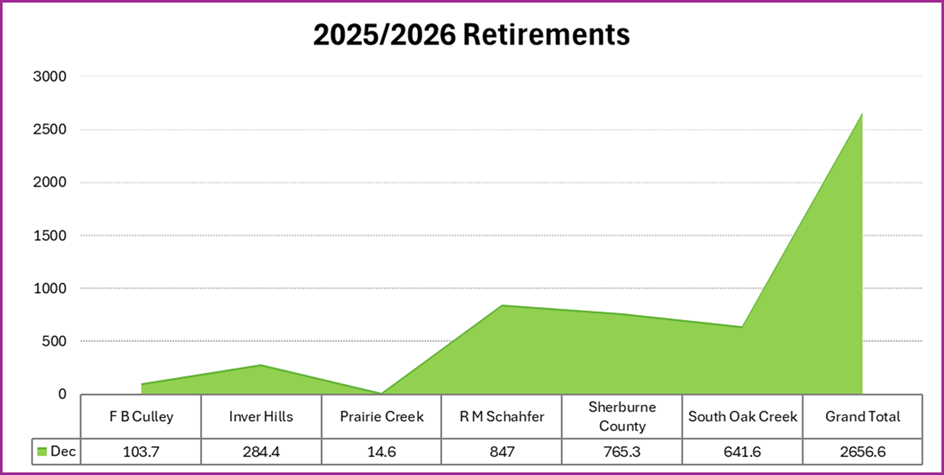
  • If Campbell stays online while Schahfer and South Oak Creek retire, congestion relief is expected in Michigan and surrounding areas.

Price Forecasts

December 2025

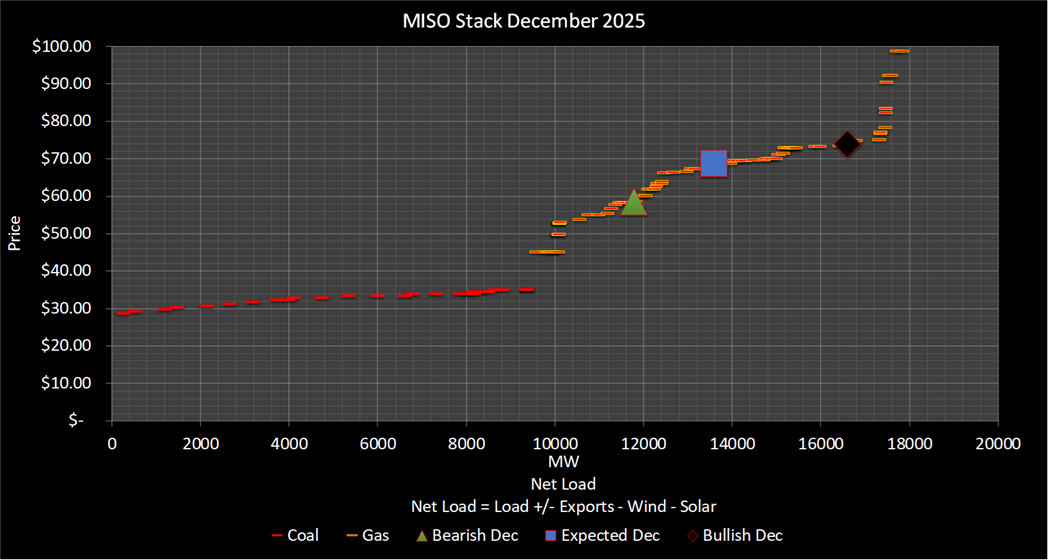
  • As winter begins, our fundamentals point to above-average load, reinforcing a bullish outlook on INDY Hub heat rates relative to the broader market.
  • With RM Schahfer not retiring, expected heat rate for INDY HUB is 15.5.
Price
Bearish
Expected
Bullish
Enverus Price Forecast
$58.25
$68.46
$73.99
Enverus Heat-Rate Forecast
14.2
16.7
18.0
Forward Heat-Rates
13.6
13.6
13.6

January 2026

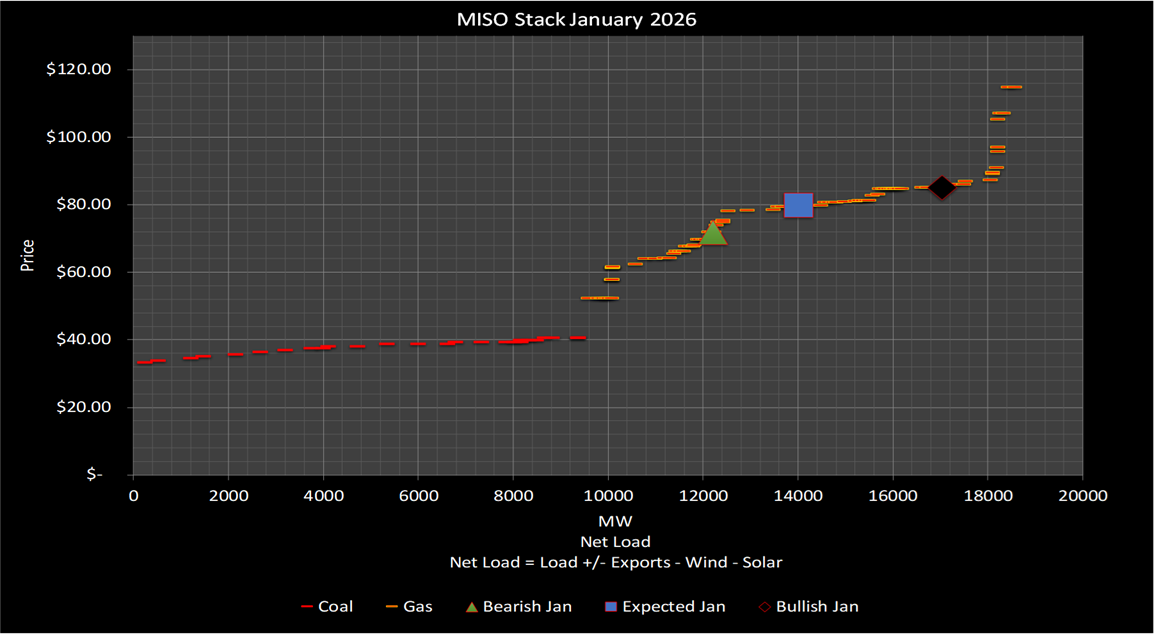
  • In January, there’s general alignment between our outlook and the market. According to the stack model, a shift to our bullish scenario would require cold snap–level conditions.
  • With RM Schahfer not retiring, expected heat rate for INDY HUB is 15.2.
Price
Bearish
Expected
Bullish
Enverus Price Forecast
$71.95
$80.09
$85.16
Enverus Heat-Rate Forecast
14.7
16.4
17.4
Forward Heat-Rates
14.9
14.9
14.9

February 2026

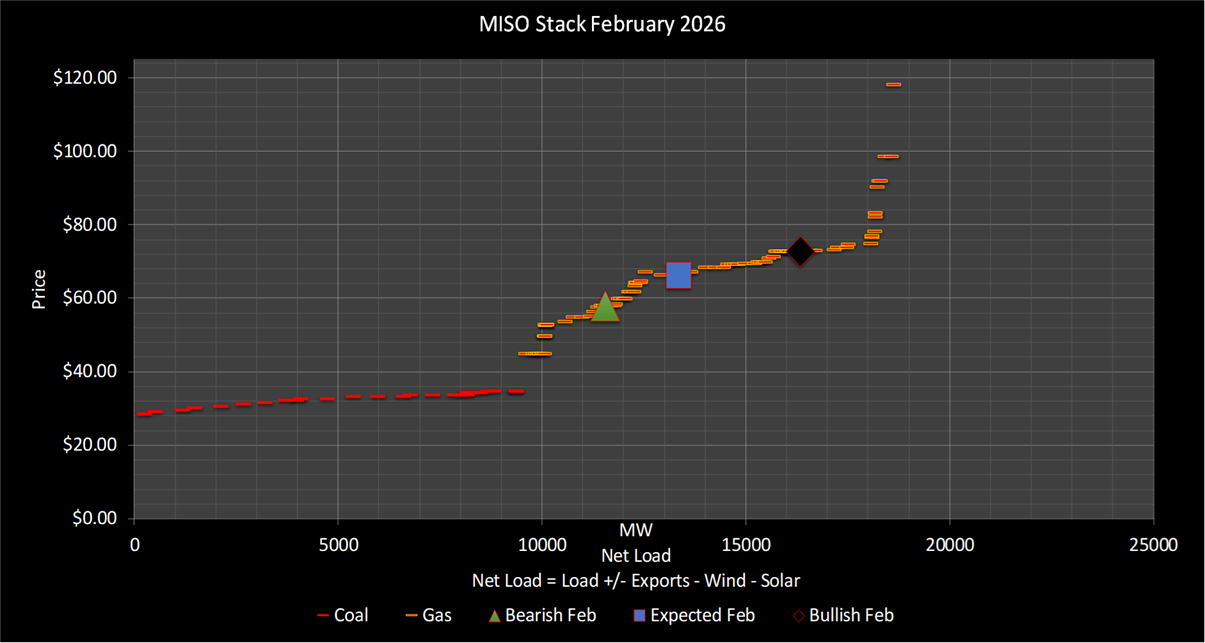
  • In February, our stack reflects the impact of removing R.M. Schahfer from the generation fleet, with expected heat rates remaining well above market levels—even under average load conditions.
  • With R.M. Schahfer not retiring, expected heat rate for INDY HUB is 13.1.
Price
Bearish
Expected
Bullish
Enverus Price Forecast
$58.10
$67.27
$72.75
Enverus Heat-Rate Forecast
12.3
14.3
15.5
Forward Heat-Rates
13.3
13.3
13.3

CAISO

Load and Generation

December 2025

  • Temperature conditions look above average with load below average and mild temperatures.
  • Historic Pop. Weighted SP-15 average temperature for December is 53 degrees. Our analog years show 56 degrees.
  • Wind generation should be near to below average with limited storm activity over the west.
Average 2010-2024
December 2013
December 2017
December 2024
Average
Average
53
55
56
56
56
Minimum
44
42
44
46
44
Maximum
62
66
68
66
67

January 2026

  • Temperature conditions look above average with load below average and mild temperatures.
  • Historic Pop. Weighted SP-15 average temperature for January is 54 degrees. Our analog years show 56 degrees.
  • Wind generation should be near to below average with limited storm activity over the west.
Average 2010-2024
January 2014
January 2018
January 2025
Average
Average
54
58
57
53
56
Minimum
45
46
47
43
47
Maximum
63
70
67
65
67

February 2026

  • Temperature conditions look near average with near average load.
  • Historic Pop. Weighted SP-15 average temperature for February is 56 degrees. Our analog years show 57 degrees.
  • Wind generation should be near to below average with limited storm activity over the west.
Average 2010-2024
February 2014
February 2018
February 2025
Average
Average
56
58
56
56
57
Minimum
46
49
46
46
47
Maximum
65
67
66
66
66

Power Unit New Build and Retirement

CAISO enters winter with major transmission and renewable developments that will reshape market dynamics and price formation.

New Builds

SunZia Wind Project:

  • Pattern Energy’s SunZia south segment is under construction and this much-anticipated project comes on-line late this year or early next year.
  • This 525KV high voltage line is 550 miles long and will end at the PaloVerde hub where it will then connect to CAISO SP-15.
  • The 3.5 GW Sun Zia wind farm in central New Mexico will connect to SP-15.
  • According to Pattern Energy, this wind farm will provide energy that is like solar/battery profile and be available during the evening peaks.
  • Market sentiment is bearish on SP-15.

CAISO Capacity:

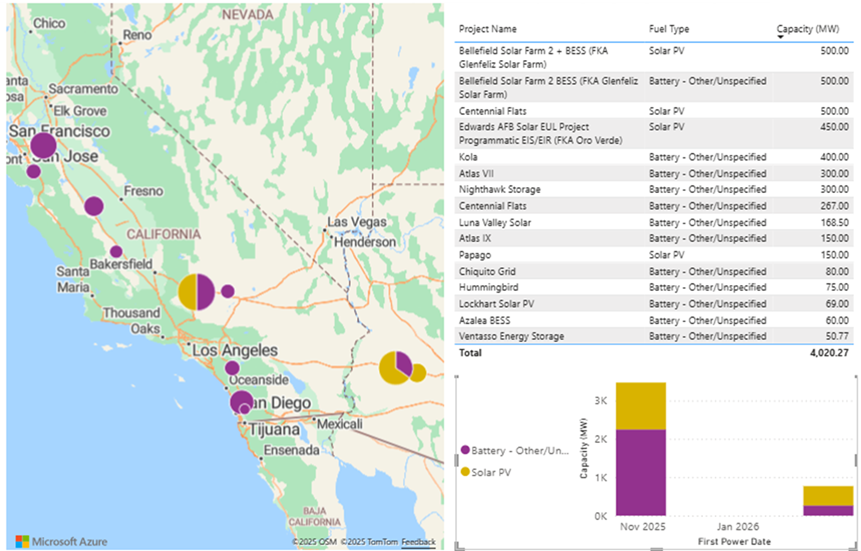
  • Over the next year, CAISO is tracking ~4 GW of new builds, primarily battery storage projects, reinforcing the trend toward storage over solar.
  • Solar development continues to slow, while battery installations accelerate, improving grid flexibility and reducing volatility risk.

Policy

CAISO’s policy landscape continues to evolve, with two major initiatives shaping the long-term market structure:

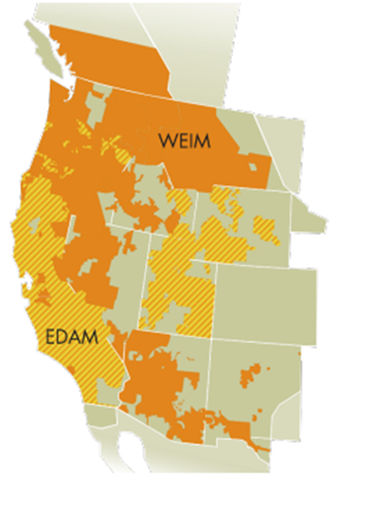
  • Extended Day-Ahead Market (EDAM)
  • The CAISO Extended Day-Ahead Market (EDAM) is scheduled to start April 2026.
  • The Pathways Initiative passed in October which gives the authority to create the regional organization (RO) to separate governance from CAISO.  Initially the RO and CAISO will work together.
  • The plan is that the RO will become independent from CAISO to help govern the rest of the EDAM participants after 2027.
  • The RO is seen as a major path forward to encourage Northwest utilities to join EDAM and bring them away from Markets+.

SPP Markets+ Development

  • The SPP Markets+ is expected to start in late 2027.
  • SPP Markets+ is a real-time and day-ahead market that will have the ability to pool renewable rich resources from the western Great Plains, the Pacific Northwest, Mountain West and Desert Southwest.
  • In June, Markets+ entered Phase 2 which allows staff to collaborate with all the new stakeholders to develop (build out) the systems needed to operate the grid, conduct market trials and conduct parallel operations.

Price Forecasts

December 2025

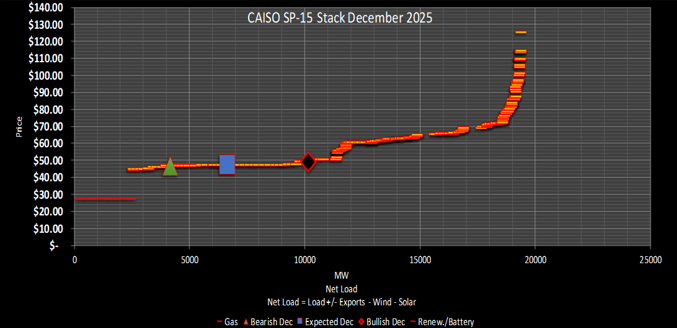
  • The SunZia transmission line will be sending in 3.5 GW nameplate New Mexico (SPP type wind generation) wind generation into SP15 starting in late December or January keeping things even more calm/bearish.
  • Enverus forecasts for December are for below average load with below average wind generation. December should be a very calm month with limited day-to-day changes.
  • If we did measure a cold snap, prices would likely be in the $60s but La Nina conditions should keep the jet stream north.
Price
Bearish
Expected
Bullish
Enverus Price Forecast
$46.96
$47.91
$49.13
Enverus Heat-Rate Forecast
9.5
9.7
10.0
Forward Heat-Rates
9.5
9.5
9.5

January 2026

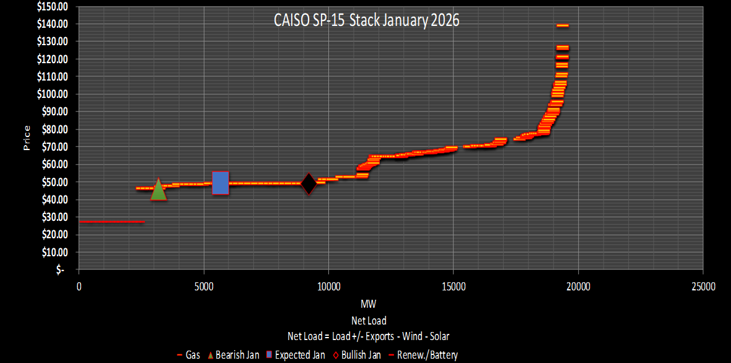
  • The SunZia transmission line will be sending in 3.5 GW nameplate New Mexico (SPP type wind generation) wind generation into SP15 starting in late December or January, keeping things even more calm/bearish.
  • Enverus forecasts for January are for near average load with near average wind generation. January (just like December) should be a very calm month with limited day-to-day changes.
  • If we did measure a cold snap, prices would likely be in the $60s, but La Nina conditions should keep the jet stream north.
Price
Bearish
Expected
Bullish
Enverus Price Forecast
$46.51
$51.19
$51.31
Enverus Heat-Rate Forecast
8.2
9.0
9.0
Forward Heat-Rates
8.4
8.4
8.4

February 2026

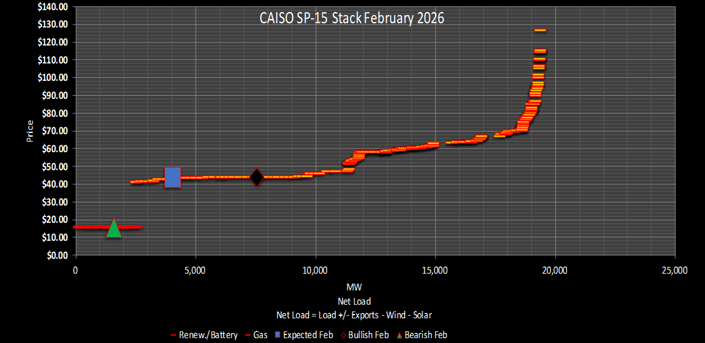
  • Enverus forecasts for February are for below average load with near average wind generation. February (just like December) should be a very calm month with limited day-to-day changes.
  • If we did measure a cold snap, prices would likely be in the $60s, but La Nina conditions should keep the jet stream north.
  • Last year the month traded at 6.9, and as you can see, our bearish scenario of gas stack is at 3.0. Enverus views that with the SunZia wind farm in place we are likely to trade somewhere between 8.2 and 3.0, so shorting On-Peak February seems prudent.
Price
Bearish
Expected
Bullish
Enverus Price Forecast
$15.73
$43.25
$45.97
Enverus Heat-Rate Forecast
3.0
8.2
8.8
Forward Heat-Rates
6.8
6.8
6.8

Mid-C

Load and Generation

December 2025

  • In December we are forecasting near to slightly below average temperatures.
  • The average temperature in Portland for December is 41 degrees. Our analog years’ average is 39 degrees.
  • In 2013 low temperatures were in the teens from Dec. 5-9, but there were limited cold snaps in 2017 with temperatures right at average.
Average 2010-2024
December 2013
December 2017
December 2024
Average
Average
41
36
40
44
40
Minimum
37
31
34
39
35
Maximum
47
42
46
50
46

January 2026

  • In January we are forecasting above average temperatures with a large ridge of high pressure likely dominating the western U.S.
  • January of 2014 and 2018 were eventful with generally mild temperatures.
  • Last January, clear skies and high pressure brought cold overnight lows to Portland with lows in the mid to upper 20s for around a week, but high temperatures were above average.
Average 2010-2024
January 2014
January 2018
January 2025
Average
Average
42
41
46
43
44
Minimum
36
35
40
35
37
Maximum
49
48
52
49
50

February 2026

  • In February we are forecasting below-average temperatures with stormy weather.
  • In February of 2014 there was a sharp cold snap Feb. 5-8 with temperatures staying below freezing in Portland and Seattle.
  • In February of 2018 and 2025, there were no extreme events, but it was cold and stormy.
Average 2010-2024
January 2014
January 2018
January 2025
Average
Average
43
40
42
42
41
Minimum
37
34
36
36
35
Maximum
50
46
49
48
48

Power Unit New Build and Retirement

New Builds

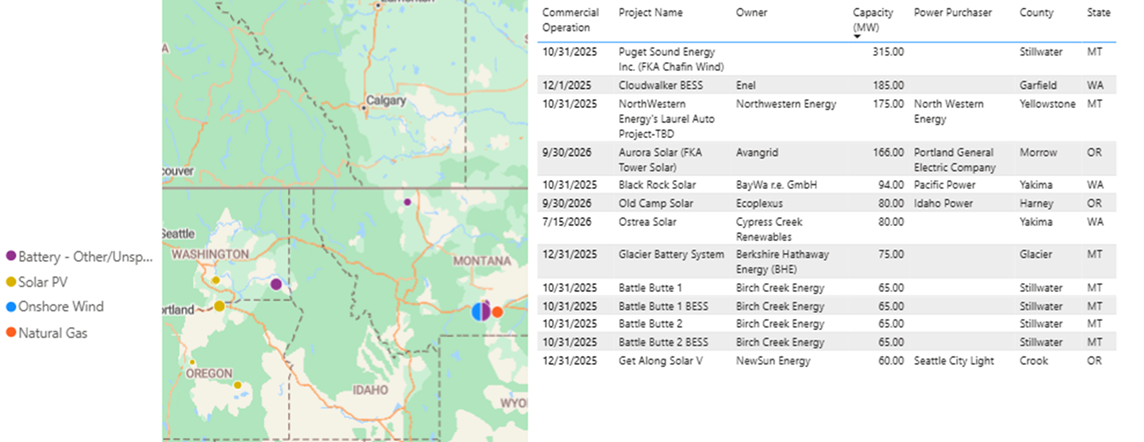
  • Battery storage projects dominate the near-term buildout, with several installations expected to come online before year-end.
  • Solar additions remain limited, continuing the trend of slower renewable penetration compared to CAISO.

Retirements

  • Centralia Unit 2, with a capacity of 670 MW, is scheduled to retire by the end of this year, further reducing the Northwest’s capacity and increasing strain on the grid. To offset this, Enverus is expecting additional MWs to flow from CAISO into the Mid-C region, providing support for the grid after the unit’s retirement. This is likely to drive up prices in both the Mid-C and CAISO markets.
  • The largest U.S. coal plant slated for retirement this year is the Intermountain Power Project in Utah, with a capacity of 1,800 MW. However, nearly half of this capacity was replaced by an 840 MW combined cycle natural gas and hydrogen. 70% of this is currently natural gas and 30% is hydrogen. This is planned to be all green hydrogen by 2045. It transmits power from Utah to Southern California under contracts with LADWP.

Price Forecasts

December 2025

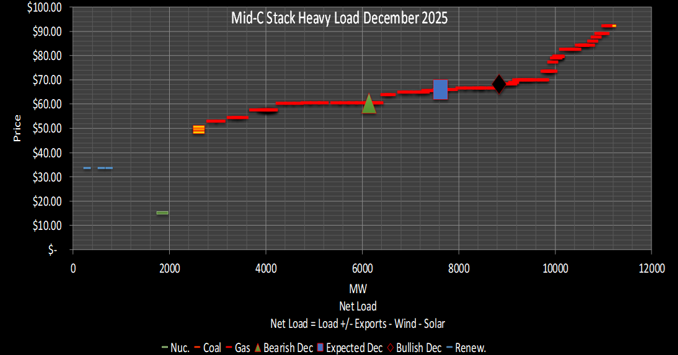
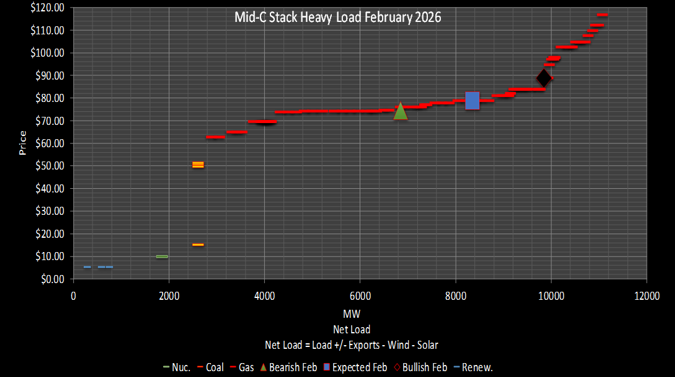
  • For December, the expected and bearish scenarios are on the flat part of the stack, but the bullish scenario is near the inflection point.
  • If there is a cold snap like our 2013 scenario shows, wholesale prices could easily move into the $70-$90 range during that cold snap period.
Price
Bearish
Expected
Bullish
Enverus Price Forecast
$60.61
$64.08
$65.68
Enverus Heat-Rate Forecast
13.8
14.6
14.9
Forward Heat-Rates
14.8
14.8
14.8

January 2026

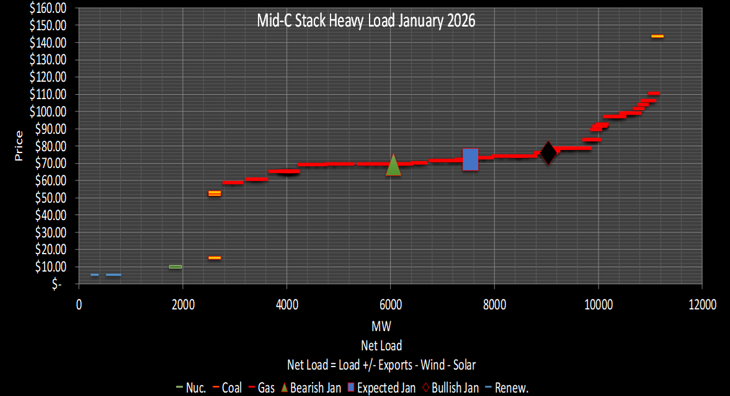
  • For January, we continue on the flatter part of the stack for the expected and bearish scenarios but again the bullish scenario is near the inflection point.
  • The analog years don’t show any cold snaps, so we do expect heat rates to be around 15.9. If there is a cold snap in January, wholesale power prices are likely to be between $90-$100 during that cold snap period.
Price
Bearish
Expected
Bullish
Enverus Price Forecast
$69.62
$72.64
$77.23
Enverus Heat-Rate Forecast
15.2
15.9
16.9
Forward Heat-Rates
16.4
16.4
16.4

February 2026

  • For February, Enverus is more bullish especially as compared to market sentiment. We think there is going to be much less water due to the flood control swap per the new treaty. This will cut inflows into Grand Coulee and take away capacity making things more bullish especially if there is a cold snap.
  • Therefore, with our expectations net load has climbed and we have climbed up the stack. If it is colder than Enverus expects for the month (high scenario) prices could realistically clear near $90 for the month. Last year it cleared at $28.70.
Price
Bearish
Expected
Bullish
Enverus Price Forecast
$74.62
$80.20
$88.80
Enverus Heat-Rate Forecast
17.7
19.0
21.0
Forward Heat-Rates
14.3
14.3
14.3

ISONE

Load and Generation

December 2025

  • Our analog years are 2013, 2017 and 2024 for December which suggest a cold and stormy month. The ISONE average high temperature for the analog years is 29 degrees in December which is 6 degrees below average.
  • December 2017 really stands out as exceptionally cold, with the last 5 days of December lows averaging 5 degrees in Boston.
Average 2010-2024
December 2013
December 2017
December 2024
Average
Average
35
32
20
34
29
Minimum
29
26
23
27
25
Maximum
42
39
36
42
39

January 2026

  • The analog years for January are 2014, 2018 and 2025 and average 3 degrees below average. The coldest analog year is 2014.
  • In fact, in 2014, Boston experienced nearly 10 days with minimum temperatures below 10 degrees, with half the month below freezing.
  • The first week of January of 2018 in Boston the average temperatures were 13 degrees, so 2018 wasn’t much better.
Average 2010-2024
January 2014
January 2018
January 2025
Average
Average
30
26
27
28
27
Minimum
23
18
19
21
19
Maximum
37
34
35
34
34

February 2026

  • The analog years for February are 2014, 2018 and 2025 and show near average temperatures with near average wind generation.
  • There is a risk of cold temperatures again with the 2014 analog year.
Average 2010-2024
February 2014
February 2018
February 2025
Average
Average
32
27
37
30
32
Minimum
25
19
28
23
23
Maximum
39
35
45
37
39

Power Unit New Build and Retirement

New Builds

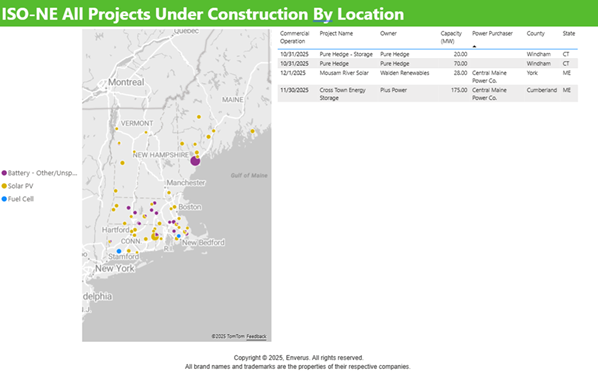
  • Pure Hedge: Pure Hedge Solar is a utility-scale 70 MW ground-mounted solar installation currently under construction in Connecticut, developed by Pure Hedge LLC. It’s expected to reach commercial operation by November 2025. Located in Connecticut, it will reduce reliance on fossil-fired plants and potentially relieve local load constraints and lower energy prices during sunny hours. The project might reduce upward spikes during sunny midday, but leave or even exacerbate evening/late afternoon spikes unless paired with dispatchable resources. It supports state-level clean energy targets and aligns with state utility decarbonization mandates (e.g., CT’s 100% clean grid by 2040 goal).
  • Cross Town Energy Storage: The Cross Town Energy Storage project in Gorham, Maine, is progressing toward becoming fully operational by winter 2025. This project is designed to add 175 MW of energy storage capacity with 350 MWh, helping to enhance the reliability of the ISO-New England grid. The project will also provide services such as grid frequency stabilization, transmission congestion relief and energy arbitrage, making it a crucial part of New England’s energy infrastructure while also supporting state-level clean energy targets and aligns with state utility decarbonization mandates (e.g., Maine’s target of 80% renewable energy by 2030 and 100% by 2050). The battery can help dampen the “evening ramp” (when solar drops but demand remains), reducing steep net load increases and price spikes in late afternoon/evening. This project is among the largest battery storage projects under construction in New England developed by Plus Power.
  • Vineyard Wind I: This is the first large-scale offshore wind farm in the country near MA. The full project is expected to consist of 62 turbines with a final total capacity of 806 MW. As of last update, 23 turbines have been fully constructed. As per latest 2025 update, Vineyard Wind I has extended its staging terminal lease in New Bedford through mid-2026, indicating that full project completion will now occur later than initially planned. Full commercial operations are now expected to start as early as mid-2026. Once fully operational, Vineyard Wind I is projected to generate enough electricity to power approximately 400,000 homes in Massachusetts. By delivering renewable, fuel-free generation, it reduces reliance on natural gas and oil-fired units, which are often constrained or expensive during cold weather. This helps lower exposure to winter fuel price volatility and can moderate wholesale power prices during non-extreme conditions.

Retirements

  • Merrimack Station (450 MW): The last coal-fired power plant of ISO-NE located in Bow, New Hampshire, stopped operations in September 2025, several years ahead of schedule. Since the plant was used for peak demands, its removal does not shift baseload supply significantly. Retiring generation capacity reduces margin and may contribute to upward pressure in winter market clearing prices, especially during peak hours or cold events.

Transmission-Linked Development:

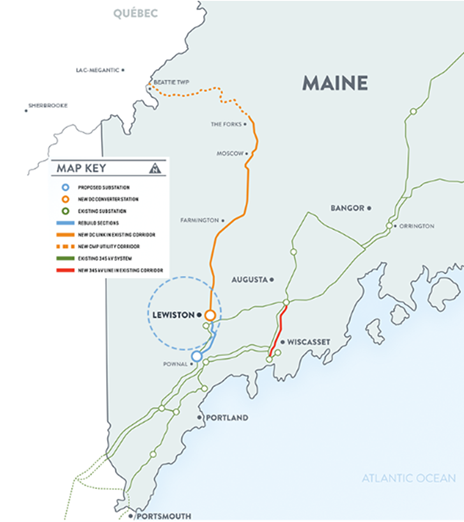
  • New England Clean Energy Connect: ISO New England expects NECEC to begin participating in its markets by Q4 2025 to supply energy from Canada to New England; the official activation date will be announced in a future notification. A new HVDC tie with Hydro Quebec will import up to 1,200MW into the ISO-NE region. The project will upgrade approximately 90 miles of existing transmission and build around 55 miles of new line. Work also includes new converter station(s) and the upgrade of other 345-kV facilities throughout Maine. Importing more clean, reliable power from Hydro Quebec has been a goal for many stakeholders in the ISO-NE area for years. 1,200MW of hydro power not only bolsters reliability but helps achieve climate initiatives.

The NECEC will increase the import capability from Quebec to New England, potentially adding 1,200MW of clean energy. This addition is expected to alleviate local generation constraints, particularly in Maine, and provide a more stable supply of renewable energy during periods of high demand or low local generation.

The impact of the injection of 1,200MW into Maine will drive the system energy cost lower but will also create the risk for more consistent price separation for the Maine region from the rest of the system. Congestion isn’t a major issue in ISO-NE, but we expect to see a bit more basis grow when this project is in service. 345-kV upgrades along the coast will help alleviate congestion risk but internal interfaces will still see higher loading.
Price Forecasts

December 2025

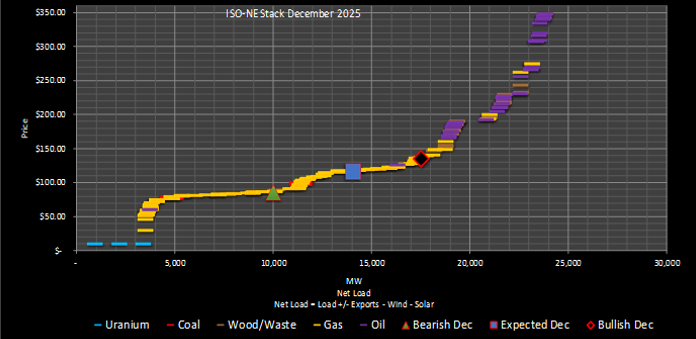
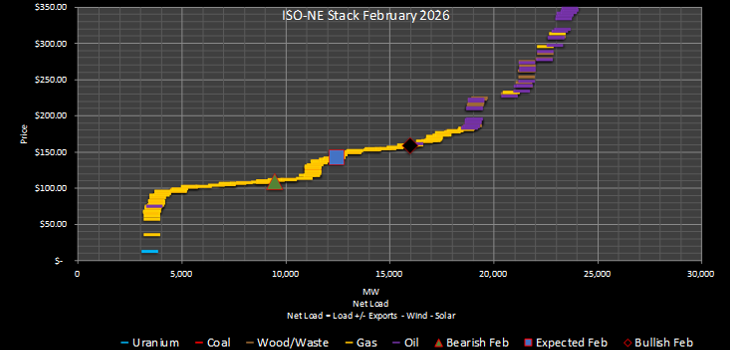
  • The December load forecast is above average, driven by cold and stormy weather conditions across the ISONE region. High heating degree days (HDDs) will increase heating-related electricity demand, while low behind the meter (BTM) solar production will force greater reliance on conventional generation, including natural gas and oil units. These factors are expected to exert a bullish influence on power prices throughout the winter.
  • Generator maintenance outages raise the risk of reserve scarcity during strong demand hours, amplifying system tightness. In our base case scenario, forecasts remain above market levels, while the bullish scenario shifts dispatch to more expensive gas units, introducing a risk of high price volatility.
  • The stack model shows that any cold snap could sharply increase the risk of pushing demand into our bullish scenario. In such an event, high-heat-rate gas units would be dispatched, and coupled with elevated natural gas prices, this could drive power prices well above our bullish scenario, creating a risk of extreme price spikes.
Price
Bearish
Expected
Bullish
Enverus Price Forecast
$85.88
$116.89
$135.11
Enverus Heat-Rate Forecast
9.3
12.7
14.7
Forward Heat-Rates
10.0
10.0
10.0

January 2026

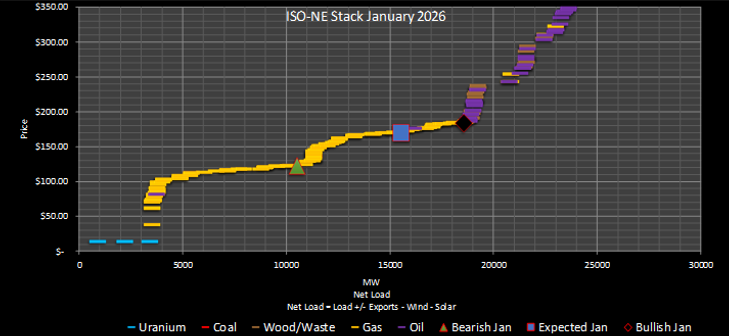
  • The January load forecast is above average, with the ISONE region expected to experience higher HDDs than December. Limited BTM solar production will force greater reliance on conventional generation, including natural gas and oil units. These factors are expected to exert a bullish influence on power prices throughout the month.
  • In the stack model, the base case heat rate remains above the market, while the bearish scenario aligns more closely with market levels. The model indicates that any significant cold snap could quickly push demand into the bullish range, where high heat rate gas units combined with elevated natural gas prices would drive power prices well above the current bullish scenario.
Price
Bearish
Expected
Bullish
Enverus Price Forecast
$123.78
$167.92
$184.99
Enverus Heat-Rate Forecast
9.1
12.4
13.6
Forward Heat-Rates
9.3
9.3
9.3

February 2026

  • February load forecast is average to above average, with HDDs slightly lower than in January. Limited BTM solar production will increase reliance on conventional generation, particularly natural gas and oil units. These conditions are expected to maintain a bullish influence on power prices throughout the month.
  • In the stack model, the base case heat rate remains above the market, while the bearish scenario aligns more closely with market levels. The model indicates that any significant cold snap could quickly push demand into the bullish range, where high heat rate gas units combined with elevated natural gas prices would drive power prices well above the current bullish scenario.
Price
Bearish
Expected
Bullish
Enverus Price Forecast
$109.25
$143.48
$158.63
Enverus Heat-Rate Forecast
8.9
11.7
12.9
Forward Heat-Rates
9.1
9.1
9.1

NYISO

Load and Generation

December 2025

  • The Enverus forecast is cold and stormy and averages 4 degrees below average based on the 2013, 2017 and 2024 analog years. 2017 stands out as the coldest of the analog years.
  • New York’s Central Park measured average low temperatures of 14 degrees for the 6 days of December which really stands out in 2017.
Average 2010-2024
December 2013
December 2017
December 2024
Average
Average
39
35
33
36
35
Minimum
33
28
27
30
28
Maximum
44
42
38
42
41

January 2026

  • The Enverus forecast is for a cold and stormy January, averaging 6 degrees below average based on the 2014, 2018 and 2025 analog years. 2014 stands out as the coldest of the analog years.
  • New York’s Central Park measured 6 days below 10 degrees in 2014.
Average 2010-2024
January 2014
January 2018
January 2025
Average
Average
34
26
29
31
28
Minimum
28
19
21
24
19
Maximum
40
33
37
38
363

February 2026

  • The analog years for February are 2014, 2018 and 2025 and show near average temperatures with near average wind generation.
  • There is a risk of cold temperatures again with the 2014 analog year.
Average 2010-2024
February 2014
February 2018
February 2025
Average
Average
36
29
39
35
35
Minimum
30
22
31
30
28
Maximum
42
36
47
43
42

Power Unit New Build and Retirement

New Builds

Baron Winds II:

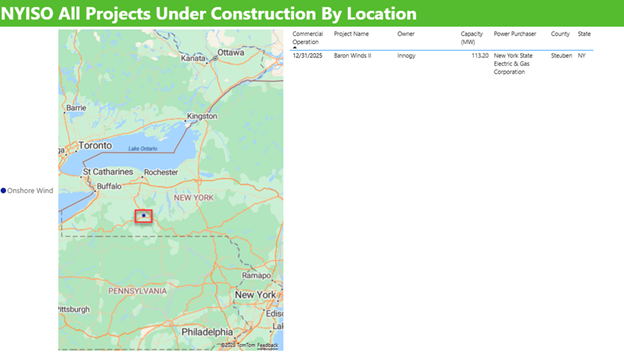
  • The Baron Winds II project, located in Steuben County, New York, is the second phase of the larger Baron Winds Wind Farm. Phase I, consisting of 32 turbines, became operational in early 2023 and generates up to 122MW of electricity. Phase II is currently under construction and is expected to come online by the end of this year. Phase II will add up to 26 wind turbines in the Town of Fremont, contributing approximately 113MW of capacity to the grid. Construction began in October 2024 and is anticipated to be completed by end the of December 2025.
  • The addition of 113MW from Phase II will enhance the renewable energy capacity within the NYISO region, contributing to the state’s clean energy goals and reducing reliance on fossil fuels. Baron Winds II strengthens NYISO’s clean energy supply, stabilizes the grid, reduces local congestion and suppresses wholesale prices, particularly during windy periods, though variable output may introduce short-term volatility. In summary, the Baron Winds II project is poised to provide significant benefits to the NYISO power market by increasing renewable energy supply.

Transmission Developments

Champlain Hudson Power Express (CHPE):

  • The Champlain Hudson Power Express is a transformative renewable energy transmission project designed to deliver clean hydroelectric power from Quebec, Canada, to New York City. Developed by Transmission Developers INC., a Blackstone Group portfolio company, CHPE aims to enhance the resilience and sustainability of New York’s power grid.
  • The project is a 1,250 MW transmission line capable of powering over one million homes, spanning 339 miles with 60% underwater and 40% underground. It runs from the U.S.-Canada border through Lake Champlain, beneath the Hudson River, and into Queens, NY. Construction began on Nov. 30, 2022, and the line is expected to be operational by spring 2026.
  • The project will deliver a stable supply of renewable hydroelectric energy to NYC, reducing wholesale electricity prices and transmission congestion costs while supporting the state’s clean energy goals of 70% renewable by 2030. It will decrease reliance on fossil-fueled generation, potentially lower consumer costs, and improve clean energy delivery. By injecting low-cost hydropower into NYC, the initiative is expected to flatten price differences between upstate and downstate zones.

Price Forecasts

December 2025

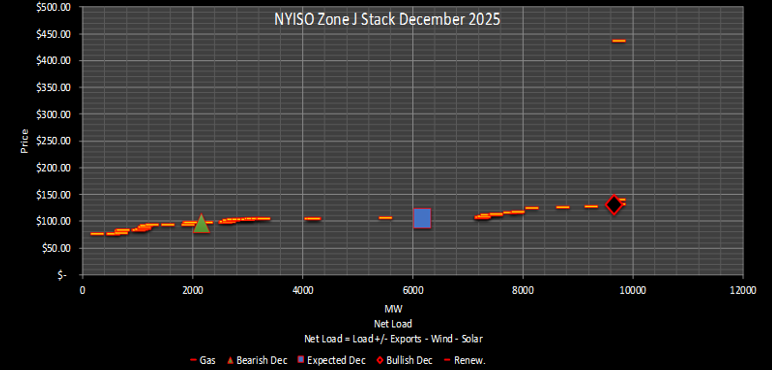
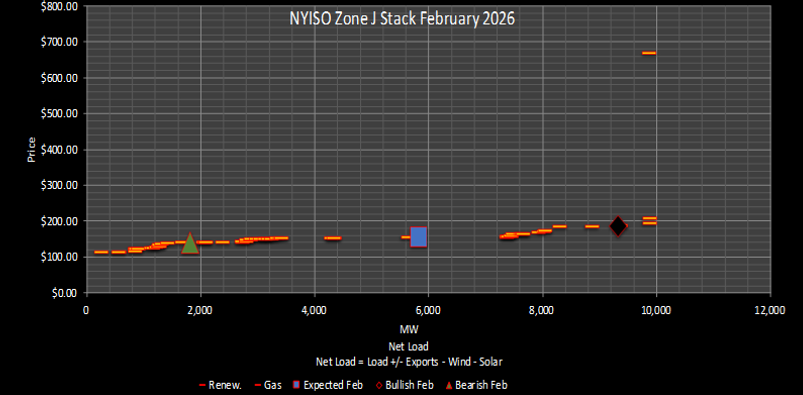
  • December is expected to bring high HDDs in the NYISO region driving strong seasonal demand. Our base case scenario is much higher than market supported by above-average demand expectations. Generator maintenance outages will decline significantly, which will reduce the congestion and RT volatility. Reserves can be tight with increasing heating demand.
  • Short daylight hours, frequent overcast conditions and snowfall in the NYISO region will reduce the BTM solar production in the month of December. Low BTM solar with low wind production can increase the risk of strong net demand during midday hours on a high heating demand day. A sharp cold snap combined with elevated natural gas prices could cause price spike events. We see risk of prices moving much above our bullish scenario with strong net demand.
Price
Bearish
Expected
Bullish
Enverus Price Forecast
$97.87
$105.75
$127.14
Enverus Heat-Rate Forecast
16.1
17.4
20.9
Forward Heat-Rates
14.0
14.0
14.0

January 2026

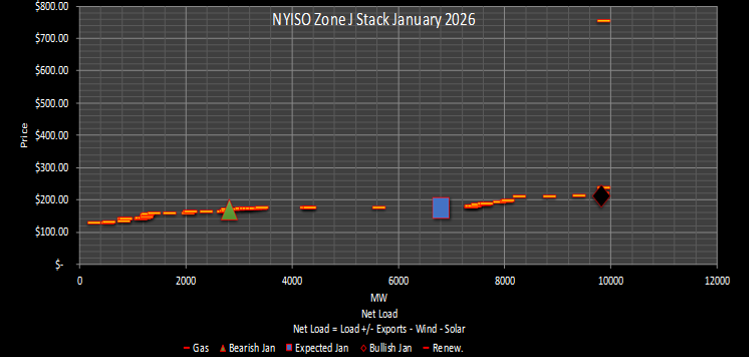
  • January is expected to bring significant HDDs across the NYISO region, supporting elevated seasonal demand. Our base case forecast remains above market levels, driven by above-average load forecast. Strong heating demand could increase the risk of transmission congestion, exerting upward pressure on power prices. Reserve margins may also tighten through the month as sustained cold weather maintains high system demand.
  • In January, short daylight hours, frequent overcast conditions, and snow or ice accumulation on rooftops will significantly limit BTM solar generation across the NYISO region. Low solar output combined with weak wind production could drive strong midday net demand, especially during periods of elevated heating load. A cold snap and bullish gas prices could cause price spike events. We see risk of prices moving much above our bullish scenario with strong net demand in January.
Price
Bearish
Expected
Bullish
Enverus Price Forecast
$169.99
$176.56
$213.82
Enverus Heat-Rate Forecast
16.0
16.7
20.2
Forward Heat-Rates
11.7
11.7
11.7

February 2026

  • February in the NYISO is typically slightly milder than January with somewhat lower HDDs. Heating demand remains seasonally strong. Our base case forecast remains above market levels, driven by above-average load forecast. Strong heating demand could increase the risk of transmission congestion, exerting upward pressure on power prices. Reserve margins may also tighten through the month as sustained cold weather maintains high system demand.
  • In February, short daylight hours, frequent overcast conditions, and snow or ice accumulation on rooftops will significantly limit BTM solar generation across the NYISO region. Low solar output combined with weak wind production could drive strong midday net demand, especially during periods of elevated heating load. A cold snap and bullish gas prices could cause price spike events. We see risk of prices moving much above our bullish scenario with strong net demand in February.
Price
Bearish
Expected
Bullish
Enverus Price Forecast
$140.13
$153.80
$184.85
Enverus Heat-Rate Forecast
14.8
16.3
19.6
Forward Heat-Rates
12.0
12.0
12.0

About Enverus Power and Renewables

With a 15-year head start in renewables and grid intelligence, real-time grid optimization to the node and unparalleled expertise in load forecasting that has outperformed the ISO forecasts, Enverus Power and Renewables is uniquely positioned to support all power insight needs and data-driven decision making. More than 6,000 businesses, including 1,000+ in electric power markets, rely on our solutions daily. 

Speak to an Expert

Let’s get started!

We’ll follow up right away to show you a quick product tour.

Let’s get started!

We’ll follow up right away to show you a quick product tour.

Register Today

Sign Up

Power Your Insights

Connect with an Expert

Access Product Tour

Speak to an Expert