
The recent announcement that America’s GDP contracted by 32.9% quarter over quarter, coupled with an increase in jobless claims to 1.4 million, sums up the economic impact that COVID-19 has had on our economy.
With economic activity down, demand for energy — both the fossil kind and the renewable kind — is also down.
Asset write-downs and impairments in the billions of dollars, as well as looming bankruptcy problems for a number of companies paint a picture of an industry that will need to restructure in order to survive.
None of this goes away without a full attack on COVID-19 to battle it down to manageable levels so economic activity can begin to accelerate.
With the president having visited the West Texas oil patch last week, it suddenly struck me that I’ve not seen a message from the industry to the White House stressing the importance of a national strategy for combatting COVID-19.
With each state crafting its own coronavirus response plan, with different re-opening policies, projecting forward demand is an exercise in pure guesswork.
Oil patch strategies for returning shut-in wells to production, completing dormant DUCs, and deployment of capex need clarity on how the U.S. will win the battle against COVID-19.
Will we have a national shut-down or stay-in-place guidance? Looks unlikely given the political implications of such a strategy.
Will we continue with our patchwork testing procedures, with test results latency making it very difficult to do any contract tracing?
Or will we ramp up federal spending to supplement state and local health budgets so that widespread testing with 24- to 48-hour test results turnaround is the national norm?
How do we model gasoline demand if large numbers of parents have to work at home or have to lose a paycheck to teach their children at home?
Or if the work-from-home tactic becomes commonplace, what does that do to gasoline and diesel demand?
There have been so many opinions on what the “new normal” will look like that there’s no consensus on future demand patterns.
It would be tremendously helpful, though, if we could get some clarity on when this “new normal” will manifest itself.
Without a federal strategy implemented uniformly across our country, our industry — maybe more so than others — will be playing against a stacked deck.
We’re not public health experts, and few of us are trained economists, so it would be difficult for the industry to back specific tactical measures deployed to kill COVID-19.
But there’s no reason why we, as an industry, shouldn’t pressure our elected officials to come together and develop a clear national policy to control the pandemic.
Our industry has been absolutely critical in driving the American dream. We deploy huge amounts of capital to find and develop the commodities that support and secure our energy future — yet we have little pricing control.
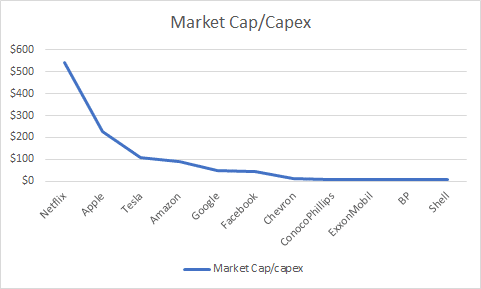
I’ve mentioned before the stunning disparity between how the stock market values companies that have pricing control over their goods (Apple and Amazon) and those companies in our business that are at the mercy of international trading.
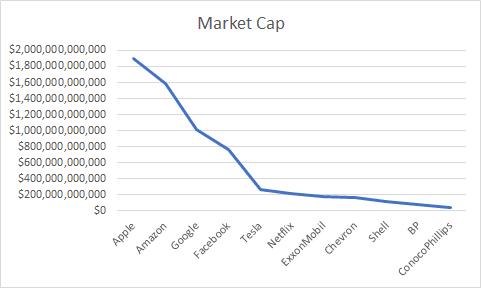
All the tech stocks — even Netflix — have market caps bigger than ExxonMobil.
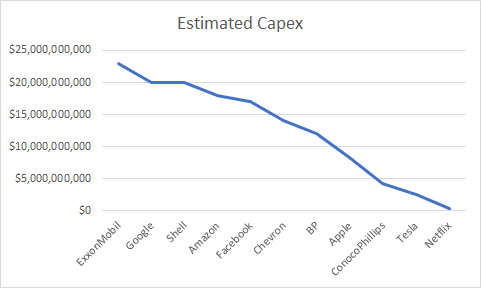
Yet, when you look at the capex our industry has to spend to get critical hydrocarbons into our energy mix, our spend (as measured by the companies shown) is about $73 billion — and our tech companies spend only $66 billion.
The disparity in intrinsic valuations is even more pronounced if you look at market cap as a function of capex.
What we as an industry deliver to American prosperity is absolutely critical to our health and future. We provide the source fuels for the energy industry that keeps the lights on, our houses warm in the winter and cool in the summer, and our manufacturing facilities (Tesla and Apple), our cloud infrastructure (Amazon and Google), streaming services (Netflix) and social media platforms (Facebook) viable.
We power the American economy — and we as an industry need to speak with a clear, unified voice to urge our government to take all measures necessary to control and minimize the damage that COVID-19 is wreaking on American demand.