Why Conventional Assets Still Matter and Why Speed Matters More Than Ever
Conventional oil and gas assets continue to underpin production across many mature basins. These assets tend to deliver long‑life output, benefit from established infrastructure, and reward steady operational discipline. For many operators, they still represent a meaningful share of the portfolio, even if they do not always receive the same level of analytical focus as unconventional development.
In fact, several industry dynamics are bringing conventional assets back into sharper focus. Capital discipline has tightened across the sector, which places more emphasis on assets that can generate durable cash flow without constant drilling. Infrastructure constraints in core basins have increased the value of assets that are already connected to gathering facilities and takeaway lines. Recent changes in federal tax policy have also modestly improved the economics of certain conventional operations that are already producing and permitted. Together, these forces are prompting operators to re‑examine mature assets with a sharper focus on durability and capital efficiency.
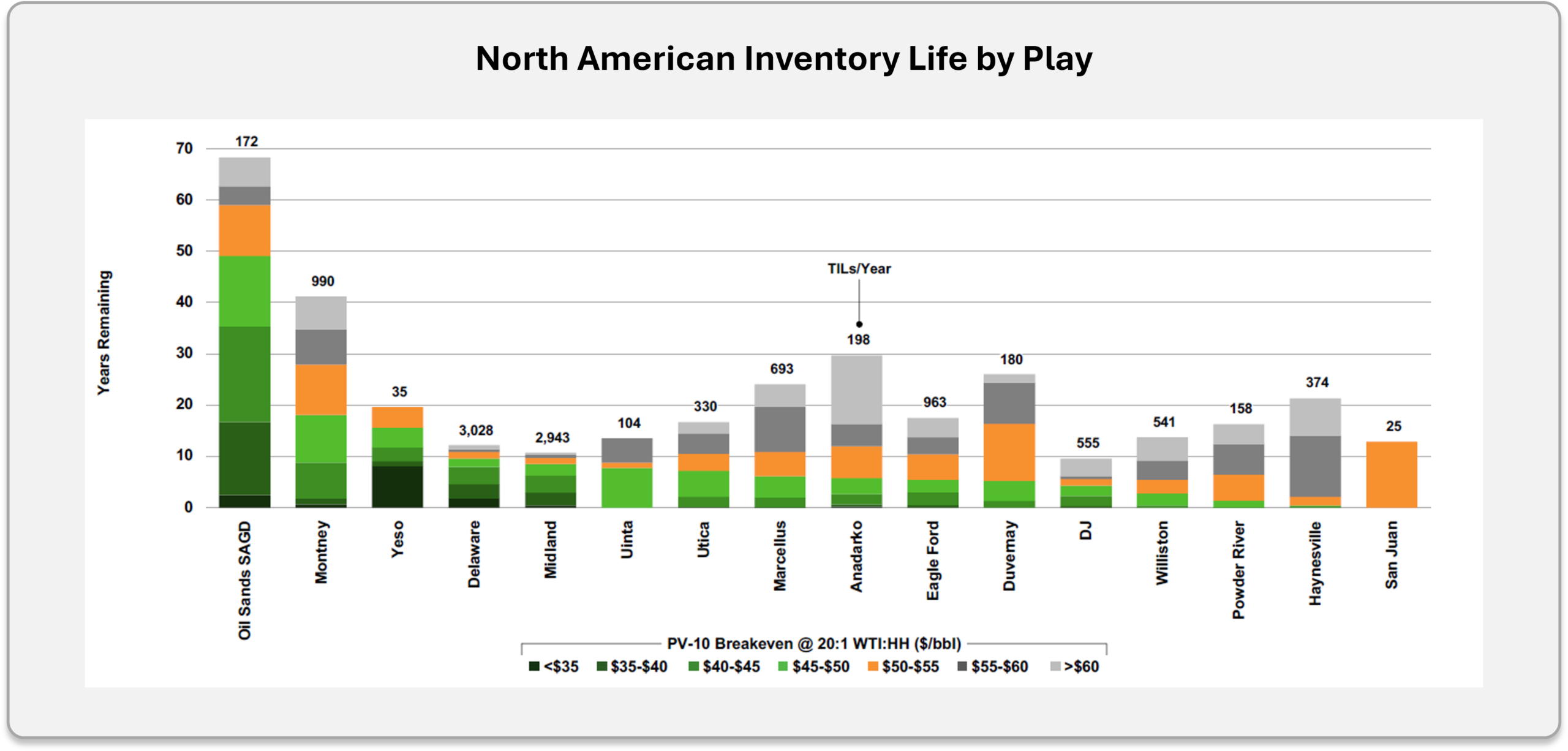
At the same time, Tier 1 inventory in several basins is becoming more concentrated. As the highest‑quality remaining locations narrow, operators are increasingly evaluating Tier 2 opportunities that still meet economic thresholds. This shift is visible in plays such as the Yeso, where a meaningful inventory of sub‑$50 breakeven locations has drawn renewed attention. While development in the Yeso is often described as semi‑conventional due to its reliance on horizontal wells, its economics highlight a broader pattern. Capital is flowing toward assets that behave more like conventional systems in terms of decline profile, infrastructure reliance, and long‑term value, as operators prioritize durability and capital efficiency, even if the development approach differs.
Fig. 1: As Tier 1 inventory tightens, operators are increasingly looking to Tier 2 opportunities that still meet economic thresholds. Plays like the Yeso illustrate this shift. While often described as semi‑conventional, these assets highlight how capital is moving toward systems that offer conventional‑style durability and long‑term value. Source: Enverus Intelligence® Research (EIR).
Across these different systems, a common challenge emerges. Conventional portfolios are large, heterogeneous, and shaped by decades of operational decisions. Performance reflects not only geology, but also how assets have been developed, maintained, and reinvested in over time. Understanding which fields are performing as expected, which are changing, and which may still hold overlooked opportunity is not straightforward.
The constraint today is no longer access to data. Production histories, injection volumes, activity records, and infrastructure information all exist. The real challenge is moving from that data to insight quickly enough to influence decisions. In an environment with lean teams and selective capital, speed has become a competitive advantage.
This eBook explores how operators are addressing that challenge. It draws on real world conventional examples, including long running enhanced oil recovery programs in the Central Basin Platform such as the Hobbs and Seminole fields. Alongside newer conventional systems like Alberta’s Clearwater, it outlines a repeatable way to screen assets, understand what drives long term performance, and identify remaining opportunity across conventional portfolios.
The Screening Challenge Facing Conventional Operators
Screening conventional assets presents a different problem than evaluating unconventional development. Instead of assessing a small number of capital‑intensive projects, operators are often responsible for making sense of large populations of mature wells and fields, each with its own history and constraints.
Effective screening requires pulling together several dimensions of information. Production data on its own rarely tells the full story without understanding injection behavior. Activity data provides context, but it can be misleading without historical performance. On the other hand, infrastructure availability can enable or limit opportunity, yet it is often evaluated separately from subsurface data. When these inputs live in disconnected systems, screening becomes slow, manual, and inconsistent.
Another challenge is choosing the right level of analysis. While individual wells matter operationally, many strategic decisions are better informed at the field level. Field‑level views allow operators to compare performance, injection behavior, and activity across large groups of wells without getting lost in detail. This perspective makes it easier to spot meaningful differences between assets and to prioritize follow‑up work.
Operators also need to distinguish between assets that are actively managed, those that are declining due to reduced investment, and those that may be overlooked entirely. Without a structured approach, it is easy to assume that age equals exhaustion or that inactivity means lack of opportunity.
The result is a familiar problems for many upstream operators: they know there is value embedded in their portfolios, but they struggle to surface it efficiently and consistently.
A Repeatable Workflow for Evaluating Conventional Assets
One practical way to address this complexity is through a repeatable screening workflow. Rather than rebuilding analysis from scratch for each asset, operators screening for opportunities can benefit from a structured approach that can be applied consistently across a portfolio.
A common starting point is basin‑level context. Understanding where conventional activity is concentrated, how production and injection volumes vary geographically, and where infrastructure is established helps narrow the universe of assets worth deeper review.
From there, analysis can move to the field level. Field‑level screening allows operators to compare production performance, injection behavior, and activity across groups of wells. This step is particularly useful for identifying fields that continue to perform well despite their maturity, as well as fields where performance has shifted over time.
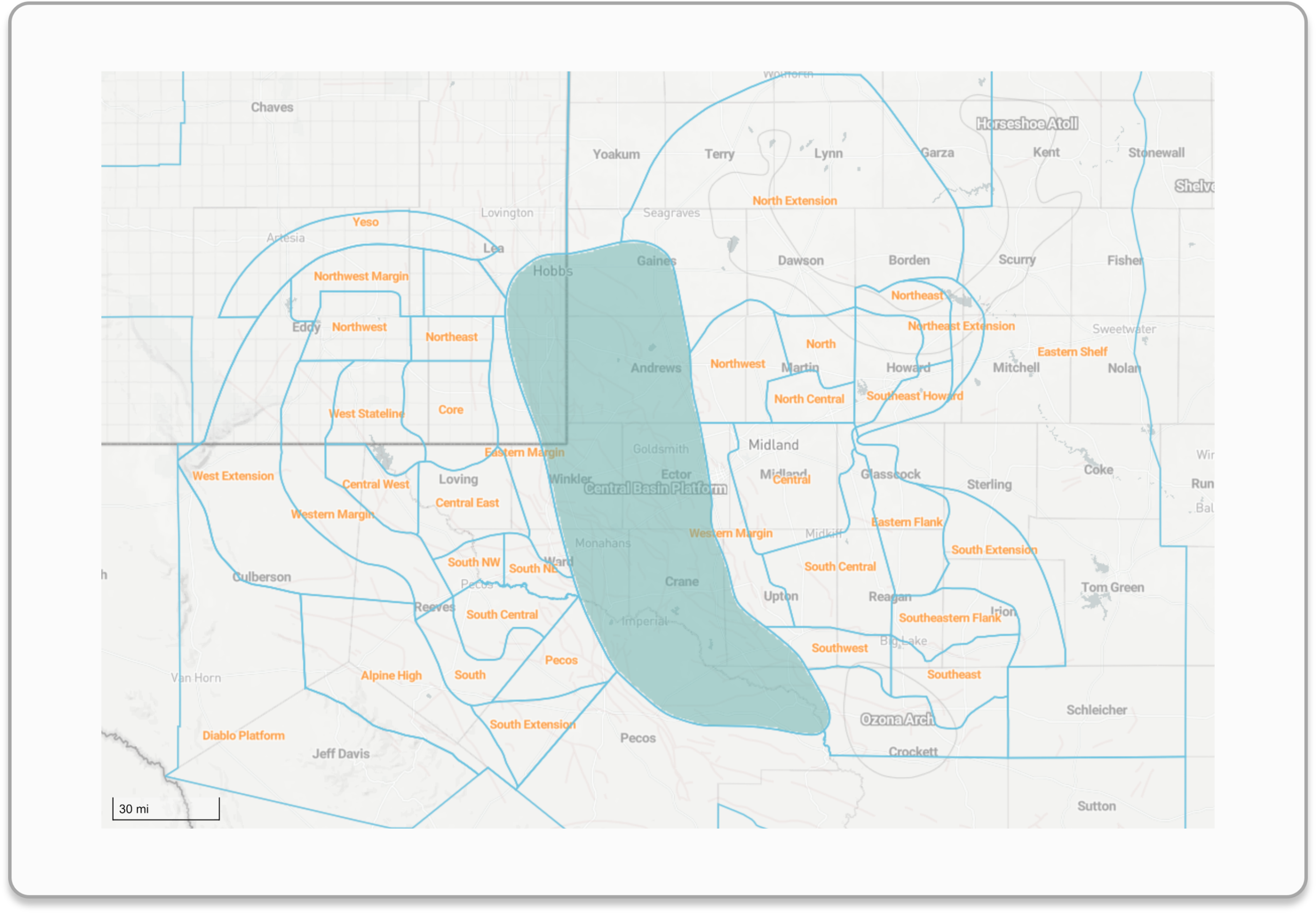
Fig. 2: The Central Basin Platform provides a useful example of a mature conventional system where asset screening benefits from field‑level and basin‑level context.
Following this, activity and infrastructure can be layered in. Permits, rigs, pads, pipelines, and injection facilities provide early signals about where capital is being deployed and whether assets are supported by the infrastructure needed to sustain or expand operations. It is important to note that these signals often appear before changes are visible in production trends.
Finally, observations are validated using historical and recent performance. Reviewing production and injection data over longer time horizons helps separate structural behavior from short‑term noise.
This basin‑to‑field‑to‑well progression does not replace detailed engineering or subsurface work. Instead, it helps ensure that deeper analysis is focused on the assets most likely to influence outcomes. Engineers looking to apply these workflows in more depth — including transparent benchmarking and defensible forecasting — can explore: Enverus for Engineers: Transparent Benchmarking & Forecasting.
Inside a High Performing Conventional EOR Asset
High‑performing conventional assets tend to leave recognizable signatures in the data. Understanding those signatures provides a useful benchmark for evaluating other fields with similar characteristics.
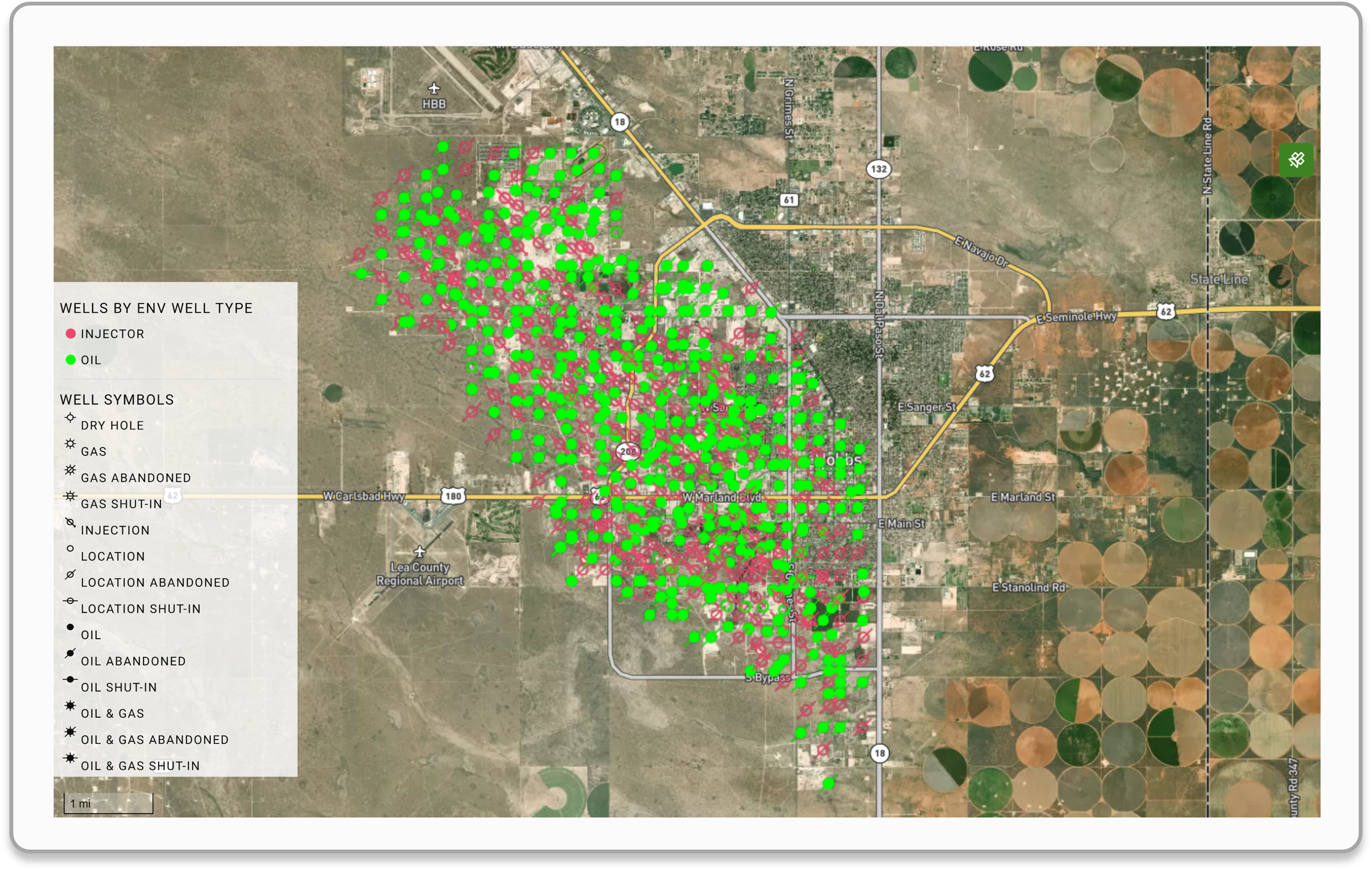
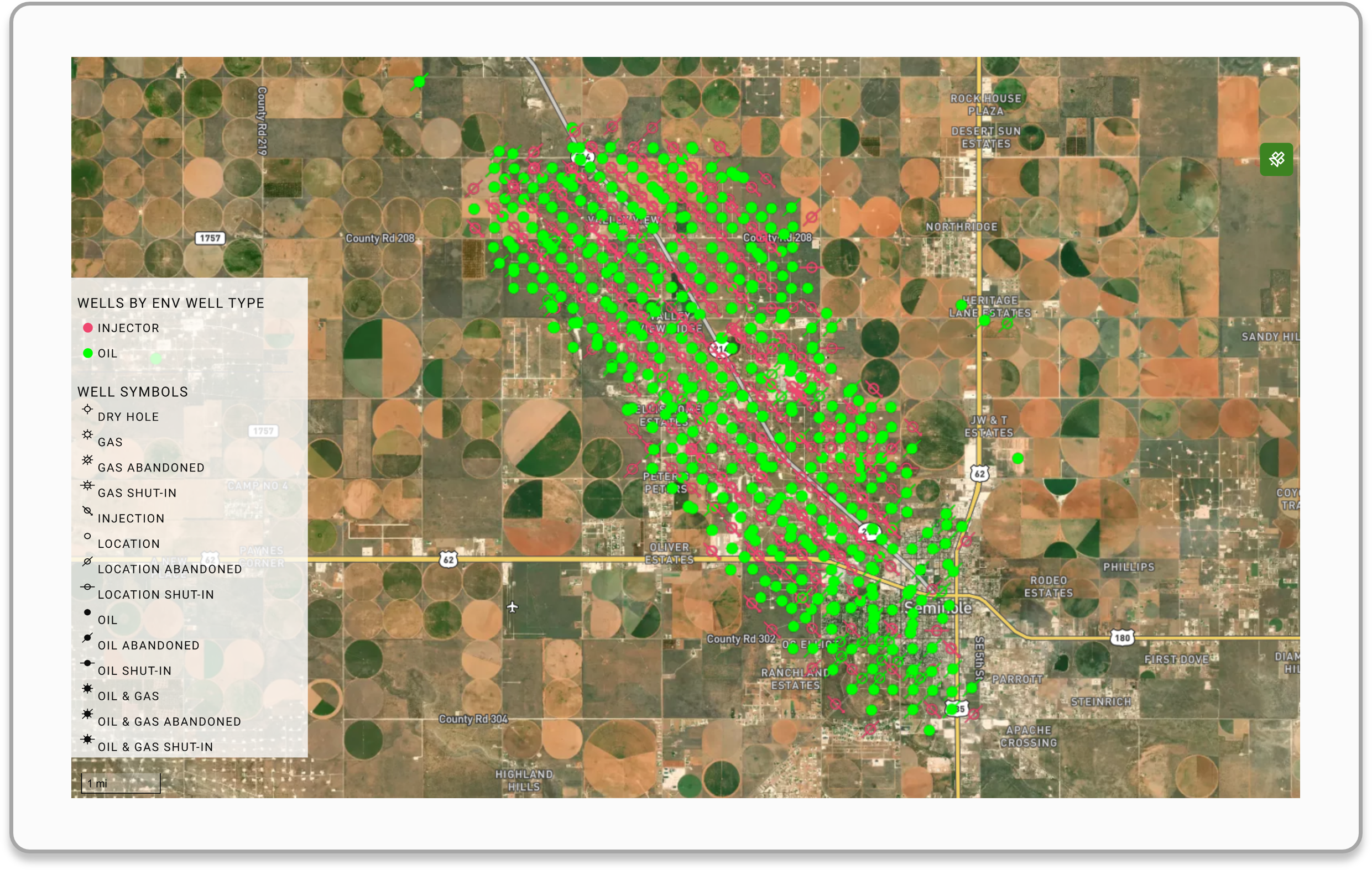
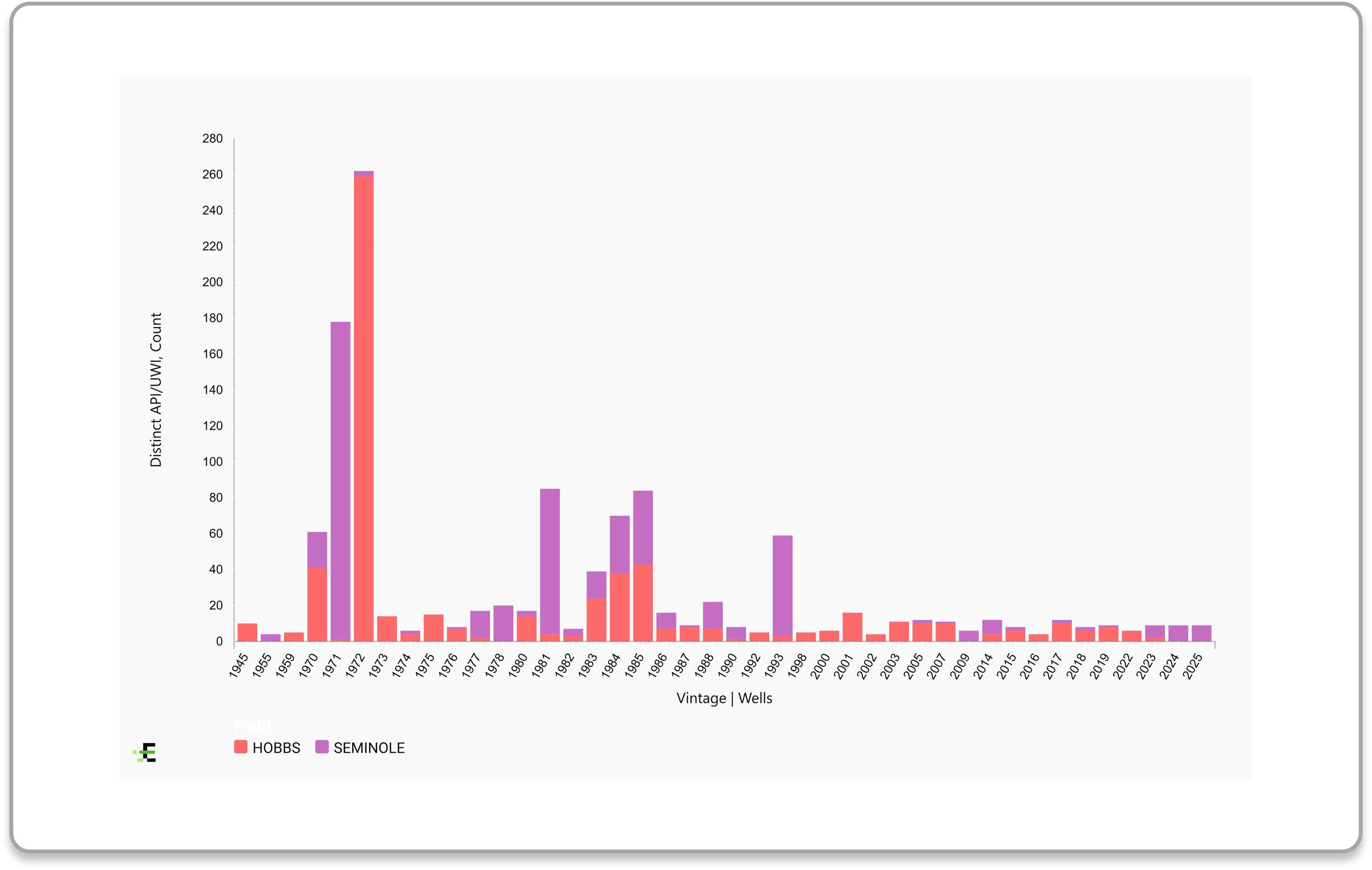
In mature basins such as the Central Basin Platform, enhanced oil recovery has long been a core operating strategy. Fields like the Hobbs and Seminole illustrate how sustained investment in water and gas injection can support relatively stable oil production over long periods of time. These are large, mature fields with on the order of a thousand wells each, yet their production profiles have remained more resilient than their age alone might suggest.
Fig. 3: The Hobbs Field illustrates the scale of mature conventional EOR assets, with dense producer and injector networks operating across a long‑developed footprint.
A defining characteristic of these assets is the scale and consistency of injection. Large volumes of water and gas are injected continuously to maintain pressure and support recovery. When viewed over long time horizons, production and injection volumes show stable relationships rather than erratic behavior.
Fig. 4: The Seminole Field provides a complementary example of a Central Basin Platform asset where enhanced oil recovery has supported long‑term production.
Ratios derived from this data offer additional insight. Comparing injected volumes to produced volumes over time helps explain how these systems behave and what “normal” looks like within a given geologic setting. While these ratios are not universally transferable, they provide valuable benchmarks when evaluating similar assets.
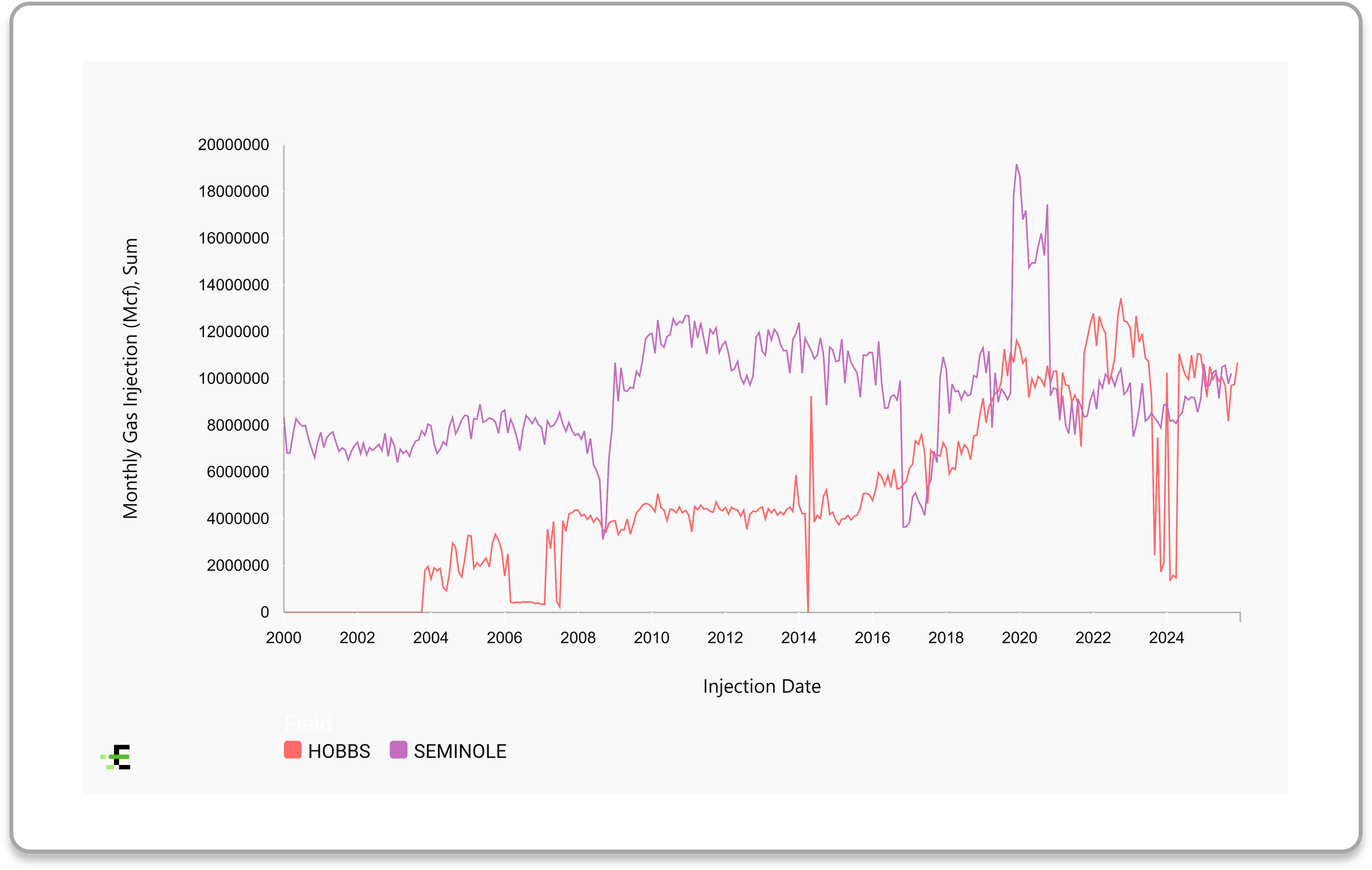
Fig. 5: Sustained gas injection in the Hobbs and Seminole fields highlights the consistency required to support long life conventional production under EOR strategies.
Similar dynamics are playing out in other mature conventional systems. For instance, in Alberta’s Clearwater play, development has shifted from rapid delineation toward optimization and secondary recovery, particularly across the Greater Marten Hills subplay. What began as a multilateral‑driven primary development story is increasingly centered on waterflood expansion as operators work to extend asset life and stabilize declines. Because of this, the conversation has moved beyond whether secondary recovery works in the Clearwater to how far it can be scaled.
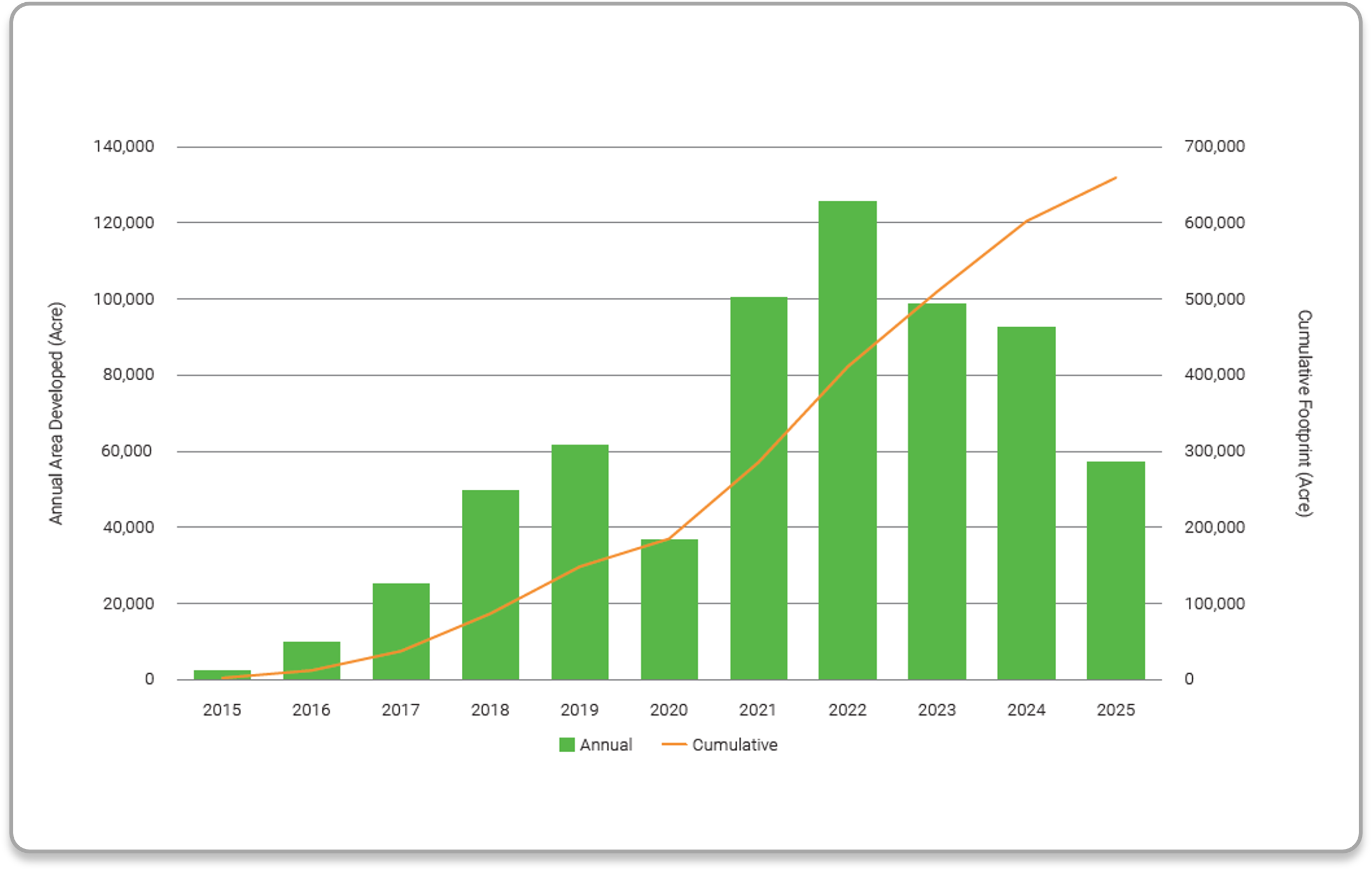
Fig. 6: As productive acreage expansion slows in the Clearwater, development has shifted toward optimization, overlapping benches, and increased waterflood activity. Source: EIR.
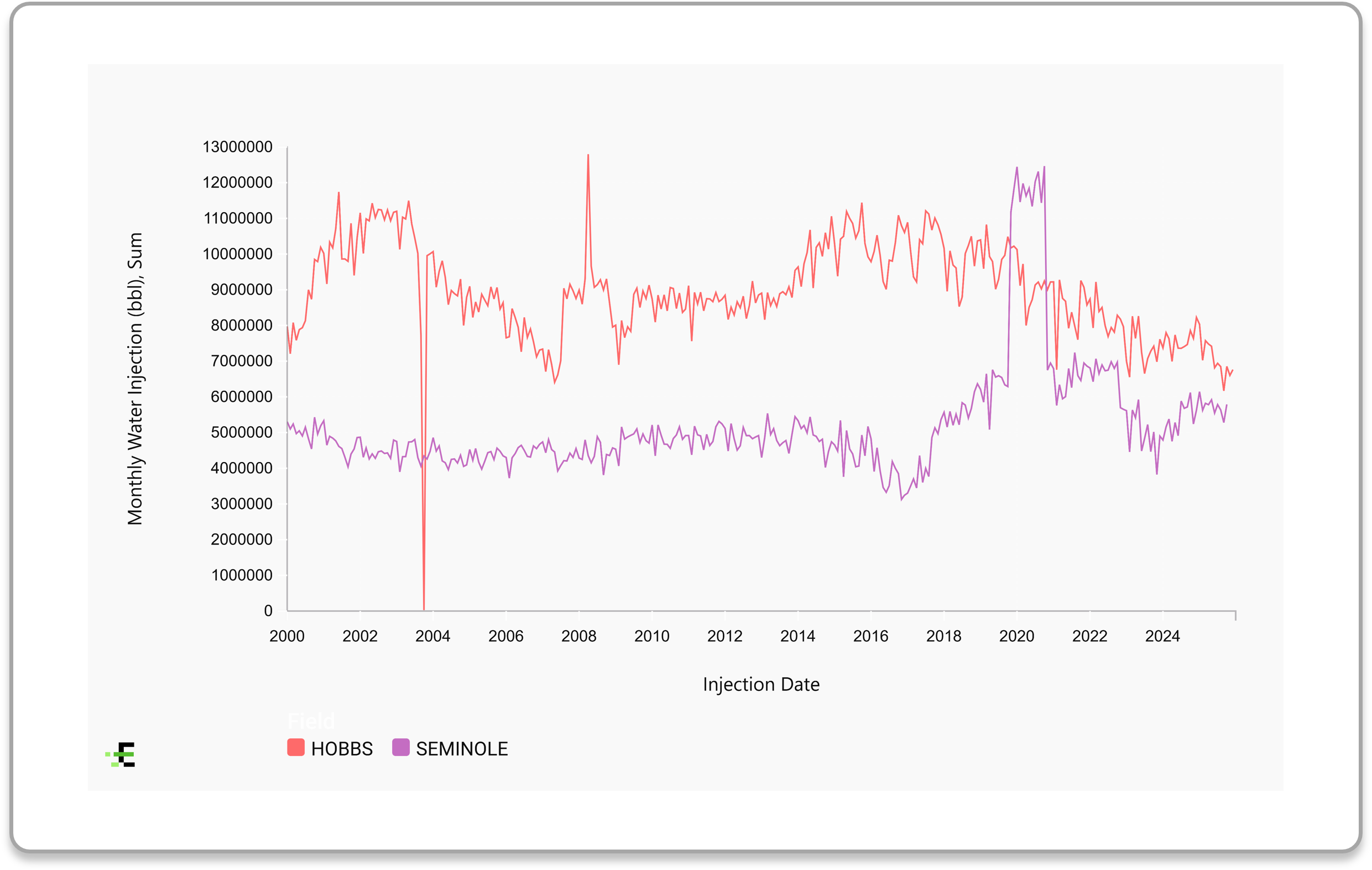
Fig. 7: Water injection volumes in the Hobbs and Seminole fields reflect the ongoing operational effort needed to maintain pressure and recovery in mature conventional fields.
The broader takeaway is that durable conventional performance is measurable. Fields that sustain output over time tend to do so through identifiable patterns of investment and management. Recognizing those patterns is a key part of effective screening.
Forecasting at Scale with Enverus Forecast Studio
Historical performance provides essential context, but forward‑looking decisions require an understanding of what remains. Forecasting offers a way to extend screening beyond what has happened to what may still be recoverable.
When applied consistently, production forecasting allows operators to compare assets on a common basis. Decline‑curve analysis can be used to estimate ultimate recovery and remaining reserves for individual wells, fields, or entire basins. The value of this approach lies less in precision at the single‑well level and more in comparability across large datasets. For a deeper look at how these forecasts are built, including model inputs, assumptions, and validation steps, see: How Enverus Models Work: Engineer‑Verified Insights.
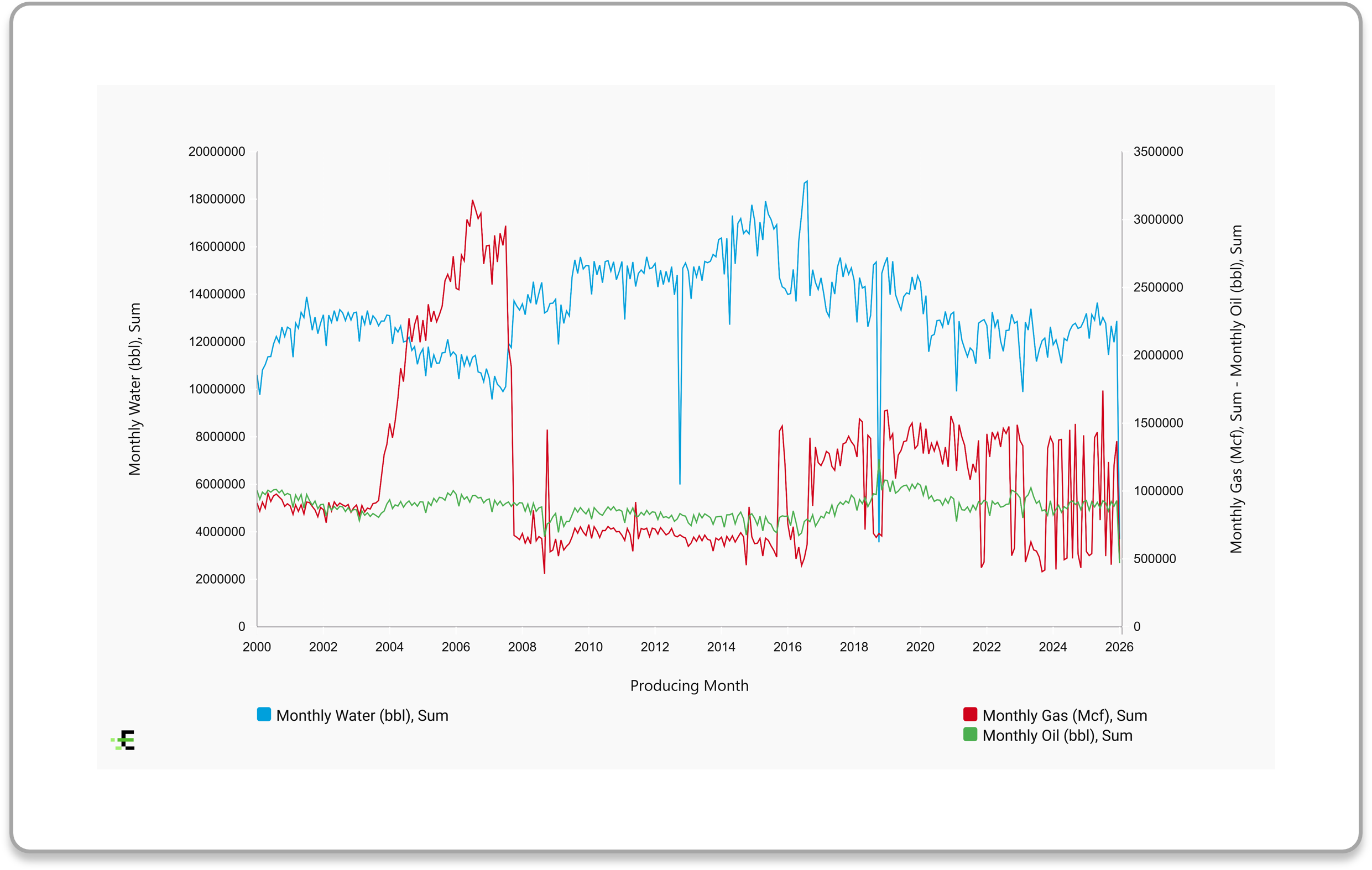
Fig. 8: Long‑term production trends provide the historical context needed to evaluate remaining opportunity, not just past performance.
Running forecasts at scale across thousands of wells helps surface relative differences between assets that may not be obvious from historical production alone. Two fields with similar production histories may have very different remaining potential depending on decline behavior and operational context.
Forecast outputs such as estimated ultimate recovery and remaining reserves can then be folded back into the broader screening workflow. When combined with production history and activity data, forecasts help prioritize assets for reinvestment, further evaluation, or closer monitoring.
Monitoring and Ranking Opportunity in Real Time
Conventional assets are not static. Activity levels change, injection strategies evolve, and development plans shift as capital priorities move. Monitoring these changes in near real time adds an important layer, albeit a challenging one, to conventional screening.
Activity data such as rigs, permits, and pad development provides early signals about where capital is being deployed. In some cases, renewed activity in mature fields reflects confidence in remaining potential. In other cases, declining activity points to shifting priorities or constraints.
Injection behavior also provides context. Changes in injection volumes or patterns can signal adjustments in secondary recovery strategy. When viewed alongside historical performance, these changes help distinguish between structural decline and deliberate operational decisions.
In maturing plays like the Clearwater, these signals are especially important. As outward expansion slows and development shifts toward optimization, changes in activity and injection patterns often appear before shifts in production trends. Monitoring these signals helps ensure assets are evaluated in the right operational context.
Combining activity data with forecast‑based estimates of remaining potential allows operators to rank assets dynamically. Fields with meaningful remaining reserves but declining activity may warrant closer attention. Fields with high activity but limited remaining upside may require a different lens.
Fig. 9: Decades of well development in mature fields highlight why conventional asset evaluation must account for both legacy performance and remaining opportunity.
From Insight to Action Across the Portfolio
Individually, each of these analytical steps provides value. Together, they support a more proactive approach to conventional asset management.
A structured workflow helps operators move efficiently from broad screening to focused evaluation, from historical context to forward‑looking insight, and from static analysis to continuous monitoring. The same approach can be applied across owned assets, competitive landscapes, or potential acquisition targets.
Screening is not a one‑time exercise. As activity changes and performance evolves, conclusions should be revisited. A repeatable workflow makes that reassessment manageable rather than burdensome.
While the examples in this eBook draw from specific basins and assets, the underlying principles are widely applicable. Conventional portfolios vary, but the need to prioritize attention and capital is universal.
Actionable Checklist for Conventional Operators
The following checklist summarizes a practical approach to modern conventional screening:
Start screening at the field level before drilling down to individual wells
Review production and injection history together to understand performance drivers
Use ratios and benchmarks within comparable geologic settings
Monitor rigs, permits, pads, and infrastructure for early signals of change
Apply consistent forecasting to estimate remaining reserves
Validate infrastructure support and operational risk
Revisit screening results as activity and performance evolve
Applied consistently, this approach helps conventional operators focus technical effort where it matters most and make decisions with greater confidence across complex, mature portfolios.
About Enverus Intelligence® | Research Enverus Intelligence® | Research, Inc. (EIR) is a subsidiary of Enverus that publishes energy-sector research focused on the oil, natural gas, power and renewable industries. EIR publishes reports including asset and company valuations, resource assessments, technical evaluations, and macro-economic forecasts and helps make intelligent connections for energy industry participants, service companies, and capital providers worldwide. See additional disclosures here.
Speak to an Expert
Have questions about any of the research mentioned above? Fill out the form below to schedule some time to meet with one of our expert analysts:
Let’s get started!
We’ll follow up right away to show you a quick product tour.
Let’s get started!
We’ll follow up right away to show you a quick product tour.