
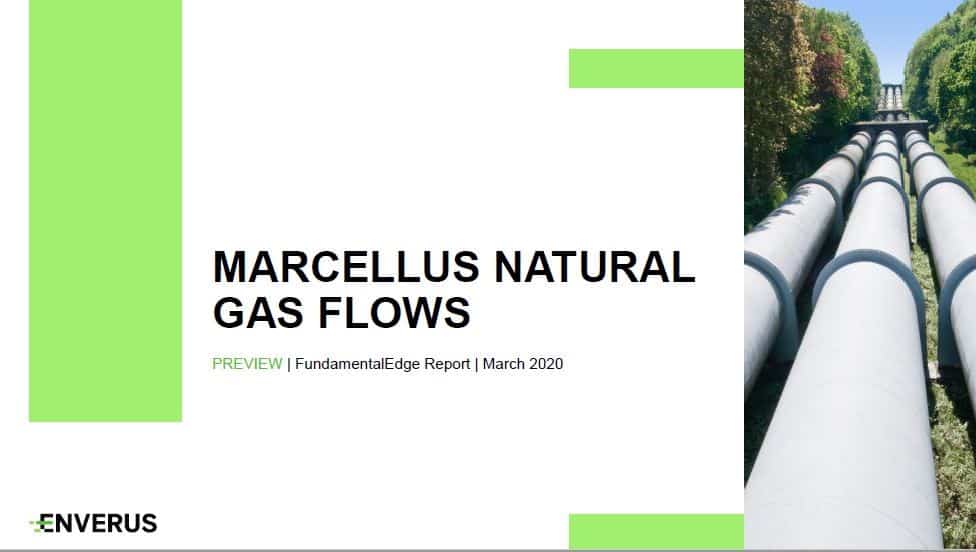
Austin, TX (March 10, 2020) – Enverus, the leading oil & gas SaaS and data analytics company, released its latest FundamentalEdge report, Marcellus Natural Gas Flows, which is focused on natural gas production and pipeline flow patterns in the Marcellus and Utica formations in the Northeast, MidAtlantic, and Midwestern regions of the U.S. Utilizing OptiFlo Gas, Enverus analysts examine the history of these two prolific natural gas plays, their tremendous growth over the last decade, pipeline bottlenecks and flow patterns, regional export opportunities, and life in what seems to be a never-ending low price environment.
“As the number one producer of natural gas in the world, the U.S. continues to suffer from growing pains and that’s most obvious in the Northeastern U.S.,” said Rob McBride, Senior Director, Strategy and Analytics at Enverus.
“However, on a macro scale, we can look to this region as a case study for the country as a whole. Just as production here surpassed local demand, the U.S. nationally has overproduced and surpassed demand domestically and needs more outlets to share its pent-up natural gas with the world. We are seeing the benefits from the call years ago for more pipelines and tactical ways to move Marcellus and Utica gas to the markets who demand it. It’s a microcosm of our new, global outlook in exporting liquefied natural gas (LNG) worldwide,” McBride said.
“To add insult to injury for today’s current natural gas pains, the elephant in the room now is the coronavirus,” added McBride. “While many are focused on suppressed demand for crude oil—natural gas’ higher valued hydrocarbon partner—there will be an impact on the gas market as well. Unlike oil, which is much more a global commodity, natural gas prices in the U.S. are mostly impacted by U.S. gas fundamentals. Still, all hydrocarbons are tied together at the drill bit, and one will affect the other,” he added.
Key Takeaways from Marcellus Natural Gas Flows:
- The Marcellus and Utica shale plays have been two of the most prolific plays since the Shale Revolution hit the United States. Production at the beginning of 2010 was below 3 Bcf/d, and the region was a net importer of natural gas. By the end of 2019, the Marcellus and Utica plays were producing over 32 Bcf/d and now must export gas to other demand regions.
- As the Marcellus region has grown, midstream players were forced to make adjustments to take gas out of the region. This involved reversing flows on pipelines that traditionally flowed gas from the south to the north, as well as new pipeline projects. These projects have mostly taken gas into the Midwest and the MidAtlantic regions.
- Marcellus exported the most gas to the MidAtlantic region in 2019 with the MidAtlantic receiving ~41% of total Marcellus exports. Gas flows to the Midwest have been the largest growth in Marcellus exports since 2015, growing ~330% by the end of 2019. Flows to the Northeast from the Marcellus have remained relatively constant since 2015, peaking in winter months around 10 Bcf/d when heating demand is higher.
- Today’s environment of low prices and living-within-cash flows is driving expectations for Marcellus production to remain flat or slightly decline in 2020. Much of this will depend on hedges in place for each operator. Multibasin players are increasingly focusing on opportunities outside of the Marcellus. Pure Marcellus players are guiding for notable CAPEX declines. Decreased investment in 2020, resulting in flat to decreasing production, is expected to help chip away at the lower 48 supply/demand imbalance.

Enverus OptiFlo Gas contains daily U.S. and Canadian interstate pipeline flow data, updating 20,000+ meters, four times a day, to give the user the most up-to-date data. It allows users to analyze daily supply and demand dynamics in the lower 48 without delay. Enverus OptiFlo and Enverus ProdCast provide a well-informed view of the market’s potential outcomes so that users can maintain a portfolio of diversified trades, positioning them for the highest probability of capturing market share.
Members of the media can download a preview of the full report, Marcellus Natural Gas Flows, or contact Jon Haubert to schedule an interview with one of Enverus’ expert analysts.
About Enverus
Enverus is the leading data, software, and insights company focused on the energy industry. Through its SaaS platform, Enverus provides innovative technologies and predictive/prescriptive analytics, empowering customers to navigate the future. Enverus’ solutions deliver value across upstream, midstream and downstream sectors, enabling the industry to be more collaborative, efficient and competitive. With more than 1,300 employees across the globe, the Company’s solutions are sold to more than 6,000 customers across 50 countries. Enverus is a portfolio company of Genstar Capital and brings together the technology of Drillinginfo, RS Energy Group, PLS, 1Derrick, MineralSoft, Midland Map Co., MarketView, DataGenic Group, PRT, Oildex, Cortex, Red Dog Systems and RigData as one company. Creating the future of energy together. Learn more at www.enverus.com.