
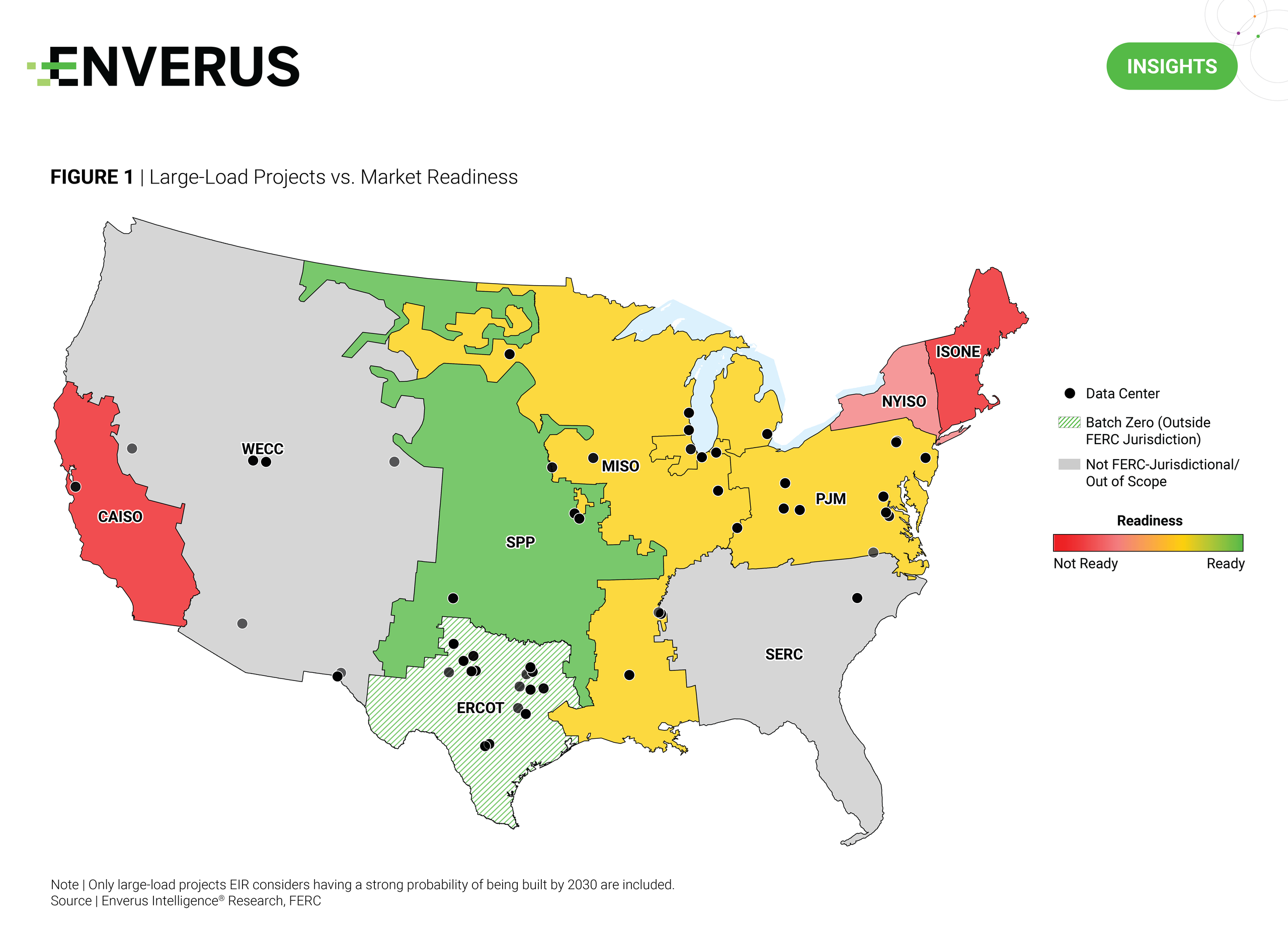
Unsurprisingly, all six grid operators overseen by the Federal Energy Regulatory Commission (FERC) are seeking to push their large-load tariff filings to November. FERC’s June 18 orders gave the independent system operators and regional transmission organizations 60 days to amend or justify their tariffs. The commission warned it would not grant extension requests reflexively.
The pipeline of large loads waiting to come online is concentrated in regions that are seeking more time to finalize their tariff frameworks. PJM and the MISO account for most of the identified high-confidence large load, but neither has a finished rulebook. SPP, the only region with FERC-approved large-load tariffs that the commission has pointed to as a model, has comparatively little identified capacity.
That mismatch is the central issue. Developers struggle to underwrite projects against tariffs that do not yet exist, and each delay leaves more risk unpriced. The uncertainty extends to colocated and behind-the-meter generation, both of which FERC included in its June orders. Capital does not wait for a docket. It flows into regions with known regulations and a clear barrier to entry, like ERCOT’s Batch Zero. Kicking the can down the road does not slow the buildout; it just decides where it ends up.
The real question is why the grid operators sought 90-day extensions. The simplest answer is that revising tariffs to satisfy FERC’s just-and-reasonable standard while protecting existing customers from improper cost shifting is harder than it looks. Operators may also be struggling to satisfy two audiences at once: FERC and the large-load developers deciding where to locate projects. That is the game now. Build a tariff that works for everyone or lose those loads to an operator with a more competitive one.
This blog offers just a glimpse of the powerful analysis Power and Energy Transition Research delivers on the trending themes. Don’t miss the full picture.
Research Highlights:
- ERCOT WLPUNs | Time to Power, Priced – We examine how infrastructure developers are leveraging ERCOT private use networks to accelerate project timelines and avoid costly interconnection fees. The analysis also assesses the policies officials in Austin are weighing that could curtail the strategy’s effectiveness.
- DRV Breaks the Tie | Downstate New York’s Split Decision for Storage – We dive into how New York’s energy storage incentive mechanisms compare in terms of revenue drivers, sensitivities and project risk.
- Behind-the-Meter Generation Forecast | Skipping the Queue – We forecast the BTM generation required to serve new U.S. industrial facilities through 2030, analyze the technologies expected to meet that demand and identify the original equipment manufacturers best positioned to benefit.
DID YOU KNOW?
The first computer load was a grid problem too. ENIAC drew about 150 kW when it came online in 1945, enough that its operators worried about the effect on local service. A single 1 GW AI campus today pulls roughly 6,500 times that.
Top Three Takeaways:
1: Why are six ISOs asking FERC for more time on large-load tariffs?
All six grid operators FERC oversees are pushing their large-load tariff filings to November instead of meeting the original 60-day window from FERC’s June 18 orders. Revising tariffs to meet FERC’s just-and-reasonable standard while protecting existing customers from improper cost shifting is harder than it looks, and operators must satisfy both FERC and the large-load developers deciding where to locate projects.
2: Which regions have the most large-load capacity waiting on unfinished tariffs?
PJM and MISO account for most of the identified high-confidence large load, but neither has a finished tariff rulebook yet. SPP is the only region with FERC-approved large-load tariffs, the model FERC has pointed to, but it has comparatively little identified capacity waiting behind it.
3: Where is capital headed while ISOs finalize their large-load rules?
Developers struggle to underwrite projects against tariffs that don’t exist yet, so capital flows toward regions with known regulations and a clear barrier to entry, like ERCOT’s Batch Zero. Delaying tariff reform doesn’t slow the large-load buildout overall, it just decides which region ends up capturing it.
About Enverus Intelligence® | Research, Inc. (EIR)
Enverus Intelligence® | Research, Inc. (EIR) is a subsidiary of Enverus that publishes energy-sector research focused on the oil, natural gas, power and renewable industries. EIR publishes reports including asset and company valuations, resource assessments, technical evaluations, and macroeconomic forecasts and helps make intelligent connections for energy industry participants, service companies, and capital providers worldwide. See additional disclosures here.