GOOGL is now the anchor customer for FRVO’s Cape Station geothermal project in Utah. In its third-quarter update, FRVO identified the eight geothermal generating units, known as GeoBlocks, that will supply GOOGL’s 396 MW contract, with first deliveries expected in mid-2028. GOOGL also holds an option to add ~600 MW by June 2030, bringing its potential purchases to nearly 1 GW. The companies are pursuing the expansion as a behind-the-meter connection to a proposed Google data center campus in Beaver County. Cape Station has ~900 MW of fully contracted offtake, but only 33 MW is operating.
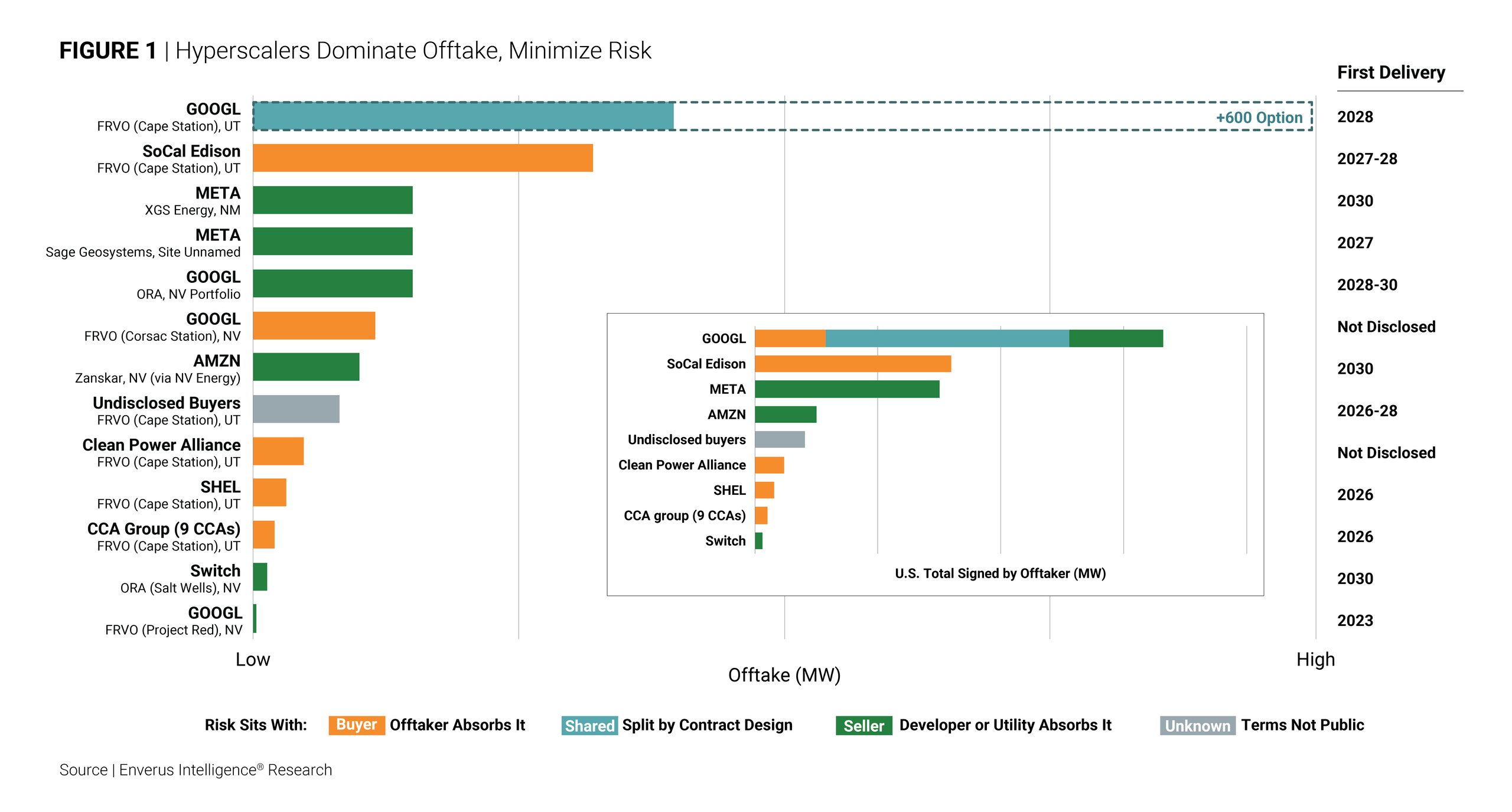
GOOGL is not alone. Enverus Intelligence® Research (EIR) tracks more than 1 GW of U.S. geothermal offtake signed against a ~1.5 GW buildout, with GOOGL accounting for 664 MW across FRVO and ORA projects (Figure 1). Under most of those contracts, the developer or utility absorbs the delivery risk. Buyers lock in clean, firm megawatts, while sellers assume the risk of producing them.
That risk has not been tested at scale. Cape Station’s design assumes water losses below 1%, compared with 27%-30% at FRVO’s Project Red pilot. Without infill drilling, thermal drawdown reduces well output to nearly zero within 20 years. Equipment supply is also tight. By 2028, FRVO’s annual demand for organic Rankine cycle turbines alone exceeds the industry’s ~300 MW/year of output.
FRVO closed Nov. 17 about 73% below its May peak and below our $15.71/share valuation. GOOGL’s contract demonstrates who will buy geothermal power. Cape Station’s water and production data will show how much of that power gets delivered.
This blog offers just a glimpse of the powerful analysis Power and Energy Transition Research delivers on the trending themes. Don’t miss the full picture.
Did you know?
Organic Rankine cycle turbines, now one of geothermal’s tightest supply bottlenecks, got their start in 1967 at Paratunka on Russia’s Kamchatka Peninsula. The world’s first geothermal binary plant used refrigerant to turn 80°C water, well below boiling, into about 680 kW of power. Google’s 396 MW Cape Station contract alone is about 580 times larger.
Research Highlights:
- Behind-the-Meter Edge | How Much Buffer Do Islanded Data Centers Have
Enverus Intelligence® Research looks at how much delay a behind-the-meter (BTM) data center campus can absorb.
- CoreWeave NAV | Credit Where It’s Due
Enverus Intelligence® Research examines CRWV using a sum of parts analysis to get a total net asset value per share.
- AI Chip Supply | EUV Capacity Caps Power at 37.0 GW
Enverus Intelligence® Research uncovers how extreme ultraviolet (EUV) lithography capacity will limit AI accelerator supply, must be optimized between memory and logic, and ultimately caps chip power growth through 2030.
Upcoming Events
- Roadshow: Equipment Constraints and Storage Revenue | Dec. 1–3 | Houston & Dallas | Request a Meeting
- Webinar: Follow the Load: Where Data Centers Will Need Your Gas | Dec. 3 | 9:00–10:00 a.m. PCT | Online | Register Here
Can power keep pace with AI in 2027?
Load forecasts keep climbing. See where new capacity is getting built, and where it’s falling short.
Top Three Takeaways:
1: Who is the anchor customer for Cape Station geothermal power?
GOOGL is now the anchor customer for FRVO’s Cape Station in Utah. Its 396 MW contract will be supplied by eight GeoBlocks, with first deliveries expected in mid-2028. GOOGL also holds an option to add ~600 MW by June 2030, bringing potential purchases to nearly 1 GW.
2: Who bears the delivery risk on U.S. geothermal contracts?
EIR tracks more than 1 GW of U.S. geothermal offtake signed against a ~1.5 GW buildout. Under most of those contracts, the developer or utility absorbs the delivery risk. Buyers lock in clean, firm megawatts, while sellers assume the risk of producing them.
3: What could stop Cape Station from delivering its contracted geothermal power?
Cape Station has ~900 MW of fully contracted offtake, but only 33 MW is operating. Its design assumes water losses below 1%, compared with 27%-30% at FRVO’s Project Red pilot. Thermal drawdown also reduces well output to nearly zero within 20 years without infill drilling, and FRVO’s annual demand for organic Rankine cycle turbines exceeds industry output by 2028.
About Enverus Intelligence® | Research, Inc. (EIR)
Enverus Intelligence® | Research, Inc. (EIR) is a subsidiary of Enverus that publishes energy-sector research focused on the oil, natural gas, power and renewable industries. EIR publishes reports including asset and company valuations, resource assessments, technical evaluations, and macroeconomic forecasts and helps make intelligent connections for energy industry participants, service companies, and capital providers worldwide. See additional disclosures here.